Time to say adios? Final year at the Krystal? Maybe.
Trump’s hostility towards Mexico won’t endear gringos to the Mexicans. I sensed no specific animosity towards us, mostly a practiced indifference. Friendliness exceptional.
The hospitality workers of Ixtapa less fluent in English, even veteran servants seem to have lost their articulate edge. As if to match, I have lapsed in Spanish as well, which is to say delinquent with Duolingo, and so it seems any semi-fluency on my part goes a long way communicating with the younger and newer servers.
Benny the famous entrepreneur of fishing tours told me more than once that when he was young he learned if he was ever going to make anything of himself — make any money — he needed to learn English. He has done well. Three boats — two pangas and a cruiser — he still patrols the beach on foot along Playa Palmar seeking clients, lately shadowed by his son Benny Junior, who apparently didn’t listen to his dad and speaks English just a little like a lot of young men his age. Benny the elder says business is slack because fewer and fewer gringos sign up for fishing excursions. He says Mexican tourists aren’t interested in fishing. He offers whale and dolphin watching but it doesn’t make up for the slack in fishing trips.
We are no help. Over twenty visits to Ixtapa we have gone fishing half a dozen times on one of Benny’s boats, captained by one of his chief boatsmen, and caught more than our share of black tuna. We’re fished out. If we go to Las Gatas for a shore lunch we choose our fish at the market, and it isn’t black tuna.
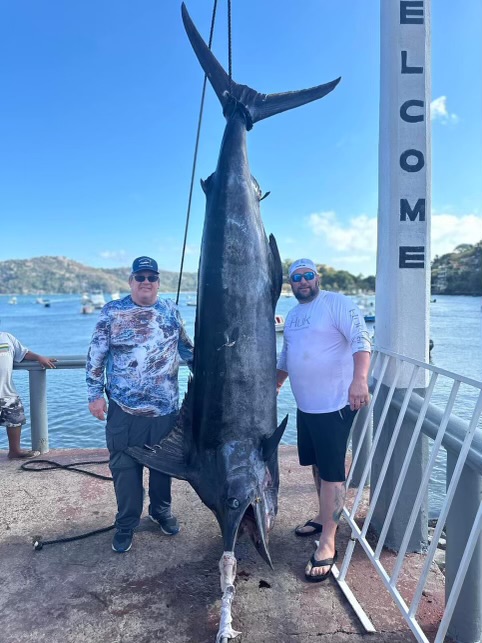
We have never signed up for a big game excursion for sailfish. Last year on the Zihuatanejo pier coming back from Isla Las Gatas we witnessed a gang of eight guys heave-ho and trying not to drag an enormous sailfish hauled in on an excursion boat that afternoon. It took eight guys twenty minutes to haul the big fish the length of the pier to hoist it by the tail and weigh it and display it to us gawkers under a gallows. I forget its exact weight — a zillion kilograms — a number too heavy to comprehend. The guy who claimed to bring it in said it took two hours. The captain, who likely did most of the heavy lifting those two hours, concurred with what the guy said. The fisherman and his buddies from the excursion seemed giddy with pride and glee and posed for pictures with the upside down beast. Spectators on the pier remarked it was the biggest catch they ever saw. So big its sword nose was bent in half on the concrete pier deck.
It made me sad seeing this magnificent beast humiliated. What happened to the corpse? They say it got donated to be butchered for tacos. They say sailfish is too bony for steaks. The fisherman got his trophy photo, which he presented to the General to proudly display on a pillar at the General’s sports bar. I think of it as a grand waste of sea life for the amusement of an American tourist. To each his own.
We tell Benny maybe we’ll sign up for a boat ride. A ride down the coast past Zihuatanejo Bay can be relaxing, but the sightseeing part of it lost its allure after the third time around. There’s a small archipelago of humpy, barren, rocky islands past the mouth of the bay towards the airport. Saguaro cactus grows six to a dozen feet tall grow on the craggy cliffs along the ocean side of Islas Las Gatas, which you can only see from a boat.
Las Gatas isn’t really an island but they call it that. It’s really a peninsula at the southern mouth of Zihuatanejo Bay accessible by boat. Tourists take a water taxi across the bay from the Zihuatanejo pier. The bay is immense. Between the city and its three beaches and the so-called island of Las Gatas is a rugged strip of wild real estate with no road or official trail. It isn’t the Darien Gap and can be hiked with proper shoes and arduous patience, but in the heat of day the effort will exhaust you for your beachside day trip and to my knowledge there are no one way tickets for a water taxi from Las Gatas back to Zihuatanejo pier.
We used to make at least excursion each year to Las Gatas with some gringo friends we met at our hotel who came down to Ixtapa each year like us. In the morning about nine we would ride a bus to Zihuatanejo. The buses run every few minutes on the main boulevard along the hotels, essential transport for the resident workforce of the region. Not much more than oversized step vans with seats and windows, these buses chauffeur young, old, men, women, all the people without cars who go between Lazaro Cardenas to the north and Petatlan to the south through the Ixtapa Zihuatanejo corridor, a population of about 200,000 souls keeping busy. Riding the bus has always been one of my favorite pastimes checking the real pulse of this place. Few gringo tourists ride the buses, but those who do know where they’re going and why. Roxanne and I used the bus to independently explore beyond the Ixtapa hotel campus and take day trips into Zihuatanejo el centro to see what the day life was like.
Our group excursions to Isla Las Gatas with Bob and Rose and various other pals from the hotel would start our adventure on a bus into the heart of Zihuatanejo, Downtown Mexico, to the mercado central, a roofed labyrinth of vendors of fresh meat, fish, produce, spices and wholesale sundries like vanilla. As Rosa’s shrimp booth we would choose a dozen or so jumbo size shrimp, and while she tripped the veins we would peruse the bins of the fish dealers to pick out red snappers and mahi-mahi, which they would filet for us at no extra charge. Our seafood packed in plastic bags of ice we would exit the market to the central taxi stand, and we would hail a couple of taxicabs to ride across downtown to the embarcadero at the pier of the harbor.
Adjacent to the navy station at the gateway to the pier we would purchase blue round trip water taxi tickets to Las Gatas. We prefer the blue ticket water taxis to the white ones because the blue are more reliable. The taxi is a standard, no frills fiberglass panga boat with a capacity of about ten passengers. Young men and boys hang around the pier to assist passengers with the awkward boarding and unboarding and expect a few pesos for their service. The boat captain collects the half of the twin tickets and reminds us to watch our heads and we duck under the roof as we slide onto the benches in the cabin. uides the craft by outboard motor through the anchored vessels moored in the harbor and out into the bay for a fifteen minute crossing of open water to the strip of peninsula at the southeast point of the mouth of the bay. The view from the middle of the bay all the way to the other side tells a panorama of habitation rising from the three city beaches into terraced hillsides, a city in a bowl crested by villas backdropped by wooly green mountains, sailboats and jet skis on the water between beaches, the habitation like illusory monuments hanging off zigzagged cliffs. From a distance Zihuatanejo looks like Paradise City.
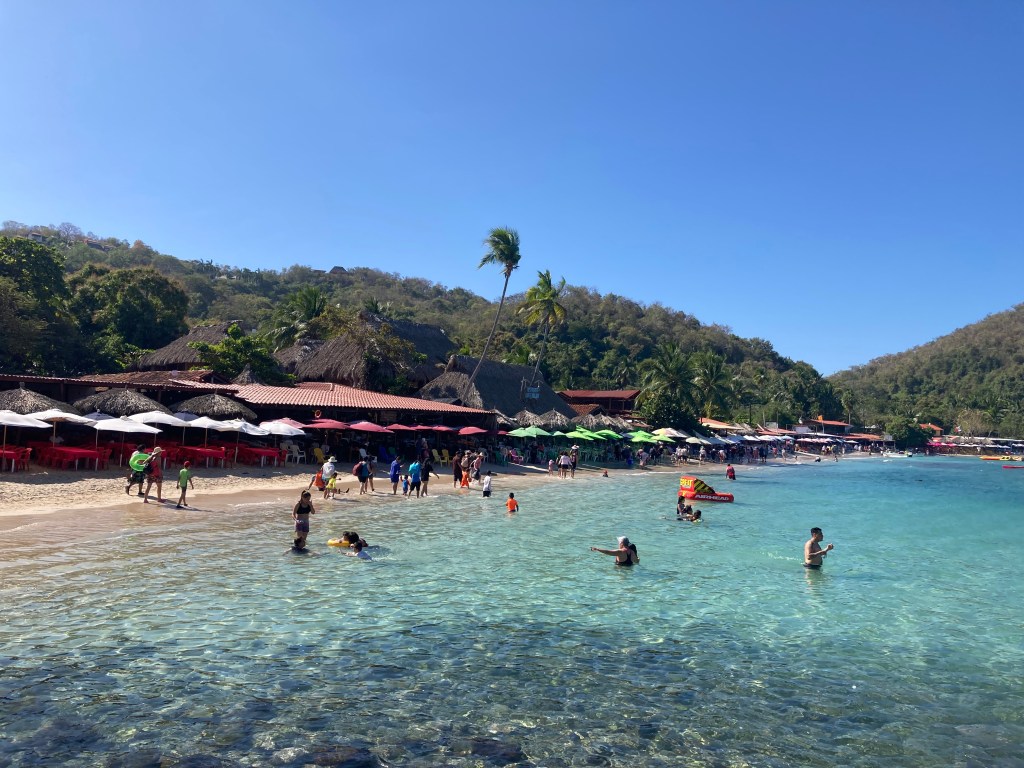
On the other side we would disembark at a small concrete pier where more young men and boys reach out to assist us for pesos like valets at a car park. We tote our go bags and our ice bagged seafood down the semi paved path around the edge of the steep peninsula towards the ocean. Facing the jagged breakwater of lava rock and dead coral at the edge of the mouth of the bay a long stretch of sandy beach stretches almost a mile to the jagged edge, and all along the beach from the edge of the sand is a succession of canopied cantinas open for business. Asking for business. We get there early because by noon the place is jumping with daytrippers.
Cruise ships used to dock at Zihuatanejo for day trips to Las Gatas. Not so much any longer. Roxanne and I first went there directed by the vacation package people with whom we booked our first couple visits to the Krystal. We tried snorkeling but learned the fish were dull and the coral long dead. We came back on our own just to swim in calm waters and drink beer and walk the full beach, people watch, something to do off the beach at the hotel. When we made friends with Bob and Rose and booked fishing trips with Benny the excursion included, at a discounted extra price, a shore lunch at Las Gatas where our boat captain would hook us up at one of the beach cantinas to cook up our catch and serve it with drinks and fixings from the menu. When we felt fished out and tired of tuna we devised our customized excursion (Bob and Rose’s idea) to bring our own shore lunch bought at the market and arrange a cantina to reserve us a shaded table (or two, some years there was about a dozen of us) with a few beach chairs to take into the water and cook our shrimp and fish to order.
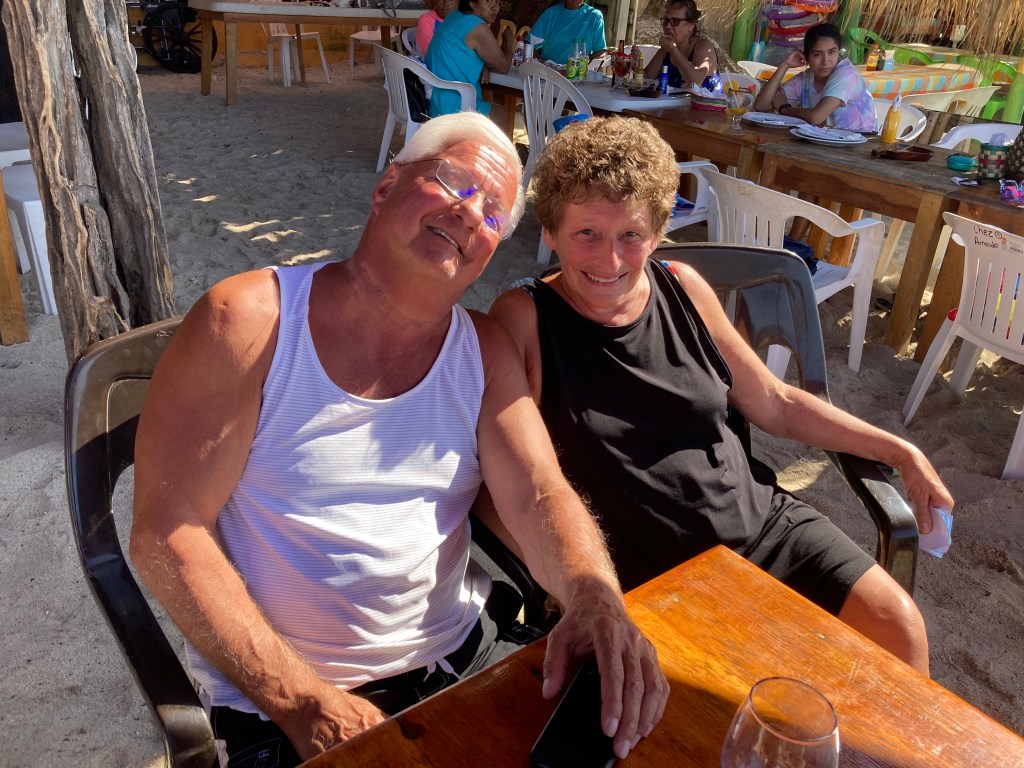
Based on a few years of trial and error founded by our experience from Benny’s boat captains we established a connection (Rose’s cell phone) with Chez Arnoldo, third cantina from the front. Bob and Rose think the host and manager is named Chaz. We would arrive around 11:00 and Chaz and his crew would be ready for us and our sacks of seafood. From our front row tables we watched the cantinas come to life as the beach swelled with the visitors arriving behind us on the water taxis from Zihuatanejo. With our first round of margaritas we observed as the grocery delivery boat beached in the sand with its load for the day. The kitchen grilled our lunch while we floated in the gentle waves of the volcanic lagoon. We bought Victoria beer by the bucket. At lunch time we feasted on butterfly shrimp in three styles, coconut, garlic and the chef’s sauce. Mahi mahi Veracruzana. Red snapper steaks in garlic. All served on platters with rice, beans and salad with salsa and chips with ceviche and fish taquitos. With the lunch hour so much on the beach front came to life. Jewelry vendors with their sample boxes entertain the ladies from table to table. Masajistas pass through offering appointments at the cabanas down the way. Cupped fruits. Ice cream and shaved ice. Crafts and trinkets. Hair braids and beads. Henna tattoos. The vendors pass through like Playa Palmar only more condensed. Some of them like the jewelry guys might well turn up on Playa Palmar before day is done.
Around three while the sun is still high we tally la cuenta with Chaz and pack our beach bags and thank him and all the servers and cooks. Gracias all around. As usual we pay in cash. What we saved bringing our own fish we easily spent in tips, and the exquisite service amid the daily surge of hungry and thirsty tourists was worth it. The last water taxis leave at six. We try to leave before four to beat the rush and get back to the Krystal for sunset at a leftover palapa or check our phones on the balcony. We do not ride the bus home but take taxis from the Zihuatanejo pier back to Ixtapa because by then we are tipsy and a little exhausted from the sun, another hard day exploring the heart of a Mexican vacation.
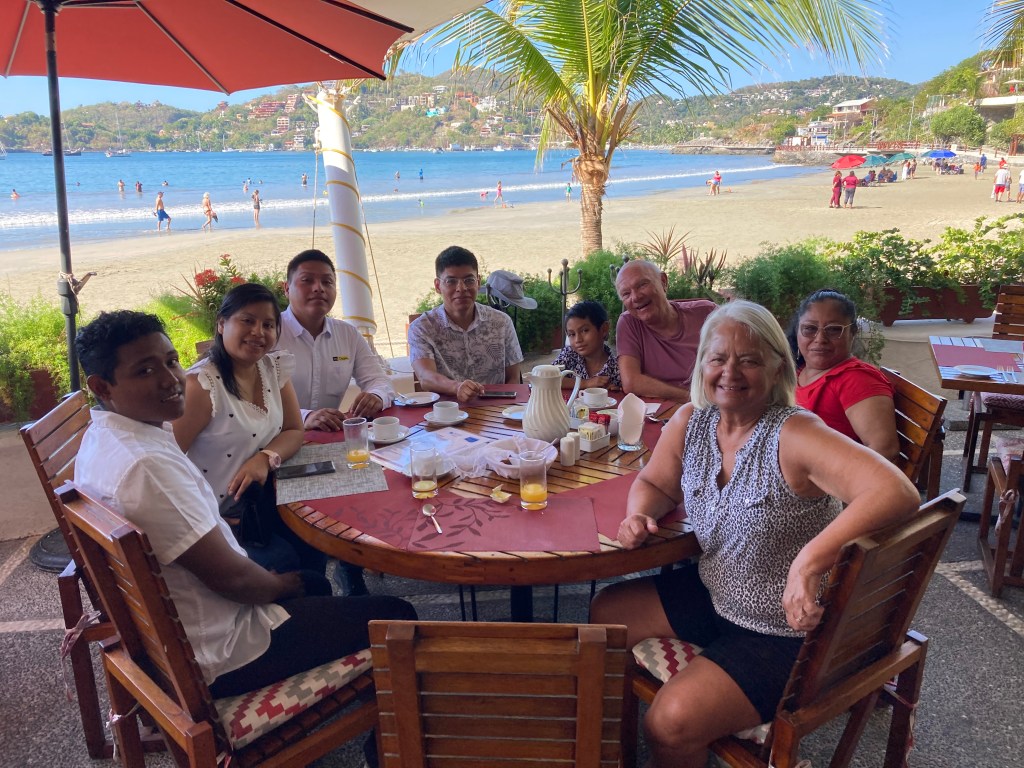
This year we did not go to Las Gatas. No Bob and Rose, no sense. Just the two of us? Las Gatas meant more than just a day trip, it drew us as a ritual pilgrimage of celebration of being at Chez Arnoldo one more year. Together. Besides Bob and Rose our excursions included at least half dozen other compatriots from the Krystal, all known to us, friends and relatives down for the week or two more than their first year. All comrades celebrating a day of adventure in a foreign land on the sea. Health issues, aging, economic reasons and personal preferences reduced our numbers after the pandemic to just us four last year. Bob and Rose had their cellphone connection with Chaz, not Roxanne and me. Going to the fish market for just us two wasn’t economical, and we learned from earlier experience the food off the standard menu wasn’t worth it. The pilgrimage for just us two lacked special status. Old times sake didn’t occur to us. Without Bob and Rose or any of the others the whole daytrip seemed pointless. Lonesome. Almost lonely. Not worth the hassle.
Roxanne misses the social aspect more than I do. Bob and Rose had to cancel for health reasons this year. We’ve hung together with them at least twenty years. I like them because they mind their own business, even if they like to talk about themselves — there are several stories they have told so many times I could recite them back word for word, but I won’t, as if they’ve confided in me because I won’t forget them and won’t rat out their simple worries for a cheap story about the human condition. They are honest people with liberal opinions who bring to their vacation in Mexico a respectful place to reside in the tropics away from the turgid winter of Minnesota, as well as away from the rat race back home in the middle of America. Much like Roxanne and me. Missing them reveals to me a greater absence of isolation. Not having them around doesn’t make me seek new friends. Roxanne thrives making conversations among the other snowbird gringos at the pool. I’m not as adept. The gap left by Bob and Rose is insupplantable, notwithstanding their extroversion attracting a variety of aging boomer vacationers along the way. Bob and Rose were good mixers. They didn’t wear their liberal hearts on their sleeves, and they were good guests at the hotel.
Roxanne reports back to me what she hears from the gringos who hang out at the pool. They are a subcommunity of repeat vacationers who, like us, retreat to the Krystal Ixtapa in the dead of winter from more northern North America. Some more Minnesotans not from the Twin Cities, like Bob and Rose. Some North and South Dakotans. The rest Canadians from Manitoba, Saskatchewan, and Alberta. The pool people. Familiar faces. Names like Dennis and Mary. A very civil faction of people who prefer to hang around the pool under umbrellas than down at the beach under palapas, like me. Word among the pool people this year laments the passing of the guy known as Big Mike that past winter. Several other of the usuals were gone from the Krystal, defecting to the Emporio, they say, because the Krystal was getting too Mexican.
I see the same dwindling proportion of gringo vacationers and guests to the rising tide of Mexicans as the natural flow of society favoring the Mexican middle class and the decline of the influence of the American baby boom generation. I don’t see this as any reason to abandon this hotel or this location to retreat from harsh winter or the inanities of the American world. What I fear is feeling backlash from Mexicans who might resent a gringo attitude of lost entitlement if it got around gringos liked Mexico but didn’t like Mexicans.
Unless they are servants, of course.
Roxanne reports that the pool people like to talk politics in a form of code that aligns with the MAGA movement. They still reargued against the pandemic lockdowns of yore, and that damn Governor Walz of Minnesota or Premier Trudeau practically destroyed our economy with dictatorial powers. And what of lives lost or saved? Hell, people die all the time! And you can’t prove anybody was saved. They hail the return of Trump. The tariffs will do us good. The Canadians relished becoming the 51st state, rolling in that real cash.
I overhear them myself when I’m at the pool or standing at the bar. They talk more brazen than subtle, maybe lulled by the padded walls of the prevailing Spanish, maybe emboldened by victory over the dreaded radical left, or maybe just a little tipsy and overconfident nobody would disagree. I play dumb — or deaf — and act as if sensory impaired. Roxanne is known as a socially astute mixer but I pass myself as a naive simpleton, a bumpkin and a bookworm disengaged from any kind of popularity. I’m sure they don’t know my name — I’m Mr Roxanne. Roxanne doesn’t endorse their political musings, or their social attitudes or conspiracy theories, but gives them a listen just to have people to talk to and to give a listen to somebody else’s gripes. I’m a little disappointed to hear them breach the customary No Politics Zone, an unspoken tradition among all visiting gringos dating at least to the Clinton administration, through the Bush years, Obama, Trump’s first term and frailly carried through Biden. Sometimes you might hear a Republican conservative caucus having dinner, and since the pandemic I have overheard allusions to a stolen election, but overall, except for occasional unasked-for praise of Trump by moot, supposedly disinterested Canadians, people mostly leave their American politics at the Mexican border. No red MAGA ball caps. No campaign t-shirts.
After all, none of us has any say in the elections of Mexico.
I tell myself it’s too soon to tell how it will all turn out because he just got inaugurated, Trump, and maybe it won’t be so bad with the trade wars and he’ll show some presidential mercy once he settles back into office. The country survived four years eight years ago and the world was no worse for wear, given a worldwide coronavirus epidemic that killed millions and stopped civilization in its tracks, which could hardly be blamed on Trump. His malfeasance in office in that epoch was supposed to be proof he should have never been elected at all, and yet there he was, back in that Oval Office behind that resolute desk, or speaking from one of his golf resorts, proclaiming away every liberal principle in the canon of American government.
I didn’t sit well in the middle of a groundswell victory celebration of MAGA in the heart of Mexico, so without our liberal friends Bob and Rose to confide in I meant to keep to myself under the palapa on the beach, reflecting and observing, reading, and watching the theater of beachgoers and the ocean waves rolling upon the sand.
Those four weeks of meditation on the beach gave me pause to indulge in some paranoid depression. When I wasn’t worried about what it would be like back home, my impressions of my immediate surroundings left me anxious each day whether my welcome in Mexico could run out at any minute.
The year before, on a typical afternoon at the beach under the palapas there was an incident between me and a middle-aged Mexican couple. They were at a nearby palapa with their young teenage kids, enjoying two or three days at the ocean. They played tunes on a portable system. Gradually the dad raised the volume. I caught his eye and made a calming hand gesture to request he turn it down, if just a little. The Krystal posts a notice in Spanish and English prohibiting personal music devices without earphones, but it isn’t enforced strictly, only when the music is audaciously loud or two or more devices compete like a battle of the bands. I asked the man if he would turn it down, just a little. Instead his wife cranked it up louder and he began to dance, coming towards me. The two teenage kids grabbed their towels and took off for the pool.
As he approached me the man did not look happy. In English he said he was on vacation and had a right to have fun. He had been drinking. Behind him his wife who turned up the volume yelled at me. “This is our country. Go back to your own country.” The man stopped his approach before he arrived in my face. I remained in my chair until he retreated and then I went away to the hotel to cool off and take a whiz. When I came back I observed from the patio above the sea wall the head of security, a decades long stalwart named Andres, was down at the man and woman’s palapa holding a calm conversation. I waited until its conclusion to give the scene a chance to normalize before I reoccupied my beach chair. No more eye contact was made. The music played muted, then went away.
Within the hour that same afternoon I was in the pool when I saw the man wobbling across the wet pool deck. His foot slipped and he went down on his back. Immediately he stirred but couldn’t stand up without help. Several guys came to his aid. Andres from security strode to his side to escort him someplace he could sit. I talked to Andres later that afternoon, and I tried to apologize for the incident, but he waved it off. “Drunk people do stupid things,” he said. The next day I saw my erstwhile nemesis in the crowd in the pool. We made no eye contact and I kept a distance. He looked sober. Tranquil. I kept an eye out for his wife. In a day or so they were gone. I learned later that our friend Rose witnessed the altercation and ran upstairs to get Andres because she was scared the guy might beat me up.
Ever since I’ve been self conscious of the impressions I conveyed to the Mexicans — servants, proprietors, taxi drivers, and especially tourists, who were under no obligations to be friendly. I keep seeing that angry woman at the beach yelling, “This is our country. Go back to your own country.”
It’s eminently clear that the Krystal’s business model relies on domestic Mexican tourism and not so much the gringos from up north like us. Nothing personal. The Mexican market has matured along with the rise of the middle class, who can afford three day weekends or a week at the beach, nowadays as normal as a summertime jaunt to a rented cabin along a lakeshore in northern Minnesota for any average soul. The decline in numbers of snowbirds seeking refuge from winter in the Mexican tropics has easily been supplanted by leisure seekers from towns and cities within driving distance. The Krystal offers all-inclusive package deals to attract occupancy, and the place is near full every week with Mexican families and couples, a few gringo retirees or near retirees testing where they might spend their retirement winters, and maybe a few North American vacationers looking for midwinter adventure someplace new they heard about. The retirees will eventually die off, and the ones soon to retire think twice about the amenities and potential risks of calling Ixtapa Zihuatanejo a winter home, while the one-off gringo vacationers discover for all its charm there is no adventure except the lazy kind, the ocean and places to eat.
There used to be, several years ago, a tour guide — El Guia — who canvassed the beachfront palapas trying to sign people up for tours to the nature preserve south of the airport. It sounded interesting but I resisted commitment. He got upset. “You gringos, all you do is sit around on your fat asses and drink away your day.” He had a good point. He made me feel guilty. I asked around and learned El Guia had a good reputation, and there was indeed a flourishing nature preserve to explore if you like that sort of thing. He grew up around the Krystal, as his parents both worked at the hotel. Roxanne and I talked about it and decided next time El Guia came around we would sign up. We never saw him again.
The years we first started coming down, Ixtapa Krystal was not only a refuge from Minnesota’s harsh winter but a place of relaxation and rehabilitation from high stress and anxiety at my job. Retirement pretty much solved the stress and anxiety, though I took several winters for this to sink in. Freedom to do little else than swim and laze around at the beach seemed ideal for awhile. I got an enormous amount of pleasure reading done, and a considerable amount of writing. The pandemic allowed this laziness to influence my everyday life at home, and it gradually became clear there was nothing in my life to recuperate and restore myself from, and most of the rest and relaxation I was getting each winter came at the expense of an urge for some kind of greater vitality. Something more than a field trip into Zihuatanejo and a day at Las Gatas.
Compared to vacations and trips elsewhere, with the exception of a visit to Mexico City our time spent in Mexico constituted little other than beach time. In the capitals, provinces and cantons of Europe we hustled around exploring sites. In Mexico City we visited Frida Kahlo’s blue house and the murals of Diego Rivera. True, in the early days we walked the blocks of Zihuatanejo to get to know the backstreets of Downtown Mexico. And we took field trips to towns like Petatlan and Troncones on occasion. We passed up tours with El Guia. There is supposed to be a Nahuatl excavation site in the hills, but people who have gone there say the excavation is in such an early stage there is little revealed to see.
Gazing at the perpetually rolling ocean that month I slowly concluded that I needed stimulation beyond what I brought with me in reading material from home, and Ixtapa Zihuanejo offered me nothing more. I didn’t need to recuperate. I was already relaxed. No more craving to hunker down, hide out and hole up. I realized I was all caught up with my own rehab. I no longer needed a place of anonymous seclusion to meditate the midwinter state of some complicated existence, but rather found myself in the enviable situation of feeling as satisfied with my life so far as I could ever reasonably expect. I had found a beautiful beach on the Mexican Pacific where the sun shines just about every day and the daily high temperature averages 87 degrees Fahrenheit, compared to mostly cloudy and lows below zero back home. I was ever grateful to have found comfort and joy all the winters at Ixtapa Zihuatanejo. We have been well fed and the lodging is of the highest hospitality. To consider breaking our traditional relationship to this place meant searching for somewhere else just as good or better.
Instead of our usual six weeks at the Krystal we cut our time short to four weeks, with intent to turn around in a week again and fly to San Juan to spend two weeks exploring Puerto Rico in a rented car. This is something we would not dare to do in Mexico. In Mexico City, being a big city, we relied on public taxi. In Ixtapa Zihuatanejo we relied on foot, buses, taxis or tour guides with cars and vans, and thus we never ventured very far from our hotel. No road trips.
For one thing the roads and highways of Mexico are notorious for car crashes. Our gringo insurance carrier would never permit us to rent a car in Mexcico without extra expensive coverage. Secondly the countryside surrounding Ixtapa Zihuatanejo seems dangerous. Armed and in full combat gear, federal troops establish checkpoints on the main freeways leading in and out of the district, which assures us only that they are looking to interdict somebody, and those somebodies might do us harm. There is much talk in North America about the cartels, crime and a high murder rate in Mexico, even if it isn’t spoken about between the Mexicans and the gringo tourists. Roxanne and I witnessed a murder a few years ago, on the restaurant plaza in Ixtapa as we paid our check for dinner, when a small kiosk vendor in the plaza took a bullet to the chest from a shooter in a baseball cap who was purported to have argued earlier in the day with the vendor over a kickback payment to the shooter equivalent to $20 USD. The vendor’s wife was shot in the face. Their young daughter was unhurt physically but obviously traumatized. The shooter got one more shot off, at a blank wall while he ran against the grain of the dinnertime crowd and disappeared towards the parking lot behind Ruben’s hamburger casa. We used to run into retired couples from the Pacific Northwest and western Canada who drove all the way down to Zihuatanejo in their RVs and campers and said they thought nothing of the danger traversing two thirds of Mexico north to south, and then back in the spring. We haven’t run across those types in years.
Even twenty years ago we thought driving to Ixtapa unthinkable. Not that we would fetch any ransom if we were seized by kidnappers, but how would they know unless they tried? With the political tensions only growing more intense between our two countries the potential for confusion and misunderstanding could only amplify resentment. We felt reasonably safe and secure within the Ixtapa Zihuatanejo district, broadly named Lazaro Cardenas, but we would never feel free to drive a car up or down the coast or up into the mountains to explore the countryside as we have in France, Germany, Switzerland, northern Italy, Czech Republic, Canada and Ireland. I would never care to drive across downtown Zihuatanejo.
A couple of years ago, to celebrate the end of the pandemic, after our six weeks in Ixtapa we spontaneously took off again, this time for Hawaii, where we spent two weeks on the Big Island, poking around in a rental car. We’re feeling cloistered and confined in Mexico. We need less rest and relaxation and more physical stimulation only more flexible mobility will procure. Hence our curiosity about Puerto Rico — not as far away as Hawaii, or as expensive we have heard.
It would be sad to kiss off Mexico. There’s a lot to love. For me it’s proven the perfect hideout from the American rat race. Nobody really knows me and yet I am assumed to be of good character — good enough to trust for la cuenta. I have never double-crossed their hospitality or disrespected their honor, and I am grateful for their respect for my privacy. For more than twenty years they have granted me free, unlimited access to about three miles of clean public beach. A chair under a palm palapa on that beach has been all the personal space I required to live most of the day for up to six weeks every winter. My driver’s seat. I didn’t need to get a car and drive up to Chilpancingo, capital city of the state of Guerrero or any such day trip, because that wasn’t why I chose to retreat into Mexico the most stressful time of my year. I would have liked to drive up into the Bajio mountains north of Mexico City to visit San Miguel de Allende, but all along I feared what could go wrong. To witness a murder in my happy place got me to articulate to myself why I didn’t tour beloved Mexico the way I did Ireland. I think about my confrontation with the couple on the beach over the music volume and I wonder if an escalated misunderstanding isn’t inevitable the more I hung around.
Nobody would know we aren’t worth kidnap ransom, but somebody might try. With Trump stirring a trade war there could be dozens of motives to shake us down or chase us away. I’ve already calculated in my head the loss of gringos to the tourist economy is already being made up in domestic traffic. I was losing my anonymity and security of feeling as invisible as I wanted. The MAGA dingoes and right wing Canadians would have to fend for themselves in the winters to come, and Roxanne and I pondered politely the prospect of not coming back.
After all, life here was easy. And predictable. If insanity is doing something over and over expecting a different result, then this was my place of sanity — coming here year after year expecting the same result. The weather was almost always sunny or partly sunny, and hot. The ocean was perpetually elegant. There is a lot to be said about doing nothing. The serenity is addictive.
The vendors trudge by in the sand selling trinkets and souvenirs, Yeti mugs, t-shirts and beach wraps, sunglasses and hats. They offer to bead and braid your hair or illustrate your skin with henna tattoos. One lady, Margarita, sells home made tamales every day lugging an old Penguin cooler up and down the beach every day. She passes the palapas at the Krystal about 3 and 3:30, and I highly recommend her tamales, all fresh, wrapped in banana leaves and juicy. There’s a rule against eating meals at the palapas but Margarita’s tamales seem to be exempt.
Hector hauls a big camping backpack and hawks his hand carved sculptures he fashions from ironwood and polishes with brown Shinola. I have purchased over the years a turtle, a whale, a palm tree and a buffalo. Other vendors sell snacks such as peanuts, pork rinds, coconuts and fresh shrimp. Solicitors in white uniforms with notebooks tout fishing excursions like Benny’s. Young men and women pass out flyers hyping the local disco. Photo service agents solicit clients for their photographers.
The most fascinating buskers are the musicians who trek the sand in cowboy boots and cowboy hats in twos and threes in matching western shirts, carrying guitars, accordions, sometimes an upright bass or snare drum and cymbal, offering to set up around a palapa to sing and play favorite Mexican songs. Whole families chip in to hire them and usually sing along.
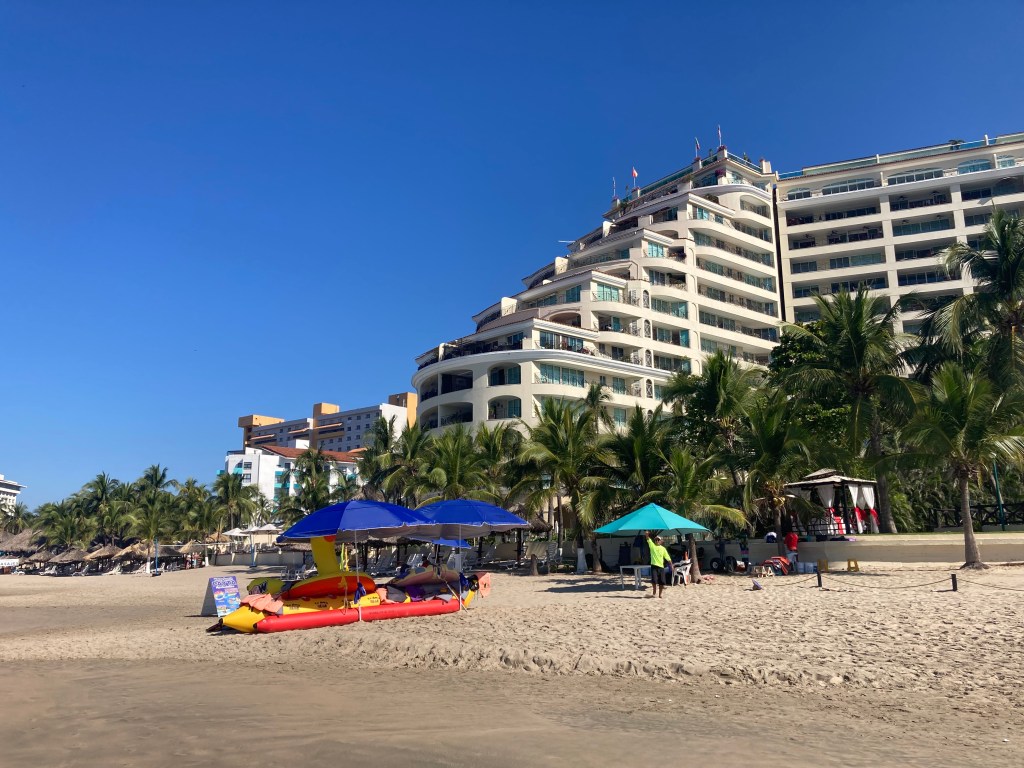
The entire beach called Playa Palmar forms a wide sandy horseshoe along three miles of Ixtapa Bay, bounded by steep, rugged hills of volcanic rock at each end. We walk this beach two or three times each day. The Krystal sits exactly in the middle of the beach. We can go either way. We usually go left amid the busiest half. We pass the most populous hotels and condos, where the shoreline and surf are jumping with bathers and walkers. Kids sculpt sand castles and bury their dads horizontally up to their chins, or just dig holes to be filled with the flow of the waves.
Couples pose for selfies against the surf. Girls and young women pose like glamor models for phone cameras or photography services. Volleyball nets front each hotel and condo complex, balls supplied. The Krystal and Fontan hotels provide balls and portable goals for sand soccer. American footballs get tossed like Hail Marys over the crowds. Frisbees get tossed and pairs play catch with Aerobies, a round, flat, hollow, aerodynamic thing like tossing the rings of Saturn.
Some play bocce ball, pitch horseshoes or toss those bolo balls connected by cords at a three rung rack target. (Bean bag cornhole tossing hasn’t caught on yet.) Some just jog or run on the flat wet sand. Others like us just walk back and forth enjoying the ambience of the beach activity.
At the far left end of the beach is the resort called Pacifica. I single them out as particular and peculiar. They are the most aggressive at trying to sell time share memberships. Their campus straddles a boggy stream that runs from a mangrove forest through the Ixtapa golf course. On the beach side of the stream is the low rise hotel with its social center, restaurant, swimming pool, lounge chairs, recreational amenities and palapas facing the flat beach. On the other side of the stream bed is a steep rocky cliff with terraced levels of condominiums rising hundreds of feet above the beach and facing the sea. Guests at the resort cross the boggy stream via footbridge or ride a cable gondola between the main resort and the condos on the terraced cliffs.
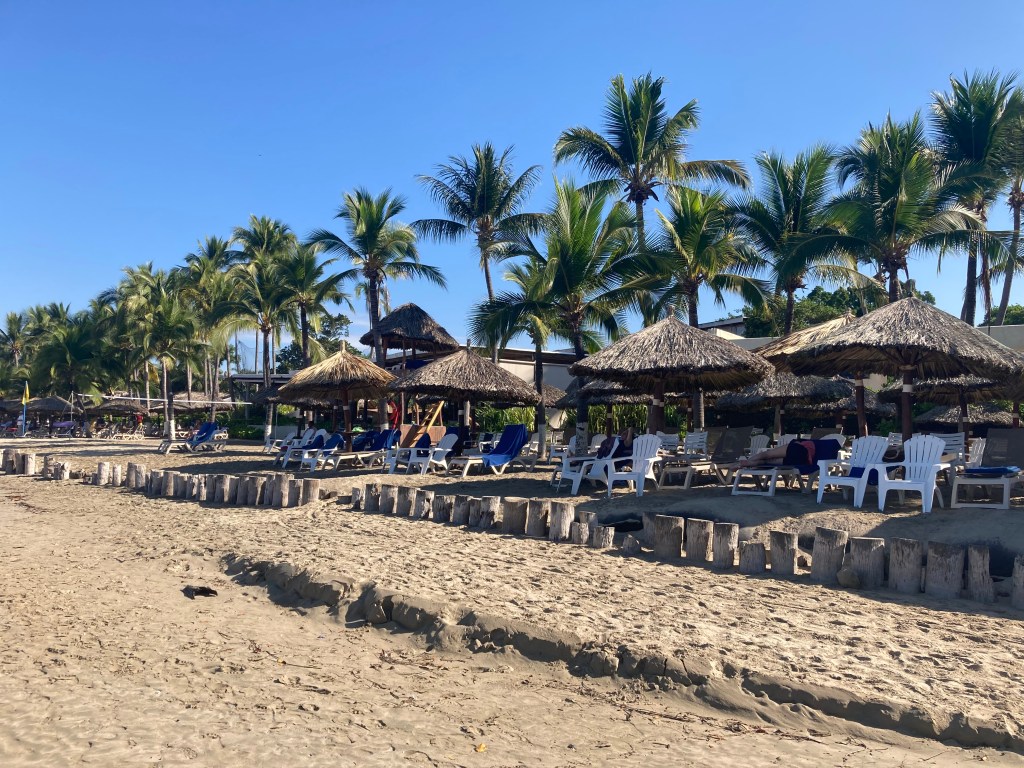
The tides in recent years have not treated the Pacifica’s beach front kindly. They have buried a wall of sand bags behind a battalion of thick wooden pilings to keep the sand from eroding all the way up to the edge of the deck of the main hotel. The tide is winning.
Most problematic is the boggy stream coming out of the mangrove swamp. The water is brackish and often smells like poop. Sometimes it swells enough from rainwater in the mountains to flow into the ocean carrying organic pollutants that float in the tides and grosses-out would be swimmers for a hundred yards from the mouth of the stream.
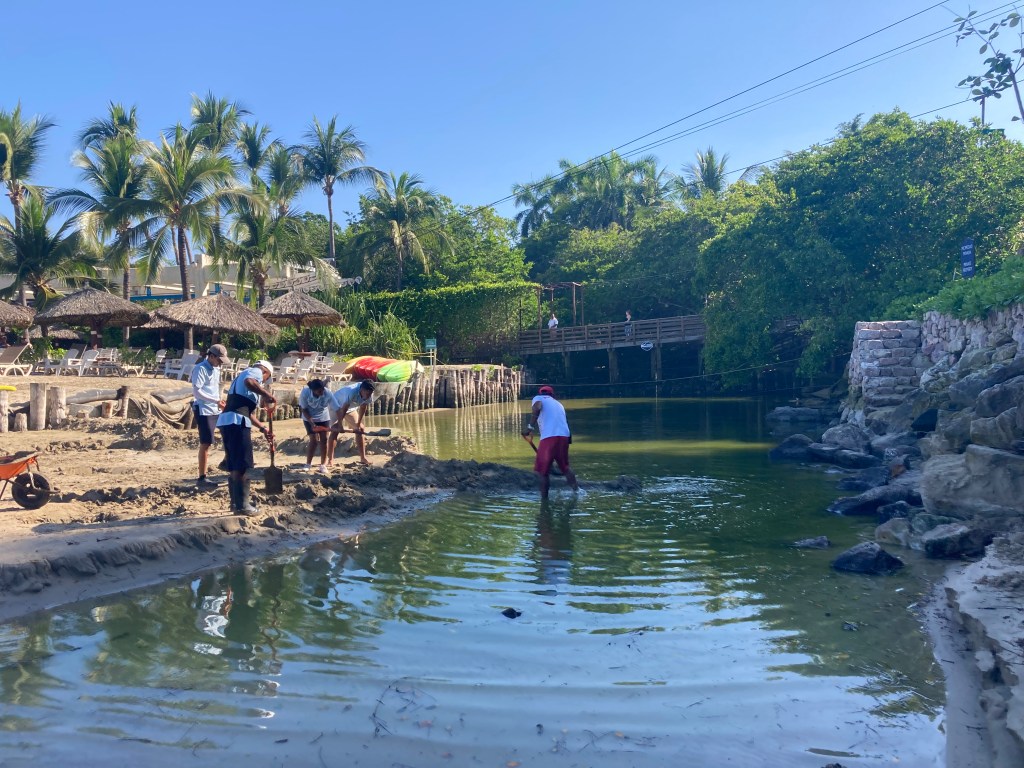
This year the Pacifica employed a daily gang of laborers with shovels wheelbarrows to dig sand off the beach to build a dike to hold the stream back from the ocean to contain it from polluting the swimming beach. The brackish swamp water builds up behind the dike and the smell gets poopier. Then overnight the tide washes away the sandy dike, the stream courses into the sea along the rocky cliff and crappy matter spoils the swimming. The shovels and wheelbarrow crew goes back at it the next morning. It’s a losing cause.
Yet I have overheard a crew chief from the hotel tell onlookers it’s an effort to contain alligators who dwell along the golf course from venturing onto the beach. Common sense would say any determined alligator can climb over the scrawny dike, and anyway there is a wire fence further upstream at the golf course to restrain the gators.
Clear to any observor the Pacifica faces an existential crisis. In that environment nobody should buy a time share, and in good conscience they should stop selling them. But business is business. Perhaps they are a metaphor for the destiny of Ixtapa.
The pity for Roxanne and me is that’s the beach front on Playa Palmar with the gentlest surf for swimming. Most days the surf in front of the Krystal is far too rough for a leisurely swim. If the water is clear down by the Pacifica we will swim in the ocean. Otherwise we cool off in our hotel pool.
If we walk the other direction, to the right from the Krystal, it’s a mile and a half of rough surf and open, unpopulated sand to the rocky breakwater along the entrance to the Ixtapa marina and the rocky hillside condos and villas beyond. A couple of hotels neighbor the Krystal, and then a couple of cantinas — one the former Carlos and Charlie’s night club, and another one called Tanta Vida which we liked for occasional lunch until they stopped serving fish tacos — and then the Delfinium where dolphins perform but you can’t swim with them any more.
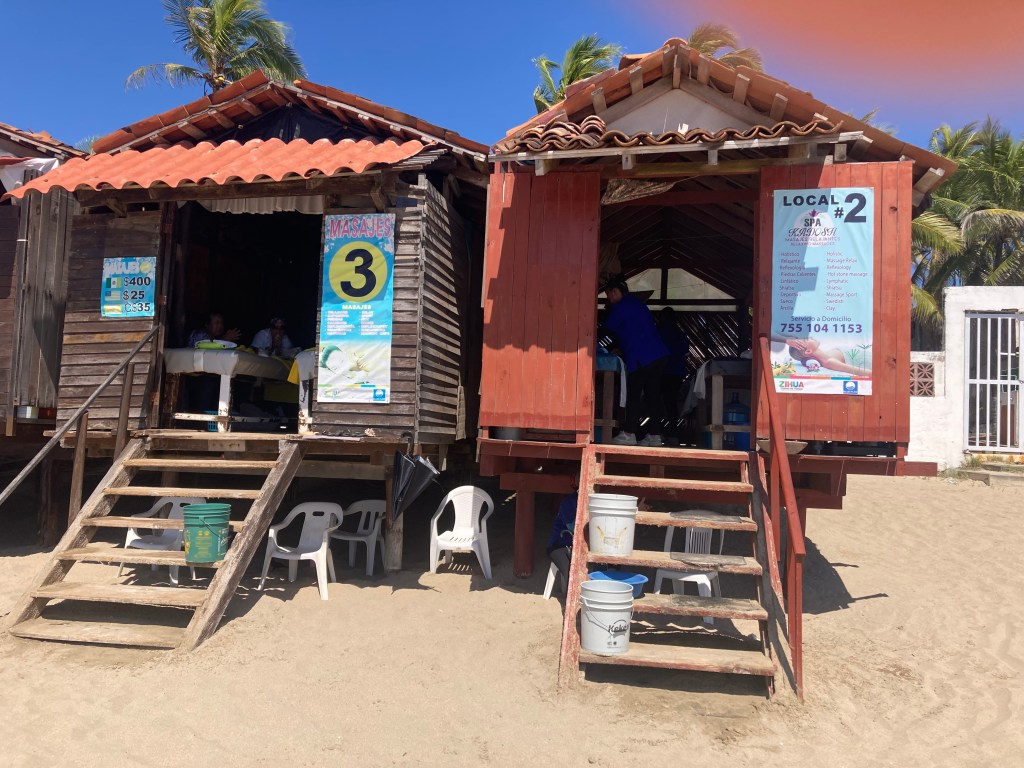
Fronting the Delfinium and facing the broad sandy beach are the six cabanas offering massages until 5 pm. Beyond the cabanas is a swath of public access, mostly vacant because of the roaring surf, and then a series of three modern, bleach white, high rise condominium buildings standing lonely as if unoccupied above the desolate beach. Finally a group of low-rise two-story condos painted in pastel colors reside in a return to welcoming scale adjacent to the marina. The beach ends at a wall of jagged rocks like at the Pacifica three miles away, only no boggy stream, just sand and a steep pile of rocks extending into the sea as a breakwater for the port of entry to the marina, where the yachts dock. There’s a boardwalk with a couple high end restaurants and nothing else, no shops or cantinas. There’s a tower like a water tower with windows purported to be a night club, but I haven’t seen it open for customers in years.
Beyond the marina there are walking trails into the jungle of natural habitat leading eventually to a nature preserve at Playa Linda. There are alligators there too, only they are called crocodrilarios. Beyond the marina along the coast opulent villas layer the modestly terraced hillsides towards the outskirts of Ixtapa, where there is little sandy access to the sea until Troncones.
The walk back from this direction faces the whole length of Playa Palmar, three miles, all the high rise buildings, the low rise infill structures, and the beaches denser and denser with people at the shore the further and further away from the marina. The beach from the marina and fronting the condos all the way to the public access and the massage cabanas is all but virtually deserted except for lonely walkers going the extra quarter mile to walk to the wall and give it a symbolic kick before turning back to their base camp. At public access sometimes someone might pitch an umbrella and set up chairs to sun bathe, but the vast sand in front of the condominiums goes unpopulated except the walking transients. Now and then some inhabitants of the high rises can be seen behind their walled deck lounging around their swimming pool, and once in a while an awkward couple or young parent with a child will venture down near the surf, but mostly that stretch of beach is the loneliest. I can feel lonely there even when walking with Roxanne. And there’s no extra serenity felt in the solitude of that stretch beside the three high rises, as if it were an eerie ghost town of white slab towers with windows and balconies. No wonder we almost always chose to take our walks in the direction of the Pacifica, where the people were and all the action.
Most of the day I would read. Under the palm thatched palapa I reclined and absorbed printed pages. Roxanne too with her Kindle, when not socializing at the pool, though I rely on paper, which means toting six or seven books and four or five back weeks of the London Economist, a newspaper, to catch up the year’s end. This year I caught up further with the Prey series of detective fiction by John Sandford, and three of the more current Navajo police novels carried forward from Tony Hillerman by his daughter Anne Hillerman, and a newer work by the Swedish guy, Fredrik Backman, called Anxious People. For non-fiction, besides stories from the Economist I read a book called All the Beauty in the World by Patrick Bringley, a soul searching tour of New York’s Metropolitan Museum of Art told from a seasoned security guard. My daughter Michel gave it to me for my birthday. For my birthday or Christmas, both in the same month, she often gives me a book evoking history or sociology, and I always read them. If all else failed me and there was nothing left to read, I’ve been slogging the past year and a half through William L Shirer’s tome from 1960, The Rise and Fall of the Third Reich, a fascinating but sorry saga, overwhelmingly detailed, exponentially exhausting and I’m way too self-conscious to be seen reading it in public with a swastika on the cover.
I subscribe to my home newspaper, the StarTribune, which now calls itself the newspaper of Minnesota — used to be newspaper of the Twin Cities, and before that the Minneapolis Star and Tribune. I get the digital edition via wi-fi on Roxanne’s old iPad when I’m away from home and keep up with news from the outside world. In its bumpkinny way the StarTribune does a credible job of collecting and presenting world stories and national events and issues and concerns of governance and national security. They cover state and local news in depth, and I like to know what’s going on back home when I get up in the morning and brew coffee at dawn, la magrugada.
Morning to night, I don’t lack mental stimulation.
I can’t always keep bringing my mental stimulation with me. If I continue to keep reading while I travel I should probably get my own Kindle, or a new iPad of my own compatible with digital books. Physical books take up valuable travel space and baggage weight. Even so, I am dependent on the written word to complete my day. I can write to my heart’s content but I need to take in perceptions formed from word testimony from outside my immediate experience. I need to read to know what I think I know. I need to read to question and challenge what I think. I need to read to enter somebody else’s life beyond my own.
I can read like that at home. I have better access at home. Ixtapa is not a literary mecca or Zihuatanejo a hotbed of libraries and book stores. I used to get an English language daily newspaper from Mexico City delivered to me at my palapa by a vendor named Victor for less than a dollar a day in Mx pesos, and in it was more Mexican news than I could comprehend. Then it stopped printing. Why? Internet, said Victor, who instead sells soccer t-shirts — of which I have purchased four, just to illustrate how many years the paper has been gone.
Maybe I’m better off uninformed about events in Mexico. Ignorant bliss. Easier than fighting through the misinformation credibility of the American White House. Every day I felt a little more scared to go home. The great mess was unfolding with trade wars, meddling in matters of nobody’s business and noninvolvement where participation is crucial, sanitizing language beyond political correctness and calling it Truth Social, the roundup of immigrants, National Guards in select cities, one by one, and a purging and dismantling of the federal workforce with this mercenary coup of bureaucrat stormtroopers called DOGE.
Maybe at my advanced age I should stop paying attention altogether because I have learned over and over it doesn’t do any good one way or the other, what happens happens. I choose instead to use wi fi and monitor news events on the trusty old iPad. If anything, this annual sojourn in Mexico could be a retreat away from America, a detoxifying period of no news is no worries, but it’s not easy to let go. Pop culture connects everybody everywhere. Mexicans use cell phones. Krystal hotel cable TV offers FOX network. CNN international. It seems against my nature to willfully allow others to be aware of anything more than me, even when such knowledge doesn’t reward me with anything tangible, not even lasting solace.
The prospect of presidential pardons of the couple thousand or so insurrectionists who stormed the federal capitol back on Epithany Day January 6, 2021 really pissed me off and proved again in my mind that Trump is every bit the Snake he preached about when he ran in 2016, and now that he has again seized power he will exploit that power to his will, he holds absolute power and the country and the world will reckon with the power they have given him, he is above the law and he will flaunt it, he has no regard for the truth, or for justice, or any abstract set of rules like the Constitution of the United States.
Letting those Jan 6 thugs off the hook actually rewarded what they did and why they did it. Remember the immortal chant: Hang Mike Pence! Forget all that. These are the guys who’ll get recruited by Homeland Security to work for Immigration and Customs Enforcement (ICE) to round up the immigrants for mass deportations. Adios amigos. We will not be replaced indeed.
In Mexico I reflect how much I am among the lucky. I am a white American. I’ve lived a relatively privileged existence. A charmed life. I belong to a class of people who can choose to be immune from social chaos and absolved of any blame. People may observe me and guess I am rich, and I am by relative standards (and by psychological standards) but in the economic scale of the world I’m just American middle class, well protected, secure and content. Anonymous as I want to be, or can be in the metaverse. Unpersecuted. Even my personal and private life is without chaos or turmoil. Yes, I am lucky. How much longer?
My favorite pastime at the beach is getting a massage. One hour sessions at a cabana, three times a week, a mere ten minute walk from our palapa. $400 pesos MX, about $20 USD, plus tip. We tip generously.
It began our third or fourth year we came down to Ixtapa. Set back on the desolate stretch of beach towards the marina, before the three high rise condos were built, next to Carlos and Charlie’s and the Delfinium, Roxanne and I took a walk and discovered that somebody had set up a row of four white army style tents. From the doors of each tent a woman wearing a white uniform waved to walkers on the beach. Uniformed colleagues from each tent stood near the surf, hailing passersby and offering business cards promoting massages at the tents. $200 MX pesos for one hour at the time, about $10 USD. Skeptical, we politely declined but accepted their calling cards.
Seemed sketchy. Reminded me of a scene from the movie McCabe and Mrs Miller where the young prostitutes of the frontier greeted passing cowboys, waving from white tents pitched along the trail (set to a Leonard Cohen song like “Sisters of Mercy”). One afternoon a persistent young woman persuaded us to try it out. It changed our lives.
This is what I will miss the most if we never come back to the Ixtapa Playa Palmar. Masajes. On the beach.
Within a year or so small wooden frame cabanas replaced the tents. Cabin sheds the size of a one car garage, sturdy, open sided with curtained upper windows. Accommodated six massage cots, plus supply shelves and personal cubbies, two chairs and a makeshift desk. Surplus hotel towels and sheets served for linen. Clean. Las masajistas, invariably women though a man or two worked the beach a couple of years and male masajistos work at the hotel spas. The beach cabanas numbered six, numbered 2 through 7, all in a row, side by side. Four to six masajistas worked at each cabana. Never in twenty years were we turned away, and rarely were asked to wait. By the time the beach massages turned popular, Roxanne and I got adopted by a series of preferred masajistas who made appointments with us so we always got in, and even if we were asked to wait or we arrived early it was fun to sit in the chairs under the umbrella next to the cabana stairs and talk with whoever was not busy and taking a break. The first years the tents and cabanas were looked after by local beach boys keeping security and landscaping the sand and hauling pathways of water in buckets leading from the surf to the cabanas. Not many years into the enterprise the young men stopped hanging out, and still no security problems occurred. The women took charge and the enterprise became an institution and from a novelty turned into a ritual.
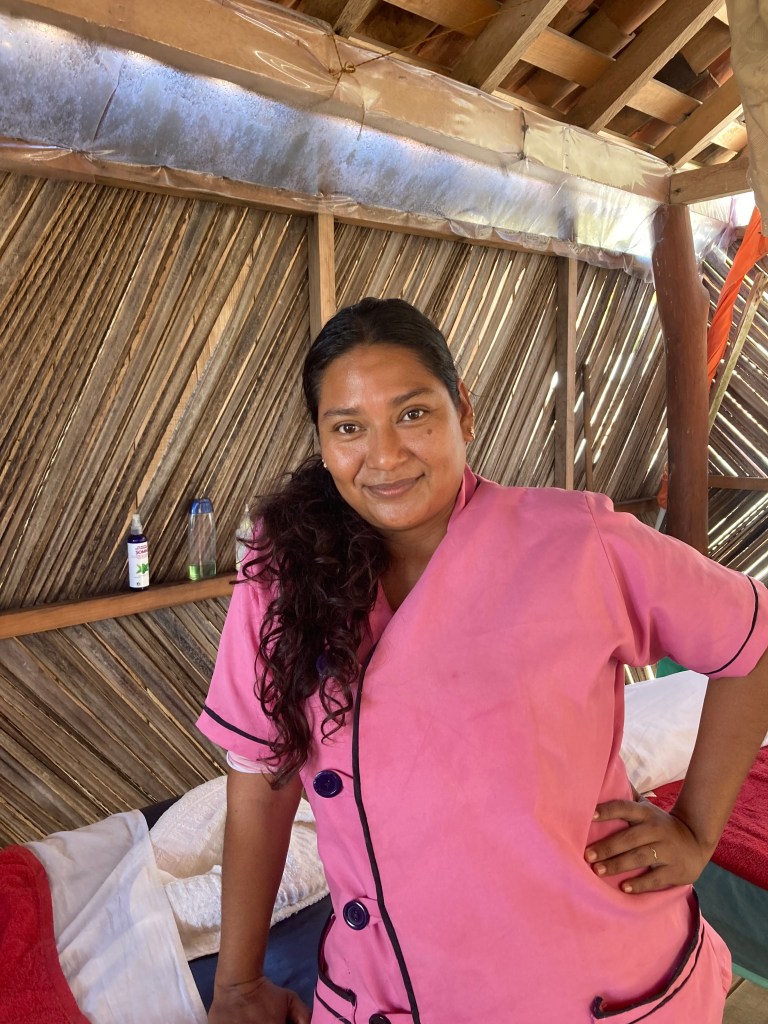
It wasn’t only cheap, it was a thrill. With few exceptions the massages I received from the first time were textbook. The women were as often middle aged as would be young in their twenties, and administered the massages with the same techniques, and some of them truly put their heart into their efforts and showed skills that were taught at some academy somewhere, although nowhere did I ever see diplomas or licenses on the premises. Most of the time the masajistas wore light clinical jackets like dental assistants or farmacia clerks over street clothes. Isabel wore scrubs sometimes and I called her Doctor because she had extraordinary healing power in the touch of her hands. Over the years we came to know some of them year over year, and as we extended our stays beyond two weeks to as many as six, we visited the masajistas for an hour every second or third day, meaning we set up appointments about a dozen times every season with the same masajistas, who as I said tended to befriend us and deliver masterful massage care. For me it’s the purest thing that unites me with Mexico, the medicinal value of the massage care given to me at the little cabana clinic at Playa del Palmar at Ixtapa.
I first came to Ixtapa seeking a place to rehabilitate my frazzled nerves and stressed out body from my rat race job and being middle aged and to escape of course the soul killing cold of Minnesota winter, if only for a couple weeks, three weeks, a month, six weeks, maybe eight … A massage every few days at the beach with a breeze and the sound of the surf, faint voices en espanol, sometimes music, sometimes Shakira, it was sublime therapy. An hour of bliss at the hands of someone who seemed to be able to determine from her touch the muscles needing special care, needed kneading, and the bones of my spine requiring gentle adjustment. Face down on the table with my face pressed into the cutout, or face up with my eyes covered with a cloth, nothing to see, my mind would drift and my body relax in total vulnerability and trust.
One thing I loved about a session at the masaje cabanas was the code of silence within the cabana. The senoritas whispered sometimes. At around the halfway point of a massage, she might say, “Over,” to get you to roll on your back, and “Finis” when it was over. Otherwise there was no chitchat. This was not a hair salon. Once in a while somebody might come in with somebody and try to talk with her companion, but someone inevitably would shush her and say, “Silencio”.
My first steady crush was a young woman in her twenties named Janeth — they wore name tags in those days. Black wavy hair worn short, deadly black brown eyes, cocoa face right off the cover of a magazine with one small scar left of the cleft of her chin. So pretty she scared me. Despite her European movie star ambivalence she took me as a regular customer and her routine massages felt like sincere effort to go beyond textbook training and provide comfort and relief to the body on the table, me. After three years she was gone. I stopped making appointments and simply showed up with Roxanne and we would go with whoever was available. We learned that everybody was pretty good, capable, and some were better than others, always worth the visit. Always therapy. Always the sound of the ocean and the feel of hands wringing my soul.
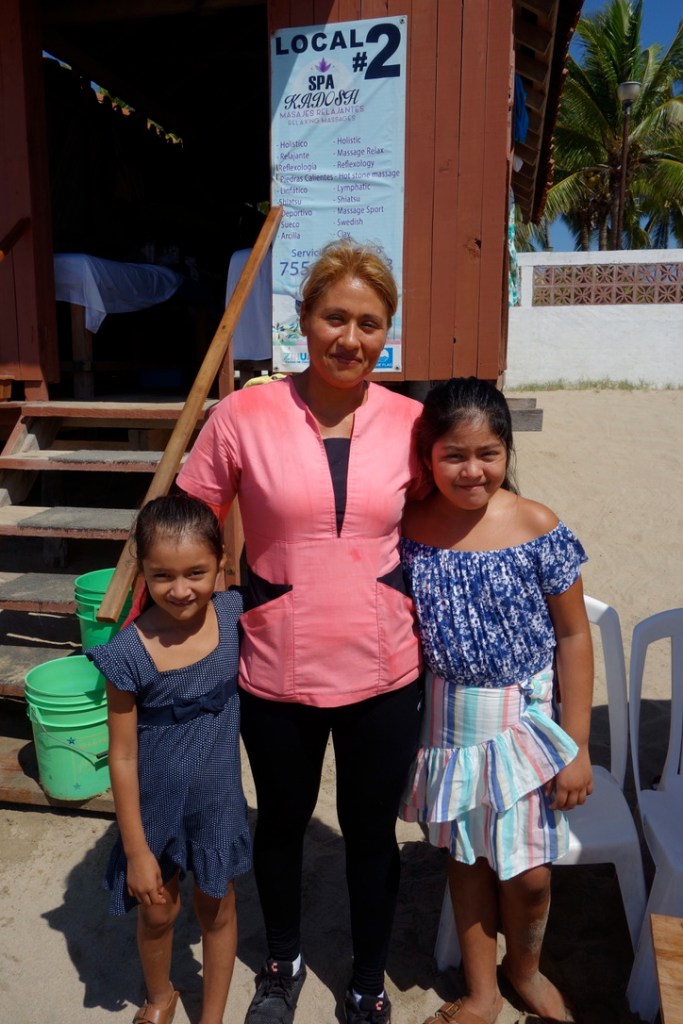
Then one year I met Isabel and Roxanne met Rosa. They both worked at number 2. Rosa was late middle aged and gave Roxanne a massage she would not soon forget. Roxanne thought she found a maestra. By coincidence and as if it were fate, I lucked into Isabel. Tall and athletic, Isabel dug deep into my muscles to find the kinks that never went away in my calfs and certain spots just inside my shoulders, and a certain area around my third thoracic vertebra that sometimes makes me feel like I’m wearing a yoke. She could feel where my body most needed attention and she gave extra pressure, not just passing by from limb to limb. She sparked with true effort. She in the end offered along with Rosa to book appointments in the deskbook, and we faithfully returned to them year after year, every two or three days at usually one o’clock, five or six weeks at a stretch. We put our lives in their hands.
I called Isabel Doctor because I believed she had healing talents in her hands. I said she should go to medical school. Freckle faced and energetic, she had long, rippling tangled streaked hair of amber and dirty blonde. Slender and athletic she used to run on the beach after her shift ended at 5, and sometimes she would wave to us if she caught our eye running past our palapa. Over the course of years we met her daughter. She was a single mom. Maybe I overstepped when I urged her to try to go to medical school if she wanted to. I was motivated by a genuine appreciation for her healing touch and expressed myself with the basic American belief that in life one can accomplish whatever one sets a mind to. Isabel would modestly shrug my praise off with a shy smile. I wish I had the means to pay more than lip service towards her education.
Then one year no Isabel. She was having a baby, they said. Maternity leave.
Rosa was still there for Roxanne at cabana 7. Not to worry, she said to me and walked me down to cabana 4, where she introduced me to Zuliema.
She looked about eighteen. A baby-faced, full figured beauty with black black hair and smooth brown skin and vivacious black eyes, she was instantly adorable. She smiled bright as the sun. Her mother also worked in that cabana and communicated with Zuli in sign language. She explained in English her daughter was deaf and mute, could neither hear nor speak, though she could read lips in Spanish. Did I mind? She was fresh out of school,whatever their massage academy.
Of course I didn’t mind. Within seconds of when she first laid her hands on my back I could tell she was gifted. Less therapeutic than Isabel, Zuli’s touch transcended muscles and nerves and skin to induce a bliss so elegant as to breach spirituality. When the hour ended I was almost delirious, hardly able to believe the exquisite attention she gave me. It gave the sign for thank you with reverent applause. I told her mother she was gifted. We set up appointments in her spiral notebook and faithfully I returned to Zuliema at cabana 4 every two or three days for six weeks to receive bliss in silence.
I wondered about that old trope about people who lack one sense like sight develop an acute sensitivity to their other senses, and that Zuli possessed an extra powerful sense of touch. I don’t know. I do know she possessed a kind of aura she infused into me that left me almost spellbound.
The following winter Isabel returned to work and I was cursed to choose between her and Zuliema. They embarrassed me pretending to rival for my favor, and ultimately I booked every other massage with one then the other. One day they fooled me by switching places mid-massage, starting with Zuli and finishing with Isabel, and I failed to detect the difference. The following year we continued to alternate. The year after that Zuliema was absent on maternity leave. The year of covid we didn’t go to Mexico.
The next year Zuli was back but Isabel was gone. Did she go to medical school? No, she simply chose to be a stay at home mom the other women said,including Rosa and Zuli’s watchful mom who worked at number 4, and so on. These past two years I have been enthralled exclusively in the hands of Zuliema. This year might be our last. I savor each session, will never forget the walk along the beach, surf to one side, resorts bordering the other, to the cabanas of massage, a trek of more than a quarter mile from our palapa at the Krystal, a pleasant walk away from the congestion fronting the hotels for an hour massage at cabana number 7 at 1:00 with Zuliema.
Mostly I savored the massage. There was a loving care in the working of her fingers and palms and wrists and forearms to infuse my muscles and tissues with life and vigor and balance and I was happy. Relaxed and vulnerable. Roxanne at the cot adjacent, though I couldn’t tell, the room was mostly silent except whispers in Spanish. No conversations. The sounds of the surf pulsed beyond acres of sand, distant but close enough to underbeat the silence of the room and give context to the random voices from the beach. Of all the reasons I love Ixtapa Zihuatanejo I will miss the most the masaje on the playa, especially the gifted magic of Zuliema. I feel sorry she may never know how beautiful her name sounds when spoken out loud.
It occurred to me how lucky it was that the atmosphere at the massage cabanas was not a haven for chit chat like a hair salon. The quietude and serenity of the sanctity within the massage cabanas enabled me to unplug my mind from the world of mindless chit chat and daydream my soul away with the ocean breeze and the surf, feeling my body reconstituted muscle by muscle and nerve for nerve with no effort from me, simply submission, surrender to relaxation. In a lucid moment of such bliss that past winter it occurred to me I didn’t need to come back to Ixtapa Zihuatanejo any more to escape a stressful, high-pressure life. It was 2025 and I didn’t live a life of stress, or high-pressure. The only reason to keep coming back was a one hour massage for 400 MX pesos, plus tip — twenty dollars USD. Primitive in its setting and with meager resources, the playa masajistas offered the same, or better when it comes to Janeth, Isabel and beloved gifted Zuliema, as one gets back home at a decent spa at five to ten times the price.
At this point I feel a need to emphasize how non-sexual the whole thing is. In the early years, when they operated out of MASH tents and then the frame cabanas, there were crews of young guys hanging out and hauling water and keeping watch in beach chairs like lifeguards. Bouncers. I saw their hairy eyeballs every time I trekked the sand to the threshold for a session. I could understand protection. And far as I know, there was never an incident with a masajista involving an abusive or sexually aggressive male customer (though I have heard tales of a customer trying to haggle down the price) and after the first few years the crew of chicos went away, and still no inappropriate behaviors. No expectations of what some call a happy ending. For one thing, there’s no privacy, all the massage tables are often occupied at once and only a sheer curtain is an option for the shy. And having observed these women doing hour after hour of hard physical labor between nine and five every day, six days a week, I can attest to their physical condition. With five or six masajistas per cabana, that accounts for a posse of thirty or more women who could be summoned by a bell, whistle or an air horn to protect their own. If necessary.
Non-sexual contact. But I would not say unsexy. I could never deny the arousing mental feelings being touched by beauty.
Just like I don’t know who trains them in the art of massage, I don’t know who bankrolls the enterprise. The small strip of beach between the finge of the hotel strip and the sprawl of new condos is not free, though the overhead is cheap. Recalling the early presence of the chico squads it isn’t hard to suspect a cartel of some kind might be at its heart. These days it’s easy to accept the concept that behind every business in Mexico is some cartel. And presuming thus, one simply accepts that it really isn’t anyone’s business who owns the business as long as the beer is cold, the food is delicious and the massage is bliss.
To characterize enterprises in Mexico as cartel usually implies drug trafficking, or human trafficking also. Vice in general. Twenty or so years hanging out along this coastline loosely called Lazaro Cardenas, first one week and eventually as many as six, every year, the only time I witnessed any criminal activity was the night I saw a souvenir kiosk vendor shot to death at the Ixtapa fountain plaza by a youngish looking chico in a red baseball cap — who also shot the vendor’s wife but didn’t kill her and spared their 12 year old daughter– who fired one last shot at a brick wall as he ran into the crowd on the plaza and dashed towards the parking lot behind Ruben’s hamburger emporium and gone. Except for that instance I never witnessed a crime, maybe some shady looking behavior, and one time someone local tried to hack a clone made of my bank debit card — don’t pay by debit card, I learned, locked out of my card by a vigilant bank — but nowhere else did I see behavior indicating commercial behavior under threat of criminal violation.
That I didn’t see it doesn’t mean it doesn’t exist, in plain sight maybe, if one knows where to look. I never brought up the subject even among the servant staff we came to know more than just by first names. (Of course Zuliema would never tell, even if I could ask her.) There was no local newspaper or website reporting crimes. Gossip among the gringo tourists retold the shooting of the kiosk keeper. Patrons at he restaurants around the plaza heard all three shots and one way or other ducked under the tables. Later talkers speculated who shot them and why. Somebody said they heard somebody observed an argument between the kiosk vendor and the punk shooter earlier that afternoon where the punk demanded two hundred pesos and the vendor told him to go fuck himself. They called it a lowlife cartel shakedown. The gringos recalled how an American guy in his early thirties got shot dead out front of a disco at about two in the morning for calling out a local pimp and demanding his money back for a date he wasn’t satisfied with, only proving no matter where you are, nothing good happens after two in the morning.
Widely known but never discussed with locals are the disappearance in 2014 of 42 student teachers in upstate Guerrero on the road to Mexico City, as well as the assassinations of downballot politicians and the bombing of a police station in Zihuatanejo. Troops in camouflage combat gear patrol the streets of Ixtapa, and occasionally the beach, reassurance in an unnerving way. There’s always a hint something could go awry. There are checkpoints on the highway to the airport and points north towards Troncones. Still, there are no reports of crimes against the tourists, snowbirds or expats. We are reminded everywhere to be aware of our surroundings, which makes common sense.
One conversation, though, stands out to remind me of my lingering longtime cynical suspicions whenever I looked out past the city to the foothills of the Sierra Madre del Sur and saw a plume of smoke from a burn pit. Jesus Calderon used to be a senior server at the restaurants of the Krystal Hotel up until his retirement around 2020, ZOZO, a year of change for many people. A year or two before that, during the offseason when Jesus spent more of his time at his campo, his small ranch in the hills with his horses and cattle, a small group of men approached his house one day. They had guns and bound his hands and produced a sheaf of papers they intended him to sign. The papers signed the deed to his land over to them. Jesus said he refused to sign. They threatened to kill him and burn his body. He refused to sign the papers. He said there was no legal way to take his land if he was dead and though he didn’t want to die he also didn’t want to live letting his land to be stolen this way. Besides, Jesus said he pointed out to them, the papers described a different plat of land, not even his, so he couldn’t legitimately sign away somebody else’s land. This stalemate went on all night and into the next day. The men never beat him, only put a gun to his head a few times. They were unkind and rough but didn’t beat or kick him. Jesus perspired into his baseball cap as he recounted this to us one morning at breakfast during a lull, fear recurring in his eyes. Eventually the men blindfolded him and drove him somewhere in a truck and let him go, drove away and disappeared into the dust. He had to walk his way back home. He left it at that.
Jesus was a reliable narrator. We’d known him at the Krystal about twenty years. He was the local union steward and eventually the most senior waiter on the restaurant staff. He spent shifts hustling back and forth on the beach front hustling buckets of Modelo and pina coladas to the palapas. He paid his dues and trained others when they were new in the art of hospitality and the science of customer care, which served the hotel well and set standards making it a desirable place to stay. Jesus was a professional lifer and made good tips and over the years at the Krystal, which pre-dated our first impressions of him, got himself a small farm in the hills where he liked to ride his horse and watch over his half dozen cows. A handsome caballero, now probably in his early sixties, he is rumored to have fathered a few offspring now handsome young adults among the emerging generation of Zihuatanejo. A gregarious man, discerning of judgment and impeccable in manners (who taught me Spanish) Jesus may have shown a mysterious dignity but there was nothing deceptive about him, and he wasn’t the kind to circulate rumors about himself or his private life to get attention or exact pity. He poured it out to us in a burst of confidential momentum during a moment after a breakfast rush, prompted by my question posed discreetly and based on a gringo rumor confided by one of the other hotel servants that Jesus had been kidnapped by a cartel the previous summer.
That story, and the murder on the plaza after dinner another night, intrigued me enough to seriously question why I had always been a naive optimist about Mexican culture. It was all Frida and Diego on the 500 peso note. This place where I returned each winter to seek refuge and repair and rehabilitation from a homeland of craven stress and psychological demands of a paranoid and decadent society was indeed deep down as sinister as any place I’d ever been and more dangerous than I was willing to concede.
And now my mind grew restless for activity beyond rest and relaxation at the palapa on the beach. Things to do with all the blissful energy generated by the mindful meditation inspired by massage. Something more busy than marching back and forth, up and down the beach. More than swimming. More than just lazing the day away in a chair under a palm leaf palapa and watching the sea and the people on the beach, reading.
I remember Luis, El Guia, a twenty-something guide going palapa to palapa along the hotels soliciting business to go visit the wildlife preserves along the southern coast south past the airport. We turned him down and he got pissed. “You people come here and all you do is sit on your asses and drink beer and margaritas, you never explore anywhere or learn about what matters.” This was at least ten years ago but it stuck in my mind. I disagreed with him then and was relieved when he went away in a huff and it didn’t lead to a confrontation. Roxanne and I did a lot of local exploring on our own, thank you, but I agreed with him enough not to argue with him, and after she and I talked it over we reconsidered taking a nature tour with Luis just to hear what else he had to say. We asked Jesus if he knew Luis and he said he knew him well, his parents worked at the Krystal and he was raised hanging out at the hotel. We waited for him to come back around to tell him we changed our mind and would like to book a tour. He never came around again.
Those were the days of escape from stress and craving for relaxation and rehabilitation, when I was probably at the peak of my latter-day corporate career and clearly felt entitled to sit on my ass for a while to rest my body and refresh my mind away from cold winter in Minnesota where I lived and worked so very hard. It was the whole point of traveling to Ixtapa. Escape. Escape a brutal cold winterscape for a warm place where plants bloomed and fresh ocean air cleared the sky. Escape my job managing teams of people who performed operations in financial services for a famous banking corporation. Escape from American mass media and bizarre politics and nonstop hype and counterhype of my society and culture since the turn of the century, to come to a place where I could disappear and think through what my life was really about. A place to take an annual time out, eventually six weeks a year. Even before Roxanne and I traveled Europe for the first time as empty nesters we used our vacation time to go-go-go, go as far as we could, do as much as we could and see as much as we could with what budget we could afford in the allotted time. Not down in Mexico at Ixtapa Zihuatanejo. Life at the Krystal hotel was primarily a beach vacation spent at peace spending days and days watching the sea break against the sand from a shaded chair beneath a palm palapa and thinking about how good I had it in this world.
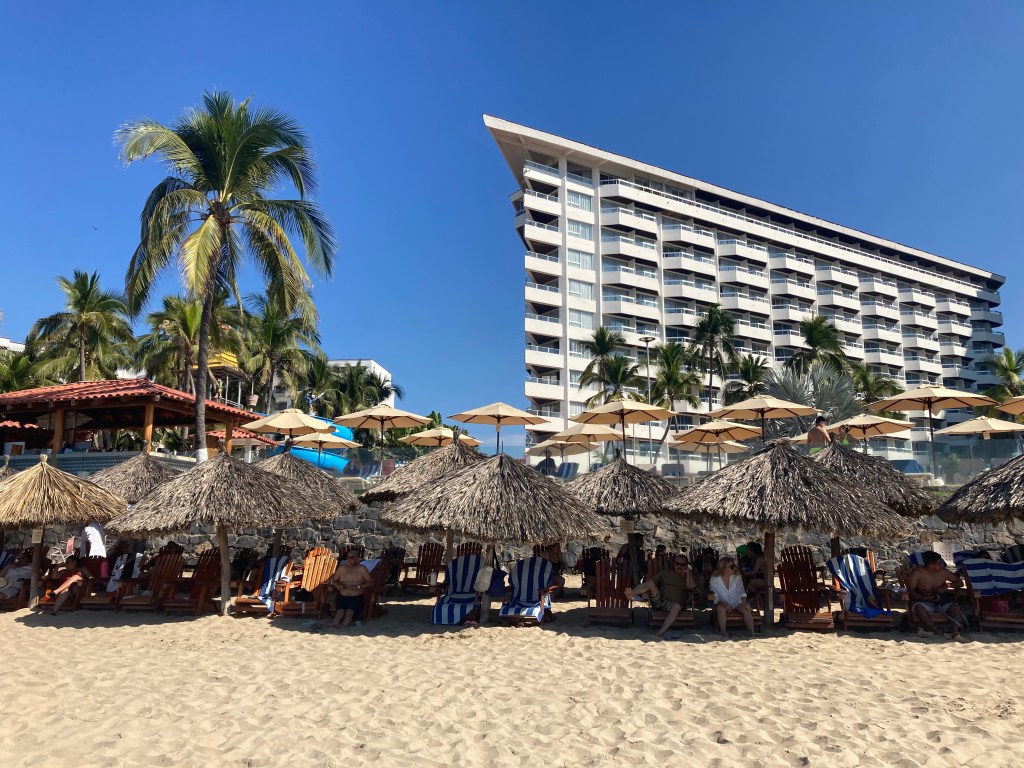
It worked. For over twenty five years I escaped into therapy to the Krystal hotel to heal my soul almost every winter because that’s what I wanted. A room with a king sized bed on the sixth or seventh floor with a balcony view over the pool and facing the ocean. Two decent restaurants on the premises — now three with a new traditional regional Mexican cuisine opened just a year — make it four with a recently added Italian cuisine named for Cinque Terre — plus a food truck, plus a pool patio grill next to the main outdoor bar for lunches, there is always quality food and service at hand. The pool — they call it alberca, the word for reservoir, rather than the common piscina, probably opting against any suggestion to anglos that pissing in the pool is okay — is clean and well kept, and there is a water slide into the deep end. The patio is spacious and decked with continuous chaise lounge chairs always occupied. Down stairs from the sea wall dozens of palm palapas line the sand in two rows just below the free standing restaurant they cal Las Velas, as in the pun for both sailboat and flame, and the main patio bar, lunch grill, patio dining and the lawn next to the Kids Klub area, and past the stairs along the sea wall white umbrellas with chaises line up next to the umbrella palapas of the hotel next door, Tesaro.
As I have said, at the Krystal there are palapa beach people and there are pool people. I prefer the beach and like a front row palapa. Palapas cannot be bought, or reserved in advance, but I wake up just before sunrise and don’t mind taking our beach towels and an identifying paperback book or old edition of the Economist down to pick out my favorite palapa, and if that’s taken pick my second favorite, set out our paraphernalia, smoke a cigarette watching the walkers and joggers in the red cast of sunlight coming over the mountains and lifting the shadow off the sand and pinks up the surf. Sunrise, la madrugada, one of my favorite Spanish words. When I return to our room the coffee maker is done, Roxanne usually wakes and we take up our devices to read the e-edition of the Star Tribune. We groom ourselves and dress in our bathing suits, gather our books and more paraphernalia in beach bags, have breakfast at the Aquamarina downstairs or across the pool patio at Las Velas and then go down to the palapa to occupy our home base headquarters for the day.
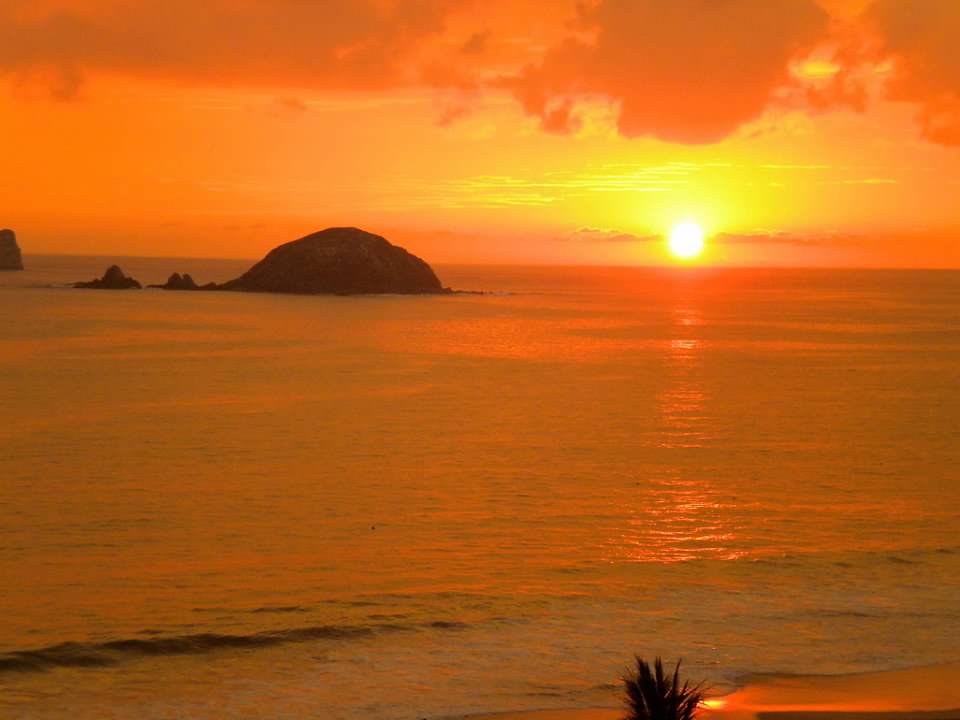
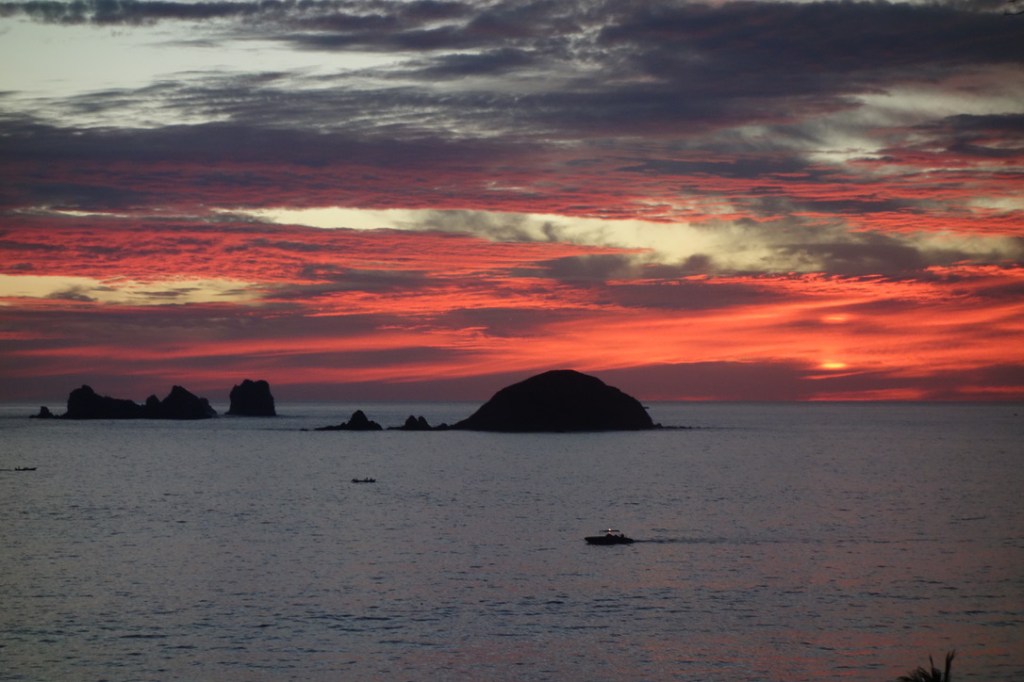
Typically. Walk the beach. Maybe a massage. Swim. People watch. Sometimes lunch at Las Velas or down the beach at Tanta Vida. Rinse in the pool and repeat. And read. Eventually the setting sun occupies the attention of everyone remaining outdoors. Sunset comes just after six, when beach people and pool people alike retreat to their lodging to get ready for the night. But first the sunset. Roxanne and I are crazy for sunsets. On the best of them the big orange ball descends with grace that last tenth of sky over the ocean horizon where you might see a sailboat, or a whale. The open water of the wide bay of Ixtapa is blocked by a grouping of rounded rock islands, typical along the coast in this vicinity. This grouping features a prominent rock and some little ones as if in the big one’s wake or orbit. From a distance at shore they look heroic, gleaming white in the sun, but up close in a boat you discover the stone is covered with birdshit and the romantic spell is forever broken. The sunset in the bay restores some of the dignity, the golden ball casting the rock islands in melted contrast to its reflection under the horizon. On the best occasions the sun invites picture takers to pose somebody with their hands positioned in the air like they are holding up the sun, the way they pose in Pisa like they’re holding up the Leaning Tower.
Some days thin clouds gather out there off the coast towards Japan and the red ball is sliced before it truly reaches the sea, but it’s still very pretty to see. It’s interesting day by day, staying as many as six weeks, to observe inch by inch the progression north of the islands the place where the sun actually goes down from January into February, a few minutes later as the days go by. These years Roxanne and I are given to packing it in by five o’clock to clean up and dress for dinner, but we try to see the compelling sunset view from our balcony.
We laugh at ourselves when we talk self-consciously about our fetish for sunsets but make no excuses. A Pacific sunset view from Ixtapa Bay at Playa Palmar is the simplest pleasure to conclude the day, a moment of serenity and vespers. We have seen the green flash.
Actuarial stats tell us our sunsets are numbered. We live well at our advanced age, in our low 70s, an average middle American lifestyle based on a full adulthood engaged in our work and family as functional community members and productive contributors to society. We played the game, voted, taught our kids right from wrong, went to work and did our jobs, minded our own business and earned a good credit rating, and when the time came to retire — that is, to stop working a job — I knew in my heart it was time to let go of that part of my life and stop going to work, my life no longer depended on a paycheck. Over eighteen years vested in my employer’s generous retirement plan netted a nest egg I feel comfortable to live out my actuarial years. Roxanne — much more reluctant to sever her career, didn’t fully leave her job for a few years after me — built a fair civil service pension. And we both qualify for Social Security. Roxanne’s department at the U got eliminated eventually or she might be still showing up at the lab (an agricultural scientist) but right away I was ready to say good bye to the commute on the light rail train downtown to the office tower and the rigorous rites, rituals and rigamarole of commercial banking. I did good work, made an honest living, formed several professional relationships and was well compensated, but there came a time when I didn’t care to do it any more. I wanted to go on vacation for life, like Tommy Bahama. I contemplated it for years. It was a matter of when. I gave the company three months notice. My boss and various colleagues assured me I wouldn’t do it, I would miss it too much, get bored and would change my mind.
They didn’t know me, did they. But what ever doubt I may have harbored went away a mere week before my last day when Roxanne’s sister’s husband Jack died in his sleep between ten o’clock December 31, 2013 and seven o’clock January 1, 2014. I could have stayed on at the bank another year, two or three, like Roxanne at the lab at the U, and I could have kept contributing to my 401.k and deferred Social Security for the sake of bigger monthlies in the future, but New Year’s Day 2014 I made the only new year’s resolution I ever made in my life, and that was to retire, walk away from the job and say, enough is enough, it’s time to live off all that dough-ray-me I’ve been tucking away all the years and live my version of the Life of Riley — what my mother’s Kelly side of the family would call my half bum half playboy vision of my retirement lifestyle. I trusted myself with free time.
At the time Michel and Sid, Clara and Tess were still living in Switzerland and I didn’t need to ask for PTO to spend a month visiting Europe every six months. By then Roxanne had amassed so much vacation and comp time she might as well have been retired. And now, we are well accustomed to our freedom. Our mortgage was paid off in 2007. We’ve lived beneath our means to get this far, and our budget allows us to indulge in life’s simple pleasures like flying to Chicago for a Shakira concert. And afford priorities such as an escape to the tropics every winter. We are debt free. We are lucky enough to call ourselves healthy. We are not rich but we live well. We know we don’t have that many more years to pursue our dream curiosities as we age.
At the same time I have found contentment as a homebody of simple pastimes and meager ambition. The pandemic taught me to enjoy my own company. New ways to deal with depression — customized versions of Cognitive Behavior. In 2025 I found myself in Ixtapa contemplating an emerging restlessness to make something more of my time at the beach. I loved the beach. It was simply the best place to be on a January or February day. And yet, I craved more.
The ocean had a captive audience in me. The ambient temperature in the daytime reached 92F with thick humidity. Seems I used to love the heat but in recent years it oppressed me if I left the vicinity of the sea or the pool between the hours of 11 in the morning and five in the afternoon. Roxanne too. In the early years for a diversion we might take the bus to Zihuatanejo and explore the town, check out the shops and maybe have lunch and one of the many cantinas. It seemed that lately even the city beaches offered no respite from the heat. With Bob and Rose and several other Krystal companions we used to make day trips across Zihuatanejo Bay to a beach cantina at Isla Las Gatas, but without our compadres there seemed little incentive to to abandon our palapa to make the trek. Likewise the shops of Ixtapa and the souvenir stalls offered no curiosities worth the thick heat. I thought of Luis, El Guia, and his tour down the coast to the nature preserve, but even now I could only imagine the heat and sweaty humidity. With only bus or taxi transportation between Zihuatanejo to the south and Playa Linda a few miles to the north, our mobility to get out and explore the hills and villages in the countryside was restricted. From what we heard about Mexican traffic and the preferences of villagers that tourists stay away, and from observing military checkpoints, and contemplating stories of cartels and the story told by Jesus Calderon, we would never rent a car to create our own road adventure the way we would in France, Ireland, Canada or back home. It didn’t feel safe to go off by ourselves beyond the coastal community. Besides, there were no ancient ruins, pyramids, historical, archaeological or architectural sites in the region (aside from the tiny indigenous villages among the hills, where outsiders were unwelcome) and no mountain vistas in the arid and scrubby terrain.
Just the beach. Ironically, the most interesting architecture in the region is the 14 story Bayview condominium, a wedding cake of arches and balconies located on the south end of the beach at Playa Palmar, which we passed by every day on our walks. The beach was reason to exist. More ironic was the awareness that Ixtapa was chosen as the steady repeat destination to escape Minnesota because it enabled me to indulge in lazy, passive behavior, spending my days doing almost nothing, all on purpose, and now I was finding that I was becoming bored with my chosen boredom.
Under our palapa I would read. I would write in my journal. I often brought five or six books from home. Roxanne would bring two or three and her Kindle, cued with e-books. Besides the books, I would usually bring at least three recent issues of TheEconomist, a newspaper, my news backlog from the hustle of the holidays. The books might be non-fiction, such as All The Beauty in the World, a backstage memoir of a former security guard at New York’s Metropolitan museum, or The Silk Roads, a history book by Peter Frankopan tracing civilization along ancient trade routes between East and West. I’ve read the likes of Malcolm Gladwell and Joseph Campbell on the beach. I read the entire Project 1619.
Mostly I read fiction. I discovered Fredrik Backman and Roddy Doyle at this beach. Peter Heller too. I’ve kept up with the chronicles of Navajo detectives Leaphorn and Chee, originated by Tony Hillerman and continued aptly by his daughter Anne with the development of the character Bernadette Manuelito. Then I got interested in St Paul Minnesota crime writer John Sandford, and over the years I backfilled reading his entire catalog, all the Prey books featuring Lucas Davenport, the Virgil Flowers series, the books featuring the artist computer whiz known as Kidd, and the emerging series based around Davenport’s adopted daughter Letty. Sandford has been around since the 1980s and each novel elevates the genre of the murder mystery ever higher. He is one of my favorite authors. Almost concurrently I found an exceptional espionage novelist in Daniel Silva, whose series featuring Gabriel Allon began in the 1990s and evolved among international tensions ever since. There are similarities in style and structure between Silva and Sandford which set their work apart from contemporaries of note. I also like David Baldacci, who toggles both murder crimes and spies.
What worries me about my recent propensity towards the novels of Sandford and Silva is the reflection of their stories on my psyche. I try to pick stuff to read that I can take to heart. Life’s too short. I guess I’ve been an active thinker and literary participant in what I read as far back as the stories of Alice and Jerry at St Simon of Cyrene, If I Were Going, second grade, my first trip to Europe. The trouble with identifying with the novels of John Sandford for me is that Sandford’s intense detailed narratives of acts of evil sometimes permeated my dreams, much less posed moral questions in my head when I wasn’t reading but busy at something else. Same with Daniel Silva.
Vivid insight into the minds, motivations and methods of supremely corrupt people could not help but scare me and make me more paranoid and suspicious of the world around me. The novels are fiction, of course. As Minneapolis writer David Housewright put it, if there were half as many psychopaths running around Minneapolis as John Sandford portrays we would all be driving our kids to school in armored personnel carriers. And as vividly suspenseful and poignant each heroic story, each book shelves itself into memory and some other experience obscures the book’s freshness — perhaps another book, and maybe the next one in the same series — because there’s no reason to get obsessive over the adventures of modern day agents of good in an evil world.
And yet, real life offered an array of intrigue. Roxanne kept me up on the gossip circulating among the MAGA pool people. They heard from an inside source that next year the Krystal would only offer all-inclusive accommodations. No more what they called the European Plan, room charges separate from food and amenities, which were charged a la carte. Rox and I never liked the idea of all-inclusive. We didn’t drink enough to break even and didn’t need an incentive to consume more. As for food, it may seem like a never ending all-you-can-eat buffet but confining ourselves exclusively to food at the hotel — for six weeks — completely alienated us. Yes, the hotel food was good, but not great, and the menu repeated itself all too frequently. We ran a tab for when we had breakfast or lunch but for dinner we preferred to go out to a restaurant in Ixtapa within walking distance or take a taxi to Zihuatanejo, where the food was better and it was nice to get out of the hotel in the cool of the evening after sunset. We could understand the economics on the side of the Krystal, a business model based on short-term, 3 – 5 night rentals marketed towards the domestic Mexican tourists who saw an all-inclusive stay as a good deal. For us it seemed like paying for something we didn’t use. According to Roxanne, the MAGA pool people felt likewise, and some suspected it was a conspiracy to cater to more Mexicans and squeeze out the gringos.
The other thing was another rumor from high up inside that next year the Krystal would discontinue honoring coupons for its decades-old loyalty program. Rox and I got in on it from the beginning, along with Bob and Rose and most of the MAGA pool posse, some Canadians, when we seemed to find ourselves coming back to the Krystal year after year for extended stays — more than one week — and the hotel came up with a marketing scheme to attract guests like us to keep coming back, so they offered discount coupons for future stays based on nights spent plus referrals of other future customers and options to buy coupons defaulted on or otherwise forfeited at a discounted discount price. In all, Roxanne and I accumulated coupons into the 2030s, and given they could be redeemed early, we still held enough coupons to last at least three more years at a rate of six weeks a year. The coupon terms were simple: each night of lodging priced 25% below the hotel’s cheapest package rate and a 20% discount on amenities charged to the room. Coupons expired the last day of each year of the coupon. There were restrictions during Christmas but not Easter. We forfeited 2020 to the panademia. The marketing scheme worked very very well. For us it seemed a dream come true, a reliably high quality tropical vacation at a bargain price, easily accessible and affordable well into our advanced age. The Krystal hotel got loyal, trustworthy, tidy and polite returning guests worth at least $85 thousand Mexican pesos a year. Win – win.
The pool people complained they felt gypped. Some of them liked to book their next year’s stay a year in advance, while they were currently registered, and they were told the room rate was all-inclusive and their coupons were expired. They were told the contract for the coupon program only lasted ten years. More than ten years had passed for most of us. Far as I could recall, there was no time limit expressed in the membership contract except that each year’s coupons expired on the last day of the year. Otherwise we had coupons for the discount for at least a week in 2034, if we didn’t spend them early. But what could I do? Sue? In a Mexican court? We always contacted the Krystal by e-mail in late June or early July for reservations, always based on booking our flights and vice versa. Projecting ahead, the policy changes at the Krystal added to rising doubts we would return in 2026, and I didn’t want to wait until July to decide.
The MAGA pool people suspected a conspiracy to squeeze out the gringos. Unwilling to surrender Ixtapa altogether, they talked about leaving the Krystal and going to the Hotel Emporio, two buildings down the beach. Room rates competitive. No all-inclusive. Might have a better pool. Nice rooms, but no balconies.
I was thinking of skipping Mexico, period. What would be gained by Mazlatan or Puerta Vallarta? We already tried Cancun and visited Chichen Itza. We’ve visited Mexico City — Frida Kahlo’s blue house and the murals of Diego Rivera at the National Palace — but that, like Paris, is not a beach vacation. We’ve considered visiting the Mexican city of Morelia, said to be a picturesque colonial town, and seeing San Miguel de Allende, said to be a charming colony of the arts, but these would be day trips and I’ve said before, I don’t want to drive in Mexico or take a long-distance bus, and unlike Europe there are no trains. After twenty-some years of Mexico the allure is the beach, and Playa Palmar at Ixtapa is a fantastic beach. Hard to replace.
But probably necessary. I used to say that if you want to experience the real Mexico you will find it at the Krystal hotel. Now it’s more true than ever. Even after experiencing Mexico City, I still refer to Zihuatanejo as Downtown Mexico. To clumsily steal a quip from a Jack Kerouac character named Remi Boncoeur, I say, man, there are sure a lot of Mexicans in Mexico. All kinds. They are at home here. Rudely perhaps, and harshly honest, that woman at the beach a year ago who yelled at me (in English) to go back to my own country had sympathy from a lot of people under the palapas I’m sure. Here we were at a popular vacation resort and who is this guy complaining of music too loud? Some ball-headed old gringo reading a book. It was Mexican music too. I like Mexican music, but who would know? I have heard about a slogan of MAGA demonstrators that goes, “We will not be replaced.” Replaced, I wonder, like how and by whom. A rhetorical question because I know the answers — immigration portrayed as alien invasion, and overall a population of underclass un-white people willing to work. In America. In Mexico replacement theory is proving itself in reverse. Year by year visitors from upper North America to Mexico has declined since we started coming to the Krystal to the point where our presence is almost irrelevant, more and more Mexicans seeking long weekends by the sea, in their own way seeking escapes from stress, boredom and oblivion. If Americans and Canadians decline in the tourist mix in Ixtapa the chilangos and familias will take up the space, and the culture of hospitality will adapt to itself without the pesky gringos.
The true expats will remain, forever embedded anonymously among the fabric woven between the populace and long term tourists wandering far from home.
I never came there to be a missionary to evangelize the American Way. Part of the allure was seeing Mexico as is. If I have a critical eye I also look for mitigations and a will to live and let live without imposing my judgements of circumstances none of my business, such as governance by cartels. The relative poverty is obvious. Even so, year by year over the decades there is ample evidence of the rise of the Mexican standard of living from Third World status. Even in backwater Zihuatanejo there’s not only an Aurerra Bodega but also a Sam’s Club, neither of which rely on tourist shoppers. From iPhones to flat screen LG televisions, Mexicans have skipped past middle technologies to compare itself among the rich world, whether the United States accepts it or not.
I think about Mexico’s collective self-awareness in light of the bullying abuse from Washington DC. Only days in office (Roxanne and I did not watch the inauguration) Trump announced tariffs on Mexican goods and threatened to tear up current trade agreements he himself renegotiated with Mexico (and Canada) during his first term. He threatens to deploy our armed forces against the drug cartels. He keeps claiming an invasion of migrants who are the “worst of the worst” of criminals sent to the US by vague Mexican authorities and says a massive crackdown is imminent. Trump asserts that Mexico poses threats to National Security. Hearing rhetoric against them like this, what do Mexicans think?
I am not a journalist (obviously) and don’t go around interviewing subjects. I don’t ask personal questions about things that might make people uncomfortable or none of my business. I see what I see and hear what I hear, feel what I feel and try to engage people with sincere respect and respectful sincerity. I am a writer. Things I observe may enter my journal or end up here in the blog. I keep confidences. Still, I am hard pressed to say what Mexicans think of America and the Americans who elected the president who heaps such abuse upon their country.
Over the years we have been befriended by several locals and I cannot say anybody feels free to talk about politics, local or national or international. Most if not all are associated with the hospitality industry, and I can understand why it’s in their best interests not to risk being overheard voicing unpopular opinions. Or should I say unpopulist opinions. I admire their apparent que sera attitude, and if it’s genuine they are better than me.
From a distance I pay attention to news from home. The hotel carries FOX and CNN International on cable in the room but we don’t watch TV except the NFL football playoffs. FOX always makes me angry at its blatant, unfiltered MAGA propaganda. CNN International takes too long to get to the point. I’m not fluent enough to watch news on the Spanish channels. We keep up via the internet with CBS News Minnesota, Roxanne gets feeds from the New York Times and we both read the e-edition of our home town newspaper, the Star Tribune. I get daily newsletters from The Economist. From these sources I saw the covid-19 pandemic coming from Wuhan, China while we were in Ixtapa in January 2020.
Deja vu all over again.
I hate it when I think I see something coming and it comes. It looked like the first Trump administration was just an improvisational dress rehearsal. This time around Trump has a floor plan and a script. Picking up where he left off, supercharged from finally beating up Joe Biden, he is establishing an administration dedicated to disestablishing every liberal institution of the infrastructure of the federal government of the United States.
Woke no more. Everybody back to sleep.
Didn’t he say at his 2024 campaign rallies that if he got elected the country would never have to vote again? He promised his voters he would take control and solve national divisions, his way. His first act after inauguration was to pardon 1,500 convicted insurrectionists from the Capitol riot on Epiphany Day, January 6, 2021. He has since begun a purge of the Department of Justice to sack every US Attorney who pursued charges against the insurrectionists or any other ally of the President, or Trump himself. He proclaimed a new Department of Government Efficiency headed by a neo-fascist billionaire immigrant from white South Africa who is charged by proclamation with unchecked powers to investigate every department and agency of the federal government and terminate any and all jobs they see fit and close down the whole office if it wants to. Already employees at the Internal Revenue Service were getting furlough notices en masse. The beautiful functioning bureaucracy that runs the USA is being dismantled, institution by institution, in favor of a ruling class of plutocrats and oligarchs running the government from extralegal private means while controlling society by propaganda propagated by communications technology — that’s what I foresaw coming while gazing at the surf.
Another Trump promise on his campaign trail was to hunt down and deport every one last immigrant taking up space within the borders of the United States if he can help it, and he was already starting the roundup in Los Angeles, California, where he said he wanted to send federal troops to reinforce Immigration and Customs Enforcement (ICE) sweeps, justifying martial law under the Insurrection Act of 1807. I could see Trump going after a two for one: a sweep-up of a million or more undocumented immigrants and confrontation with demonstrations organized by protesters he can proclaim as insurrectionists and bust them up with federal troops. I could see another Kent State magnified by the millennium and in my mind’s ear I heard the opening guitar bars of Neil Young, four dead in Ohio. This was just the first week of his presidency. Just the beginning of four years. LA is as good as any place to start, but how soon will he get to purging Minneapolis? Who can stop him? The Supreme Court makes me laugh.
His cabinet appointments scare me. Barbie doll ex-beauty queen and Trump sycophant ex-governor of South Dakota, Kristi Noem will be Secretary of Homeland Security. She will be known as ICE Barbie, and she will be ruthless, illustrative of her other nickname, Bad Dog, earned by a chapter in her 2024 autobiography where she proudly described shooting her wire-haired pointer at a gravel pit for disobedience.
Attorney General will be an ultra right-wing attack dog and former Florida attorney general Pam Bondi, tasked to cover Trump’s criminal activities in office, sack US attorneys who built cases against his allies, including but not limited to the January 6 insurrectionists, and pursue criminal indictments against his targeted enemies. She will cease enforcement of civil rights laws and slap suits against prestigious universities to block funding for research it deems too woke.
Robert F Kennedy Jr will be Secretary of Health and Human Services, a guy who advocates going completely off the grid to avoid vaccinations and links acetaminophen taken during pregnancy to autistic children with no evidence. As sort of a celebrity backup to give Kennedy some credibility Trump appointed Mehmet Oz, Dr Oz from daytime TV, director of the Centers of Medicare and Medicaid. Between DOGE and Kennedy the Center for Disease Control (CDC) will get slashed and health care will revert to the frontier of anybody’s guess.
Sycophant gadfly playboy Kash (in pocket) Patel has been installed as Director of the Federal Bureau of Investigation (FBI), or head hairy eyeball of the FB-Eye, installed by Trump to back up Bondi at her Department of In-Justice in prosecuting Trump’s enemies such as the fictional terrorist conspiracy they call Antifa, and calling off investigations into real life threats such as the Proud Boys.
For director of National Intelligence Trump installed an obscure former congresswoman from Hawaii named Tulsi Gabbard. It appeared she was planted in her position to be ignored except a nod and a wink to her classified briefings the public can never see and Trump can discreetly disregard. Hers is likely the simplest non-disclosure agreement ever signed.
Pete Hegseth is the new Secretary of the Department of Defense, also known as the Pentagon. Hegseth wants the official name of the department changed back to the Department of War, and Trump will gladly pick up his sharpie pen and change it, so obliged is the president who counts on Hegseth to consolidate militant MAGA even more harsh than the vice president. Folks might call him Heggie, but that resembles hygge, a Danish word that very loosely translates as “woke”, so he probably wouldn’t like it and ban any journalist who would do so from covering the Pentagon. For some reason he reminds me of Heinrich Himmler, so I think of him as Heinie Himmler Hegseth. Already he is purging the armed forces of senior officers, female officers and any personnel known to be LGBT, liberal or woke, in his effort to restore a warrior mentality to American troops. Trump cannot say no to his biggest foil since Rudy Guiliani. If Heinie Hegseth wants war this commander in chief will give him one. One he can lose and still come out saying he won and blame Heinie for the mistakes and miscalculations.
Alone among these and other appointments to fawning amateurs and spoiled loyalists the one appointment that stands out as particularly sane is Marco Rubio, Secretary of State. The Cuban-American former US Senator from Florida comes from an uncompromising traditional Republican caucus that used to include Dick Cheney. In 2016 he ran for president and lost the party nomination to Donald J Trump, who humiliated Rubio — “Little Marco” — at every rally. Four years later after helping save Trump from conviction and removal from office via two Senate impeachment trials in the first term, Rubio is called upon to represent the United States as our leading statesman to the world and defend Trump and his foreign policy with a straight face. It’s always been easy to believe Rubio lives in politics because he is at heart a civil servant and patriot. Except maybe a cross-generational grudge against Fidel Castro he appears to have no axes to grind. He serves at the pleasure of the president, and for Rubio it will be a dicey deal. The American citizens may luck out having Rubio embedded in the Trump circle because in his conservative way he embodies integrity to do his best to steer policy in foreign relations through peaceful diplomacy and counterbalance the influence of the secretary of war.
The hidden easter egg, as it were, the secret maestro of the machinations driving this Trump administration is rostered at the White House as a senior advisor named Stephen Miller, a senior architect of the MAGA movement and principal author of the campaign’s policy document, Project 2025, a treatise of fascist racism and xenophobia published by the Heritage Foundation. Stephen Miller is the Joseph Goebbels of the Trump regime. Under his direction ICE will beef up its ranks and sweep across the country arresting every suspect of color in sight and detaining them in secrecy at inhumane locations and deporting them as fast as possible before due process can be invoked. The state of Florida has volunteered to build a detention camp deep in the Everglades they want to call Alligator Alcatraz. The goal is to eradicate immigration and deny USA residency to any and all ethnic migrants by any means necessary, including selective denaturalization of citizens. Trump says he will end birthright citizenship for children born inthe US from parents who are non-citizens, contrary to the 14th Amendment of the Constitution.
The Constitution also specifies that the states and not the federal government regulate all elections, but Trump wants to set uniform federal rules prohibiting mail ballots and requiring proof of citizenship to vote, citing election fraud that does not exist except in Trump’s mind. He has ordered the Justice Department to subpoena from each state a roll of registered voters to judge ineligibility, with no safeguards to private information.
On the international front Trump campaigned that he would end the wars in Gaza and Ukraine his first week in office. With Gaza he can’t get past his vision of beachfront real estate when negotiating with Israel. With Ukraine he’s punishing President Zelenskyy for squealing on him for trying to put the squeeze on Joe Biden and getting him impeached the first time, so Trump sucks up to Putin and condones Russia’s invasion, flips the bird to NATO and insults the European Union. And he has further riled NATO and the EU by threatening to seize Greenland by force from Denmark. He reviles Canada, who shares a 5,525 mile border with the US — longest international boundary in the world. He keeps calling them the 51st state, and further antagonizes the longtime US ally and trading partner by slapping a 25% tariff on all Canadian imported goods. He’s slapping 25% tariffs on imports from all countries.
Trump justifies the tariffs claiming national security. He says it will raise enough federal revenue to virtually eliminate the need for income tax, contrary to the calculations of every sane economist — the policy was tried unsuccessfully before by Herbert Hoover, whose administration presided over the onslaught of the Great Depression. Trump says the costs of the tariffs on goods will be paid by the countries of export, when the costs will be really paid by the importers and ultimately consumers. He is such a liar. He is the Lyin’ King.
Project 2025 is direct response to The 1619 Project, a compendium of critical essays looking at the establishment of the United States since slavery. The MAGA movement is particularly aroused to anger over public recounting of all the horrible shit white supremacy has perpetrated upon blacks in America and pledge to cleanse official historical references to events exposing racist mistakes of the past. The results will purge museums, libraries and even national parks of any didactic material considered “woke”, that is viewed as espousing a left wing agenda of imposing DEI upon the American public — diversity, equity and inclusion. MAGA is resoundingly anti-DEI. To them, diversity, equity and inclusion are three vices to never aspire.
A key fulcrum of leverage MAGA can use politically in the state of Minnesota in its next elections is the role of DEI in the massive fraud committed against the state department of human services during the pandemic where dozens of individuals pocketed millions of dollars billing the government for hundreds of thousands of meals never served to thousands of fictitious children. The friction around DEI centers on the charitable sentiments of state administrators hesitant to respond to whistleblowers who smelled something fishy going on with invoices submitted by food providers organized as a consortium known as Feeding Our Future. An eventual state and federal investigation brought fraud and conspiracy charges against almost a hundred individuals and hundreds of millions of dollars in bilked money. Most defendants plead guilty, and almost everyone else who went to trial were convicted, including the ringleader of Feeding Our Future. Where DEI comes in is in the political fallout. It’s come out that authorities thought very carefully over accusing a group of ostensibly well-meaning people representing themselves as benevolent and charitable, of lying, cheating and chumping the government, when the overwhelming number of the defendants belong to the local community of the Somali diaspora.
Never mind that the Feeding Our Future ringleader is white.
Trump already hates the Somalis. He has called them “garbage” who add nothing to American society, and speaks of denaturalizing them (a very high percentage of the 80,000 Somali refugees who settled in Minnesota are citizens) and deporting them wholesale back to Africa, including Democratic congresswoman Ilhan Omar, she of his nemeses The Squad.
The Somalis of Minnesota now surpass in notoriety the Haitians of Ohio said to be eating cats and dogs. It crosses my mind to stop keeping up with the news, just blank out and unplug and like the ice queen in the Frozen story sings, let it go. For one, I alone am not responsible for Minneapolis’ reputation and like the prayer for serenity implores, I need to accept the things I cannot change and change the things I can (if I want to) and be wise enough to know the diff. I did not kill George Floyd and there are several Somalis I’ve known through the years I can put in a few good words for if it would do any good. They didn’t just show up yesterday. Refugees from the jihadi terror overwhelming Somalia have been in Minnesota for more than a generation. They remain a visible community among the (if you forgive me) diverse elements of the population of the Twin Cities metropolis, centered in Minneapolis, my home town. They stand out for their women in traditional Muslim dress, head to toe like old time nuns, and men with beards and pillbox hats and the long thobes, like neighborhoods of Hasidic Jews or colonies of Amish, they congregate in districts long underused by the underclasses. They drive the Ubers and Lyfts, serve in health care jobs and work in the food and hospitality trades. They have renovated abandoned warehouse spaces into mosques. All along the way they have been harassed and occasionally terrorized. Incidents were vicious and one would think conditions in East Africa must be incredibly brutal for some of them to want to live in Minnesota instead, not considering the weather, but the Somali community has persisted and made a stake of socioeconomic equity among ethnic small businesses, the trades, academics and professions, as have the migrants who came before them, the French, Swedes, Norwegians, Germans, Finns, Irish, Italians, Ukrainians, Dutch, Irish, Scots, Blacks, Southeast Asians, Latinos and whoever else came to live in this place once roamed by the Ojibwe and Dakota barely eight generations ago.
Somalis have included themselves within the fabric of society enough to get Ilhan Omar elected to the House, she herself a persistent achiever of appeal beyond identity politics who came to America as a refugee, pursued an education, became a citizen and went to work as advocate of social justice by articulating liberal policies as affecting human rights for all and not just special interests. She is young yet and could go on to campaign for universal human rights at the United Nations or some cogent international foundation.
What’s too bad for the reputation of their ethnic community is the Feeding Our Fraud scandal smearing bad blood on the whole bunch for the actions of a hundred people, laying blame on liberal government and giving credence to MAGA outcries to round up all those un-Christian jihadist conspirators who came to America to game the system and sabotage the free-market capitalist economy with Sharia. Barely three generations ago there were public outcries against niggers getting shoved down people’s throats, and see what happened. The critical lesson from Feeding Our Fraud is not that a certain ethnic group came to America to deliberately exploit humanitarian loopholes in the safety net because they all assumed it was easy, but that these guilty individuals may have taken their cues from the worst of bad examples, the oligarchs and autocrats who are the leaders of the country, who act as if it’s expected to swindle the public trust to succeed at life in America and the rest of the world.
Here I was in Mexico a week and a half not really at peace. I told myself I was relaxing by the sea but the monotony was no lasting consolation. Reading offered escape from the escape, but that itself offered mind exhaustion, and for the most I didn’t feel like writing. Some of it reflected my paranoia of being observed with a pen transcribing into a notebook. I always used to feel anonymous in Mexico, just another Anglo touristo in the crowd, no worries. Lately I felt as if I were being watched. Maybe it was a Silva novel. It occurred to me how easy it is to put me under surveillance. How would I know? I’m in some public place all day except when in the hotel room, very easy to verify. The real question would be why I would any entity care what I was up to in southern Mexico.
I wouldn’t like to believe Mexican authorities suspect me of being a spy, but why not? Twenty-something years at the same hotel — practically the same room. Few if any social contacts beyond my wife, especially this particular year. There’s a naval base in Zihuatanejo, adjoining the public pier, but I don’t frequent the gate or the guard station. If my mission interacted with someone who is a mole from the Mexican side, there could be anybody of an array of people whom we came repeatedly in contact with year by year, mostly through the hospitality businesses and mostly the servants, and otherwise the possible list of repeat contacts was nobody. No mysterious Venezuelans or Cubans. No expats dwelling near Playa Madera, Zihuatanejo.
Years ago there was an elder gentleman from Argentina who used to stay at the Krystal when we did who spent time with a middle aged lady (our age then) who brought a young girl, her daughter perhaps, to visit with him at a palapa on the beach a number of consecutive years, and I remember because the lady and the never seemed to age but the young girl grew into a young lady. I imagined the elder guy was her grandfather. Their interaction resembled a tutoring session, somewhat formal and scripted. Sometimes the lady would attend. I can’t remember how I learned the man was from Argentina — Andres the hotel security detective, or maybe from Rose, or Bob. In any case the Argentine and I did not hit it off at all. He had a kind of aristocratic attitude that rarely made enough eye contact to stay aloof, and he hasn’t stayed at the Krystal in years. It was absurd to conceive myself a contact with an Argentine secret agent.
In Mexico. Besides him I could think of nobody else dodgy I might be suspected of engaging for nefarious purposes, just as I could not put a finger on who might be watching me from the Mexican side, or who on behalf of the USA. Or Canada. I hadn’t been this paranoid since 1972, only back then I didn’t realize it. Now I wasn’t so naive to think of myself as anonymous and invisible any more. I could be a target. I could be suspected of gathering intelligence — writing in my journal at the beach. I could be a client of a cartel. I could be under cover surveilling a cartel. I could be a left wing agitator stirring up social unrest. Jesus Calderon the servor served as the union steward at the Krystal for several years before he retired, but nobody could seriously link the two of us conspiring against the state of either country. But you never know. They don’t just call them Trumped Up charges for no reason. More plausible, I’m already known as a well-known nobody to Mexican intelligence, protected from harm by my notoriety for being a harmlessly common gringo.
I still think I could recognize the guy who shot the kiosk vendor by how I recalled and described him to an undercover detective who suddenly appeared at the scene with a cell phone and directing first responders. Once the following year I thought I saw him having an intimate, intimidating talk with the first year proprietor of a sidewalk cantina of empty tables in one of the Ixtapa malls, wearing the same red baseball cap, the same hawk profile, and I hoped he didn’t recognize me if he was the same guy as the shooter. We used to eat at that cantina, Los Bigotes de Zapata, when it was owned by a guy named Martin and a servor named Celia worked there and they made the best enchiladas mole, but Martin apparently sold the place and we were hesitant to try the new menu, and then the dark, arrogant, skinny guy in a red ball cap showed up and we left. And never returned. I mentioned the ball cap guy to Roxanne at a safe distance and of course she hoped I was mistaken, so did I and we let it go.
Even so, there was something sinister and foreboding about the character of the guy and how he demanded the attention of the cantina proprietor that suggested the business wasn’t making it. A lot of empty storefronts at that corner of the mall and not much foot traffic after dark, even though the plaza was clean and well lighted. I sensed a heyday passing away.
Two weeks into our 2025 vacation my angst was starting to bother me. Even in a trance of bliss in the gifted hands of Zuliema it occurred to me how vulnerable I was at the massage cabana, like Moe Green in The Godfather. Of course it would do no good for the local tourism industry for something bad to happen to me, unless propaganda spread that I deserved it, or the news could be suppressed whatsoever. I thought about that incident the previous year, at the beach involving my request to cut the (subjectively) loud volume of their music and their request that I go back to my own country. I worried that I may be on a collision course with the hotel’s newest business model, which was designed for me to decline past mere passive ambivalence into ambivalent irrelevance.
In years past the hotel manager and senior staff would host a catered party at the cantina by the pool bar and invite all the long term guests like us and Bob and Rose and the pool people who had been coming back for years and they would toast us in appreciation of our loyalty. That practice ended with the pandemic. New management keeps a distance from the guests. My polite attempts to get answers about the future of the coupons or whether the hotel was really going to go all-inclusive got polite evasive smiles of ignorance from senior staff who professed no expertise or authority to confirm or deny the hotel’s future policies, but they kept assuring me they appreciated my business and would do everything possible to keep our relationship going, and I would get my answers soon, from the top. Maybe manana, or the manana after manana. Proximo ano at the latest.
At least the MAGA bunch at the pool seemed to have sources who confirmed the coupon program was dead and all-inclusive was the destiny of food and lodging. It irked me that these cultural barbarians seemed to hold more clout than me to confirm information but there was a certain feeling of schadenfreude in hearing they held no sway in convincing hotel management not to go that way.
My best, closest connections to people employed at the Krystal happened to be with the servants, not management, and at least in this case the servants really couldn’t say. Maybe they were just being nice just to make me feel good. I knew Jesus Calderon would know something and tell me straight, not be coy or play dumb, but I hadn’t seen him in two years. He never came back around after he retired to ask how we were or say good bye.
Which made me think about all the servants we came to know over the years by name and by face at the hotel, very few of the current staff have been there more than five years. Lorenzo and Javier the bartenders have been about ten. Josefina a server at the Las Velas restaurant about eight. Martin, Jaime, Rafael and Augusto, all breakfast servers at both restaurants, have been around more than fifteen. Juan, known as Juan Toro, also a restaurant server at breakfast at Las Velas and a favorite of ours, might be more than fifteen. He is a favorite because we’ve known him since he started as a beach server when on his first day he turned our belongings in to lost and found as being abandoned at our palapa while we were up the beach at the massage cabanas. We admire his apparent character. Among the housekeeping servants only Lourdes and Filipa have been around almost twenty years. Chief security detective Andres has been at the hotel every year we have visited, as Jesus Calderon would have been. At the front desk they are all new every year. The bell captain Claudio has been there forever, and the bellman who is my tocayo, same name, Bufalo Miguel, one f, who looks like he could be Jay Leno’s brother, has been there about ten years too. Oscar, who can barely walk and runs the concession renting snorkels and boogie boards and selling inflatables and sand toys for kids, has been there forever. And our best friend of all, Anabel De Los Santos, dinner shift server at either of the two restaurants, about twenty years herself.
One may think these dozen or so people I have named who are notable veterans at hospitality would represent a strong and stable workforce for the hotel. While they do form a core of professional hospitality they give cohesiveness to the turnover and help the managers motivate the newer recruits to emulate quality customer service. The newest wave of new people are young people in their twenties, some from training schools and looking for careers. The hospitality industry welcomes more servants. The notable veterans are aging. Oscar at his water toys concession stand can hardly walk, his hips are so arthritic, and he uses a cane and thanks every day he makes it to work. Juan Toro used to be the Kid, and even if he is several years junior to Martin, Jaime, Rafael and Augusto, seasoned servers, Juan has college age kids now, he’s a middle aged professional who will soon be senior staff if he sticks around a few more years. Same with Josefina. The older ones will fade away like Jesus Calderon and a dozen or so more of the established old timers who used to run the place when we first came around, who disappeared one by one over the years into history, replaced by a generation on the move, churning personnel with fresh personalities training for new opportunities, and who could blame them?
Our friend Anabel was a rookie the second or third year we stayed at the Krystal. She was not the first female server but the third, after Marta and Gloria, both of whom left the Krystal within the past ten years. Being female and working as a server was a big deal twenty years ago because it was automatically a male profession where men earned a living to support their families. Feminist principles and women’s rights came grudgingly to Mexican culture and then it hit hard. The president of the country is a woman today. When we started coming to Ixtapa almost all the restaurants only employed men as servers, even ones owned or fronted by women. Seemed strange, but change emerged swiftly year by year through attrition and new enterprises as the numbers of employable women grew in the new millennium, and today you would never know the old norm ever existed. (Taxi drivers are all still men. Hotel housekeeping is still all women, at least at the Krystal.)
When Anabel first started schlepping up and down the beach sand hustling drinks for the gringos under the palapas she was an exception among guys like Rafael, the earlier Martin, and even Jesus himself who hustled cervezas and pina coladas for a living for years during the vacation months. She was not just the new girl but a girl. Marta and Gloria worked at the restaurants and helped out serving the pool patios part time. Anabel used to work as a cleaner at housekeeping. She was a single mama with four kids and hustling drinks (and back then you could order food such as fish tacos) at the beck and call of the hotel guests camped in the sand under the palapas was a step up into man job territory. From the outset one could tell she worked hard because she was on probation. Jesus Calderon was her mentor. She seemed to be catching on fast. Within one more year she was a fan favorite. Her service was prompt and attentive. She spoke good English and made interesting conversation among the guests, both with ladies and gentlemen gringos. She made translations. Over the years I relied on her (and Jesus) for tutoring en espanol. It seemed she was making good tips. Soon after — four or five years — about the time Juan Toro showed up — Anabel got promoted to a servor at the restaurants, working a regular rotation between the Aquamarine and Las Velas, rotating shifts and presumably better money and easier on the legs and feet not having to schlepp the sand and climb stairs to get to the bar. We saw less of her then because we rarely ate dinner at the hotel, though we ate breakfast sometimes and occasionally lunch. Even so, Roxanne and I became friends with her beyond the hotel.
We have dined with her family, out at someplace in Zihuatanejo or at her house, or houses of her friends and extended family. We have celebrated birthdays of one of her sons, Roxanne, and of her grandson together. Anabel has extended kindness and hospitality to us in the highest and purest way. She has befriended and welcomed us to make our residence intimate. She is the prime example of our relationships with Mexicans being with mostly people of the servant class. Our gringo compadres in Ixtapa comprise professionals and otherwise accomplished and accredited members of the American middle class, mostly to an upper degree above our bumpkin selves. In Mexico our closest cohorts are the servants.
Not the managers at the hotel, not the proprietors of the galleries and boutiques, nor the occupants of the mansions atop the hills over Zihuatanejo or the yachts moored at Ixtapa marina. We know no Mexican doctors or lawyers. No telecommunications tycoons. And certainly no cartel kingpins. We are a little chummy with a few restaurant entrepreneurs we have supported over time, but they in their own turn come from the servant class or still belong at an upper level. Didn’t Bob Dylan once sing that everybody serves somebody? Seems some service is much more obvious.
One restaurateur in Ixtapa in particular worked his ass off serving at local restaurants for years until he earned a legendary reputation as a front man and then pooled his savvy and investors to open his own place, The General’s, named for himself, Genero Salinas. We met him many years ago when he worked as floor boss at a popular restaurant and hangout for gringo wannabe bikers called Frank’s. Along with Roxanne’s sister and brother in law, Jack who died in his sleep, and a couple of their friends with whom they were coincidentally vacationing the same time as us (at a different hotel), we hired Genaro, even then christened The General for the way he ran Frank’s, to take us on a tour up the coast to drink a lot of beer and boogieboard surf at Troncones. The General was moonlighting at this with his white Econoline van in the daylight hours and he showed us a fantastic time including a banquet meal at a beachside cantina. On our way back to Ixtapa we stopped at his adobe home at a little tiny town so he could change into his fresh work clothes to put in his shift at Frank’s. We met his wife Estrella, who spoke no English so I had to work with what I knew and Anabel and Jesus tutored me en espanol. Daughter Vanessa was two and Jessica a baby. Both are now in medical school in Morelia, about 216 miles away. Daddy The General established the consummate sports bar in the heart of the plaza in Ixtapa where that poor trinket seller got gunned down — no relation between the two. It would seem by any observation that the shooting has caused no effect in traffic. It’s fun to go there and get greeted at our table by Genaro and Estrella, who works there most nights and still doesn’t speak a lot of English. He remembers us from way back and in his comedian’s way acknowledges our origins and our loyalty. Maybe few or any people can say they met The General from a personal guided tour to Troncones and met his family, but there are hundreds, maybe thousands who can say they first met The General when he was a server or maitre d’ somewhere else long ago and have follwed him ever since. We’re rather proud to know him, actually, and we’ve been free beers and margaritas here and there.
It would be hard enough to end up never coming back to visit Genaro without a personal good bye, but to go away from Ixtapa without saying good bye to Anabel and her family seemed like unconscionable abandonment. Genaro and Estrella’s life will go on with great success without Roxanne and me stopping by for a chat six or seven times a year, all bunched up in six weeks. They will always be beloved by their loyal clientele. Anabel and her kids don’t depend on us, either, for their sustenance. Obviously they live and exist day by day all year long when we aren’t there — and most of their time when we are in Ixtapa, such as when lounging on the beach while they are working or going to school, shopping or caring for the grandchild and a disabled son, living as if we aren’t there.
I often wish I could be a more effective part of their lives in the role of patron, putting up school tuition and so forth, like I would like to be able to afford to sponsor Isabel through med school and Zuliema at whatever she might aspire to in life. I would like to help Anabel afford to live in a nicer house than the one and a half room adobe hovel packed alongside the hillside hovering over greater Zihuatanejo and perched in a dense terrace of similar houses just one earthquake or monsoon mudslide from disaster. We tip generously and buy dinner for the family almost all the time. During the pandemic, the year we did not visit, we wired them a couple of hundred bucks to help them get by. But we can’t afford to support them financially, we really aren’t rich — not rich enough. And they don’t ask for anything. Somehow we commingle socially every year for a very short time and share sentiments. We tell about our lives and show iPhotos on our phones. Never have they asked for so much as a favor more than exchanging pesos for American coins from tips — mostly quarters, the banks readily exchange paper dollars for pesos but will not exchange coins. Maybe that’s money laudering. Actuually it’s an even trade.
As I always said, we never went back to Ixtapa to be some kind of gringo missionaries but we have in small ways acted as undercover ambassadors. Accidental ambassadors. Ever diplomatic and polite. Never act out the Ugly American. If you accept the credo that foreign sovereign entities have no business interfering in American elections then it’s true Americans have no business meddling in how Mexico governs itself. Roxanne and I don’t favor candidates, endorse referendums or debate their issues, though I follow along from an imposed distance through the internet. Of late, as I’ve said, the undiplomatic conduct of our newly re-elected president after a four year gap term continued to worry me down in Mexico the way he disrespected their newly elected female president, slapped high tariffs on imports from there and threatened to deploy American troops to attack drug cartels on Mexican soil to control fentanyl traffic. His bully attitude towards Mexican migrants living and working in the States bode none too well for reciprocal attitudes towards us, and any Canadians mistaken for us.
The Canadians we encountered seemed confused. Most of them come from Saskatchewan and Alberta, known conservative provinces. Alberta leans into petroleum production. Their spoken politics conflate with the MAGA people at the pool but it’s hard to see how they really feel about Trump slapping fat tariffs on their goods and calling their vast country America’s 51st state, scoffing at their sovereignty. They think Trump’s just kidding around and he’ll come around once they replace the detested prime minister Trudeau. A couple guys admitted they wouldn’t mind joining the USA if Trump could be their president. I asked one guy in the pool crowd from Alberta province in the Rocky Mountains, who was the namesake of their capitol city, Edmonton. Who was Edmon? The guy tried to act like he thought fast and said King Edward. I really didn’t know the answer and I said, you’re making that up. There’s no King Edmon. At this point of our stay I didn’t care anymore whether any of the pool people liked me at all, so long as they were nice to Roxanne.
And then there was Trump’s threat to seize Canada’s leviathon island neighbor in the neorthern hemisphere, Greenland. By military force if necessary, he says. Heinie Hegseth the self-proclaimed secretary of war, says his troops are ready to pounce. Never mind that treaties exist permitting the United States to establish military bases all over Greenland, and there is already a hefty US military presence there guarding the arctic as part of NATO, the North Atlantic Treaty Organization. Greenland is is an autonomous territory of the Kingdom of Denmark. A US attack and invasion of Greenland would be an attack on a fellow NATO country, which could trigger Article 5 of the NATO treaty which considers an attack on one member as an attack on all. This could put America at war with Europe. Heinie Hegseth is so anxious to be the secretary of a real war he taunts America’s allies from behind Trump’s resolute desk, and he flaunts his Bible beliefs in the Apocalypse as so inevitable it looms over him as his favorite self-fulfilling prophecy.
When Trump took office the first time, eight years back, it worried me then. That year a couple of my sisters came down for two weeks to the Krystal and we approached Benny to hire us a guide to drive us up to Troncones for the day, in a way to recreate our field trip when we met The General. Benny got us a guy named Fernando, a perfect gentleman in his early forties in a Toyota SUV who showed us an elegant time at a cantina on a sandy beach that stretched forever on both horizons. Fernando said most arruredly that Donald Trump would be good for my country and I should give him a chance. He made me a bet, a hundred pesos that one year from today I would be better off. The honest truth was that in that calendar year our net worth increased and for some reason we were better off. When we came back to Ixtapa I tracked down Benny patrolling the beach for clients and asked to get in touch with Fernando to honor the bet. Benny somberly informed me that Fernando had died of stomach cancer that previous summer.
Two years after the pandemic we were at a party at the poolside patio bar put on by by a Kirk family and cohorts who have been coming to the Krystal for a generation. They invited pool people, palapa people, acquaintances and sundry people this gregariously generous clan had come to know over the years, hotel guests and non-guests alike. I was introduced to a woman who was Fernando’s widow. I told her about my day with Fernando and the beach cantina. That he taught me to deal with anger by finding a palm sized stone, to clench it in my palm and channel the object of anger into the stone, and when ready, throw the stone into the sea. I told her Fernando taught me that if you desire something very much, find a palm sized stone and hold it in your fist and think of the object of desire and, when ready, throw the stone into the sea. I told her that on our field trip he stopped at a roadside stand selling sea salt and made us each buy a small sack. And then I told her about our bet, and I gave her a hundred peso note. I told her when I last saw her husband he had to run an errand and stop at the bodega to pick up tamales for the family celebration that next day. I told her I was better off for knowing her husband.
My whole life was better off for knowing Ixtapa. Even walking the beach meant more than mindless exercise. We did not power walk. We like to mosey, a form of meandering. I’m prone to dawdle and pore over the angle of breaking waves or the antics of the surfbathers. Little kids never tire of burying their fathers in sand. More volcanic stones wash up than seashells. At the end of the beach at the Pacifica the sand platoon does its daily exercise damming the outflow of the alligator creek. Pelicans dive for fish or float in wait in a row just beyond the breakers. Volleyball out front of the Barcelo hotel, soccer out front of the Fontan. Frisbees fly. American footballs. Selfies. The parachute sailing vendors. Maybe the artist Jorge Perez has his card table and umbrella set up and he paints miniature seascapes with his fingertips — we have a triptych of his hanging in out bathroom. And as we pass, both coming and going, I like to pause to admire the Bayview highrise in its elegant climb of arched terraces and wedding cake shape, surely the prettiest architecture in the region. We had friends who used to stay there on the tenth floor and they invited us up for drinks before we went out to dinner, and the accommodations were modern deluxe and the ocean view remarkable.
Not even two weeks into our stay Roxanne and I were talking about alternatives to always staying at the Krystal. We lived there pretty cheaply on the loyalty coupon plan. If the hotel revoked the program and converted to an all-inclusive policy there would be no more financial incentive to stay six weeks at the Krystal. Living in a hotel has simple advantages. It’s right on the beach. Breakfast is only a few flights downstairs. There’s a bar and usually entertainment in the evenings, sometimes a good Latino band and sometimes karaoke. All we really need is a bedroom with a bath and a balcony overlooking the pool. It gets cleaned every day with fresh linen. There is security. Unlike A Gentleman in Moscow we are free to leave the premises, which we do every night for dinner. The daily ritual of the beach palapa by day (barring any field trips) and related beach moseying and massages, and going out into Ixtapa on foot or Zihuatanejo by taxi for a luxuriant meal after dark, then retiring to our room after perhaps a nightcap at ten or eleven, now manifest itself as a bit absurd no matter how much good reading got done, my inner restlessness and tiny paranoid beliefs and delusions persuaded me more every day to make contingency plans for future winters not at the Krystal.
Roxanne and I agreed our dream home in Ixtapa would be a condo suite at the Bayview. It was far and away beyond our budget. Our friend who used to stay there was a retired Twin Cities ear, nose and throat surgeon with a much bigger estate, who passed away a few years ago. What would be nice would be a modest condo flat located on the beach with a full kitchen and patio, swimming pool and laundry located within taxi range of restaurants and a grocery store. We found ourselves outgrown living in hotels, even in Mexico.
Climate change and global warming became a factor in our discussions. According to the iPhone weather app, the daily highs in the 90s were at least four degrees above the average, every day. We observed how it might be nice to take a bus to Zihuatanejo or Playa Linda to walk around the shops for the day if it wasn’t so oppressively hot and humid anywhere away from the beach. Or wouldn’t it be nice to have freedom to rent a car and go places, as if there were places to go. Two years prior we took a two week trip to the Big Island of Hawaii and stayed at a hotel and two different vacation rentals. We rented a car and drove all over the island in the name of adventure and the feeling of being in the tropics in winter and being at the same time in the United States was liberating. It was a great vacation but more expensive than Ixtapa, not to mention so much further away. We easily agreed that spending our six weeks on the Big Island at a vacation condo with a rented car would be a suitable substitute for living at the Bayview, but still unsustainable for every future winter on our budget since we expected to live a while.
We agreed Florida was a ripoff, and Arizona too damn hot and dry.
I came up with Puerto Rico. The poor man’s Hawaii. About the same air travel as Ixtapa. I wouldn’t miss Latino culture so much. We could rent a car and explore the island, maybe find a place we could establish a new base near a favorite beach at a cute little town. They use American money. Roxanne got curious and scouted the internet. She found some deals on accommodations she read aloud in bed and pretty soon we sketched out a plan to leave two weeks early from Ixtapa, fly home for a week or so, then fly down to San Juan and from there rent a car and explore the island for two weeks — more or less the way we explored Hawaii. The idea caught fire with us. Roxanne changed our airline reservations home and booked our round trip to San Juan. I served notice to the Krystal we would be changing our stay short two weeks, giving no reason or any hint of dissatisfaction. I would deal with any questions of hotel policies the next summer if we decided to try to come back to Ixtapa. The next two weeks after I gave our notice to leave early it seemed more and more probable we would not return — some kind of confidence in what we expected to find in Puerto Rico — and my heart began a process of saying a sad, critical good bye.
We would miss the food. Both Ixtapa and Zihuatanejo offer dozens of clean, well lighted places to eat. That’s our problem with the all-inclusive plan, the buffet at the Krystal hotel could never supplant what we liked to eat elsewhere, except breakfast. On our massage day we liked to mosey a few doors towards our hotel to the beachfront cantina called Tanta Vida, until this year the menu dropped the fish tacos. Another favorite place for lunch, besides The General’s, was Soleiado, just across the boulevard and down past he hotel next door, a classy Mediterranean restaurant in an outdoor bamboo garden setting, which offers for lunch a ham and swiss cheese sandwich on a baguette that pairs elegantly with a bowl of their tomato gazpacho. Dinner at Soleiado features a kind of curated cuisine based on the founder’s European recipes, and for anyone who cares they make the best bolognese sauce on the planet.
Our favorite dinner is the garlic grilled whole red snapper at the Tiburon restaurant at the Palace Hotel, which is located off the main boulevard, away from the beach hotels but within walking distance of the Krystal around the other side of the nature preserve across the boulevard. A cylindrical tower marks the hotel rising above the trees which confused me for years; we never explored that far and I thought it was some kind of church. It turned out to be a longtime hotel with a certain mid-century class. On the property was a perfectly good looking shiny water park for kids with apparently functional water slides, all fenced-off discreetly and out of service since forever. The guest clientele were invariably Mexicans. The swimming pool patio was partly visible from the open air restaurant and it always looked busy, family friendly. One year we noticed that several rooms appeared to be rented to federale troops in training. It was as if the Palace Hotel existed incognito — never anybody behind the monumental marble front desk — and its Tiburon restaurant operated as an open secret — the kitchen closed at 7:00.
The menu is printed in Spanish but includes pictures. The whole red snapper came grilled to perfection and served with green salad, mash potatoes, and rice too if you asked, and beans. The margaritas were rich and cheap. Only one servor spoke English, Miguel, and his service, along with his support staff, was impeccable, like they all went to a servant school in the mountains above Montreaux, Switzerland. I love their garlic grilled snapper, but I am told the grilled mahi-mahi Veracruz style is also delicious.
There’s an abundance of Italian cuisine available. Besides the bolognese at Soleiado there’s lasagna at Buona Sera at the Ixtapa plaza, or at La Portena on the harbor promenade in Zihuatanejo. A relatively new place in the plaza at Ixtapa is Sabrina’s La Vita e Bella, which makes its own pasta. The sauce of her (Sabrina is a real person) boscaiola is divine over fettucini. One complaint about Sabrina’s is they are a tiny bit stingy with the pasta — or as our friend Bob put it, would it kill them to dish you a few extra noodles? Buona Sera has its own boscaiola sauce but they substitute peas instead of capers.
Also at Ixtapa plaza there’s Lalo’s three cheese shrimp and tequila flambe at the Blue Shrimp. Ruben’s grills New Zealand beef hamburgers. Tequila y Salsa Brava serves barbecue ribs and chicken with baked potato. The most formidable barbecue ribs in Ixtapa are served at Emilio’s, where a rack serves two, as does their green salad. A ship motif place at the Ixtapa marina called Galeon has a good menu all around but I go there for lobster bisque. Deborah’s, located central to the Ixtapa boulevard strip, makes a creamy delicious Alfredo sauce and the town’s best fajitas, and serves a famous chocolate cake. Morelo’s serves meaty enchiladas in a rich, savory mole sauce, but their margaritas are way overpriced. I like the enchiladas at Cocina de Abuela, an open air patio cantina tucked in a corner of Ixtapa plaza near the old Ixtapa Hotel.
Zihuatanejo is a short taxi ride away. Bandido’s, located across the street from Our Lady of Guadalupe church on Avenida Cinco de Mayo a block behind the pier, makes an extraordinary chicken and onion stew called molcahete, named for the carved lava kettle it’s served in. Served over rice it’s enough for two. There are several quality places to eat along the promenade that courses the harbor from the pier to Playa Ropa, including La Portena, Casa Elvira, Sirena Gorda, and Daniel’s, which is the far side of the basketball court at the plaza along the beach. La Potena serves the best lasagna. Casa Elvira grills whole red snapper in garlic and mahi-mahi Veracruzana as good as Tiburon at Ixtapa Palace, and Daniel’s is close and also offers atmosphere of dining under a giant palm palapa on the beach. Sirena Gorda on the promenade near the pier makes their own coconut ice cream, and I like mine with kahlua. If you go there be prepared to be whelmed with paintings of hefty mermaids on every wall. The best shrimp can be had at a place called Letty’s, which used to be on the dark side of the canal where the fishing boats dock, but they have moved locations within Zihuatanejo at least twice and we’ve failed to find it.
Off the promenade to the side streets of Zihuatanejo there are dozens of cafes and cantinas which serve true Mexican tacos al pastor, authentic enchiladas and arroz con pollo. and any locally popular meal you might desire — and beer. Navigation on foot away from the embarcadero at the pier and the promenade through the plaza is safe and easy. The streets are lit and the storefronts open and bright, music plays around every corner and there are several streets closed to vehicles where pedestrians can mosey around the commercial district with no hassle from motor traffic. It’s Downtown Mexico, a vital and vivacious place. I regret two things about Zihuatanejo: the daytime temperature is too high to go there to hang out during the day the way we used to. We liked to take a bus from out front of our hotel across the coastal mountain chasm into the city of Zihuatanejo and eat breakfast at Daniel’s facing sailboats moored in the bay and Playa Ropa a short distance away, the peninsula stretching to Las Gatas enclosing the horizon. It didn’t seem as hot back then, and we would wander around the commercial and residential quarters until we found ourselves back at the main bus circle where we would catch one back to Ixtapa and the beach. These days — recent years — we learned that we lost our stamina to the heat by midmorning, even wilting on the morning bus ride. Air conditioning doesn’t exist on the buses or most public establishments. I regret the heat deters us from moseying around Zihuatanejo during the day. It’s an interesting commercial city. And I regret that we as a couple are old fogies when it comes to partying late into the night. We aren’t nighthawks any more, if we ever were. Zihuatanejo is home to many night clubs. Some of the cantinas so good for a Mexican dinner stay open late and feature live bands or a deejay. The locals like to party after work and mixed with tourists the night life thrives, and it’s too bad I haven’t got the stamina to keep up. I’m used to going to sleep at about eleven, even if there’s a good band playing down behind the Krystal pool bar (The Krystal has a ten o’clock curfew on its bands, though there is a disco called Christine next door that doesn’t even open until ten.) Even so, it’s a minor regret. I don’t feel I’m missing out that we don’t stay out all night and party. It’s not just Mexico, it’s true everywhere we travel, even on cruises.
I’ll miss the food for sure. A new restaurant opened in the strip mall next to Santander bank in a remodeled store front vacant since before the pandemic, one of those unlucky locations. We ate at a restaurant that occupied that spot when we first came down and the food was not good, the service indifferent, and the open dining patio was too close to the boulevard where exhaust from the vehicles corrupted the aroma of the food. That restaurant failed, and we never went back even when new evterprises opened at that location. Until that year, 2025. The new place still faced the boulevard, but since the elimination of leaded gasoline the street exhaust didn’t factor in the atmosphere any longer. The restaurant’s logo was absurdly perplexing: a mermaid riding a sheep. It called itself Santo Pacifico. A handsome middle aged guy dressed debonaire latino proffered the menu and touted the place at the gate. Every table was empty. Roxanne accepted a look at the menu, so I did too. There was nothing there that looked exceptional except a broiled mahi-mahi filet served in a garlic white sauce with mash potatoes and broccoli. The debonaire guy saw my interest and persuaded us to step up to a prime table on the patio and try their dinner. Offered us free margaritas. He seated us where the passersby pedestrians could observe us, as well as cars on the boulevard. He was maitre d’ and our servor, probably the manager and maybe the owner. The dinner was superb. The fish fresh and tender, and the cream garlic sauce like none I ever tasted. Maybe seeing us loving dinner paid off with passersby because two other couples were persuaded to take tables on the patio. Each time we passed by the Santo Pacifico after that we saw at least somebody dining there. The next time we ate there a birthday party was going on. We made a point to go back three more times in our four weeks, ordered the mahi-mahi with white cream sauce and every time it was a delight. We always got the same table, but not more free margaritas.
I could see the Krystal’s logic in implementing an all-inclusive policy. No more a la carte food or beverage tabs to track. Currently their accounting system tracked receipts on paper. Lately I saw young guys in dark blue polo shirts and beige khaki pants hanging around the cashier corner at the main bar by the deep end of the pool overlooking the beach, all supervising and tabulating the transactions. How much simpler it would be to include food and drinks up front in the price of the room and not have to mess with cash, or room tabs, or credit cards. How much more efficient the service would be without servants transacting money. No need for cashier intermediaries. Everybody eats free, drinks free. The hotel collects up front and only needs to track inventory and meet demand. Guests will eat and drink to get their moneysworth of perceived value. The hotel controls costs and prices its occupancy to cover its margin with a more or less captive market and automated workforce. It’s also very easy to see why it would drop the loyalty coupon program to boost revenue.
Roxanne and I mused how nice it would be if we could rent a little house on the beach up the coast towards Troncones where we could read on the veranda and watch the waves, relax in privacy, go about a household routine and enjoy a kitchen, and rent a car or take public transit down to Ixtapa and Zihuatanejo for dinner at one of our favorite places. Not going to happen. Too bad. There was always something sane about the predictability of life in Ixtapa, doing it year after year expecting the same things. Part of its charm derived from how it barely ever changed or aged. Our needs for a wider spectrum of activities and rest clearly outstretched the confines of the Krystal hotel. Nice place to visit but don’t want to live there anymore. Only time would tell by midsummer whether we would find replacement accommodations to return to Ixtapa Zihuatanejo at all. The future of Americano tourism in Mexico looked murky based on news from home, where the president seems to interntionally antagonize its citizens. The Krystal marketing plan was only taking advantage of a coming trend.
If the Krystal and more hotels adopted all-inclusive policy it would seem it would affect the local restaurants if more hotel guests ate their dinners at the hotel. Moreso, the shift would also affect the servants depending on tips. I recall Jesus Calderon lamenting the rise of Mexican hotel guests because in his experience Mexicans don’t tip. Especially chilangos.
Our friend Anabel went on a medical leave from the Krystal restaurants due to back and leg pain. Predictable of a career working on her feet. She’s a smart woman and capable of advancing her career into a sit-down job if she went to a vocational school. At dinner the week before we left she spoke as if her time at the Krystal was ending. We didn’t talk about Krystal economics or tell her we might not come back. We talked about our kids, mostly hers. One son and his partner bought a house on the north side of Ixtapa. Her daughter was engaged to be married next year. Another son had problems with depression and angst; very intelligent, he was bored with secondary school. I was like that, I told her, and I turned out okay. When we parted company I wanted to leave her with the idea that we were not leaving abruptly because the Krystal kicked us out. We were not kicked out.
News from home made me nervous about finding ourselves stranded outside the country in the event of some Trump manufactured crisis. An attack against Venezuela, air strike against a Mexican cartel. or invasion of Cuba. The massive immigration sweeps he promised. Jackboots in the streets. Arrests of political dissidents labeled (the mythical) Antifa. Prosecutions of political enemies. Revoking birthright citizenship. Rigging the election process in the name of election integrity. Jacking up inflation by making consumer prices rise due to import tariffs and corrupting the world economy with crypto money. Deliberately stirring resistence from his opposition to justify oppression in the name of national security. Ethnic cleansing in the name of revoking wokeness. White male supremacy. More lies. The Lyin’ King.
At the Zihuatanejo airport I felt more paranoid about re-entering my own country than I was of remaining in Mexico. The processing and boarding couldn’t have been more routine. In the air over the arid furry mountains I worried what might happen to me at customs. Would I be detained over some security pretext? Rationally I knew I was a small among small potatoes among Trump’s critics, more completely unknown than an average Rolling Stone reader, but the possibility seemed real, I could genuinely face questioning in the back room at MSP to test if I were a spy or subversive secret agent. Over the Gulf of Mexico I imagined Trump croossing out Mexico and writing America on the map with that same sharpie pen he used to draw that hurricane into Arkansas. If I were detained at MSP it could be a message I was on a behavioral watch list at the state department. Or they could disappear me.
Over Texas I recalled the 1980s when I thought the acolytes of Ronald Reagan were after me. In the 1960s and 70s before that I thought it was the cult of Richard Nixon. And in a way they were, and they got me. They drove me deeper into the American middle class. There from the underground I learned to live safe among the prosperity afforded by an accidentally benevolent culture.
As my friend Jim reminds me, this too shall pass. I felt the subtle sensation of descent. The sun, wherever it was in the cold sheet of sky, went down portside so I reckoned we were northbound, the expected direction over invisible Iowa, where Buddy Holly’s plane crashed. Our landing at MSP barely bounced. Customs was so automated it almost looked like they would let anybody through, self-service, only I knew better. The taxi ride up Hiawatha Ave only proved how durable life really is without checkpoints and battle dressed squads patrolling the streets.
Safe at home on my snowy front porch in the chill of the open air, glad to be wrong, I never felt so free.
There is a common refrain about needing a vacation to recover from a vacation. The few times I ever felt that way were when I returned to work with jet lag. Vacations are meant to relax the body, cleanse the soul and free the mind so when one returns to work, whatever work is, one is refreshed and rededicated. When I retired I stopped going to work, stopped working and went on permanent vacation — relax the body, cleanse the soul, free the mind full time. The idea being to continually refresh and rededicate to relaxing, cleansing and freedom. The more you see the more you know the more you see.
ZOZO and the pandemic gave new credence to being a homebody. Helped me realize I was a nobody. My mantra was nobody home. Taking that attitude on the road seemed a curious way to reestablish contact with an alien world but in a humble way it made sense. In truth everyone I made contact with was in the same situation, starting fresh with oversized expectations of what it takes to be normal in a society of conflicting radical paradigms. We had all just spent more than a year either saving our lives or wasting our time.
The delta variant of covid-19 was becoming the most prevalent strain of the virus across South Africa and the UK, causing a spike in cases, hospitalizations and deaths. No one yet knew if the delta variant was more virulent or less than alpha but there were more cases of infection among vaccinated people although the unvaccinated made up the vast majority of cases, serious sicknesses and deaths. The epidemiologists worried that the USA would eventually see the delta variant later in the summer and it would spread across the South where restrictions were few, precautions feeble and people would spend time mixing indoors with air conditioning when the weather was hot.
Home from Colorado tending my arid back yard and realizing our family summer vacation was over and summer itself, my Summer of 69, was barely ten days old and we had no more vacation plans. Harder yet to accept, my kids had a rift going that meant we might never vacation all together as a family again. That might not be the worst thing, I thought, with the complexity of it being the nine of us. It was the deeper divide between Michel and Vincent I didn’t want for a legacy if in any way I could help it.
Sid’s was the next family birthday. Would Vincent be invited to the party? Would there be a party? His mom and dad’s annual 4th of July patio pool party was a week away and Sid’s birthday a week beyond that, so there was no urgency to solve this overnight. Vincent and Amelie to my memory have never attended Gloria and Norb’s 4th of July yard party, which Roxanne and I have attended about twenty times. They are invited every year and each year politely decline to attend. Roxanne and I always hope one year they’ll go, especially now with Neko who would love playing in the pool with Clara and Tess and all their cousins, the kids of Sid’s three sisters. Things as they are we could be sure they would skip this year’s pool party. Sid’s birthday was different. We would learn their plans for Sid’s birthday at Gloria and Norb’s party. No rush.
Not only Vincent was in the doghouse with Michel but so was Roxanne, unreasonably for just being Vincent’s mother, but so was I, reasonably, for flaunting reefer under the noses of her teenage kids. Grandma Roxanne, whatever our daughter would ever say about her mother, would never fall from awe in the esteem of Clara and Tess. Looking at a good example Roxanne set the highest bar and it was inconceivable she would ever vary, and everyone loved her. The kids loved me too, but if ever they held me anywhere near the esteem they held Grandma Roxanne — ever, like when they were toddlers — from Colorado going forward Granpa Kelly came from the Land of Sketchy. My only support and vouchsafe for credibility was Roxanne by association — not the first instance either, I’m sure others would agree. O well, I told myself, it’s for the best. The kids eventually need to know me as I am.
When Michel was in high school she gave me a CD for Christmas she burned at school and bootlegged the album cover for the jewel box, The Perfect World by Freedy Johnston, featuring one of my favorite songs:
“I know I got a bad reputation, and it isn’t just talk, talk, talk…”
I never said I was a perfect man, but I do have a minor police record. It’s so minor nobody cares about it but me, and what some people may remember about me mattered far less on the criminal level as much as my personal experiences with these people in the fleeting events of life. What my daughter might have guessed or sussed out about my past before she was born she may not have considered me a hero but she never abandoned me altogether. Her gift of that album with that one song showed me love. Her fathers day gift of buffalo socks showed me love. Those times I wondered if she loved me I had no proof that she didn’t, it was always just a longing for something extra I felt I was missing, whether from an unrealized guilt, or paranoid insecurity, self-doubt of unworthiness, I eventually reasoned it out it was mental. My pet theory, that Michel, born premature five weeks and spending the first days of her life in an isolette in neonatal intensive care, alone in a heated incubator and not being held, cuddled or snuggled very much, could never be proven. But it helped me try to get into her head and her heart to know her. It was always important to me to feel close to her.
How she would hold my reputation to her daughters she would leave to me to reconcile and I would be given an even chance not to muff it. The first opportunity came in a text from Michel asking if we would write a character reference for Clara to the sponsors of her missionary camp in Appalachia. Michel forwarded us a kind of template for the content, a list of criteria to address Clara’s spiritual character. The more I read the criteria the better I understood the letter was meant to be a memento given to each camper on the trip but it would be seen and reviewed by the coordinators at the sponsoring congregation. Michel asked us to e-mail the letter to her and she would forward it to the coordinator. Deadline July 10.
After deducing we only needed to send one letter, not one each, Roxanne assigned it to me. She said, I don’t know how to address where this stuff is coming from. I mean I get what they’re asking us to say but I don’t have the words or the frame of reference to address it and I don’t want to blow it with Michel or for Clara. You do it. At least you’ve got the background.
In truth Roxanne was confirmed in the Lutheran faith, a church of the strict Missouri Synod, she wasn’t raised as a churchgoer, forgot most of what they taught about the bible, never belonged to any evangelical youth groups, came of age associating the name Martin Luther with Dr Martin Luther King Jr and came to know what the 95 Theses were all about from our travels to Germany and an exhibition at the Minneapolis Institute of Art.
Not that I knew John Wesley from John Wesley Harding until I was well into my sixties. Michel chose the United Methodist Church about six years ago when they moved back home from Switzerland. Sid was raised Methodist and they married in his family’s church in Rosemount, not far from his family’s homestead in Apple Valley. Their first dozen years they didn’t belong to any church. In Switzerland they attended services every so many Sundays, feeling a sense of obligation to introduce Clara and Tess to formal religion. So when I visited them and made priority efforts to visit European churches and shrines when we traveled together I felt obliged to explain what we were looking at. My upbringing was Roman Catholic, as I’ve confessed already. Somehow I have retained a significant appreciation for history including the impact of religion on the culture I know best, my own. It hasn’t gone unnoticed and I feel respected for knowing what I know about the Church even though it is also commonly known I am not a believer.
When they settled in southwest Minneapolis Michel and Sid shopped churches and chose to join the Hennepin Avenue United Methodist next to downtown instead of Sid’s family church because it’s a long commute to Rosemount but about fifteen minutes from their neighborhood to Loring Park, the location of the church on Hennepin Avenue. Instead of their neighborhood Methodist congregation, they chose Hennepin because they felt greater attraction to the pastors, two of whom were women and the youth pastor, a big chubby dude in his forties seemed to put a lot into his ministry more than a part-time job and they liked him. Over the years their family joined the congregation, Michel got baptized along with her kids and until the pandemic participated in most if not every endeavor the congregation engaged in, liturgical as well as multiple social outreach activities engaging inner city neighbors.
Thus Michel lured me to church to hear the kids sing and see them read passages and play the bells on special Sundays and Christmas and I believe she thought she sincerely could persuade me to devote my passionate quest for meaning and knowledge of history and religion to joining their congregation formally and start attending extra meetings but I’m plainly not a joiner. I leave a creased bill in the brass plate in the pew and in the basket at the basement breakfasts. It’s not the Groucho Marx excuse, that I wouldn’t be caught dead a member of any organization who would have me as a member. This retirement thing is supposed to be prime time for guys like me to volunteer. I like to see myself as stepping aside and out of the way from interfering in things simply by being involved. That and I’m unreliable — I might stop showing up. I wouldn’t want to embarrass my grandkids, or my daughter. With the church I cannot commit myself to its Nicene Creed. I’ll help out at the Halloween Trunk or Treat and the Christmas sacks under the tree drive when called upon by Michel, but otherwise I’m just a visitor.
As for this testimonial letter for Clara, I wasn’t about to wait until the last minute although I had more than a week. I wanted it in Michel’s hands with plenty time to spare if she needed revisions or a letter from somebody else.
This wasn’t going to the pastors at Hennepin Avenue. The departure of the beloved youth pastor (promoted to his own congregation further south in the city) and then the pandemic practically shut down Hennepin’s youth programs — Sunday school, kids choir, bells, confirmation class. So Sid and Michel connected Clara to the Methodist church way out in Woodbury, a suburb where Sid’s eldest sister’s family lived and her kids, Clara’s cousins, belonged to their church’s relatively thriving youth group. It was this church, called the Grove, who sponsored the camp in the Tennessee Appalachians to do community outreach work among the poor mountain communities. They called their camp Mountain TOP — Tennessee Outreach Project.
The instructions for the letter said to point out the student’s special qualities and characteristics, to give credit to the time, energy and commitment given for a 10 day trip like Mountain TOP. It suggests mentioning a life changing faith experience of one’s own. It said to emphasize the importance of belonging to a faith community like the Grove. It urged to talk about the benefits of a spiritual life and lifelong spiritual growth and to mention how people of faith pray with their hands and feet by serving other people and the world. It said not every idea needed to be mentioned.
I thought about it watching an especially crimson sunset into the trees and rooftops above the alley behind my nextdoor neighbors, made redder from the smoke of the western wildfires. A story formed. A composition formulated. I wrote:
Clara Kysylyczyn practices her faith by free will.
She is reinforced by a loving family who support her moral choices to fulfill herself spiritually through service to her community and the world, in her own words, as the hands and feet of God.
As a nuanced influencer Clara goes forth on volunteer projects such as Mountain TOP to act on her spiritual instincts to help others in the spirit attributed to John Wesley, to do as much good in as many ways possible. She is moved by the voice of the Holy Spirit and acts as Jesus taught, as if her left hand doen’t know what her right hand is doing.
Clara’s lifelong spiritual growth relies on belonging to a community where she is challenged to observe the details of faith’s impact on the behavior among herself and others. In her community she will encounter real world examples of mysteries of faith to sustain her engagements with people.
Grandparents
Buffalo M and Roxanne L Kelly
Did I miss any bullet points? Good.
You may ask, when did I start writing horoscopes?
The principal person I meant to impress was Clara. Asked to describe someone’s faith — faith — even Faith — to herself was a one time chance to — in the words of her icon superstar Taylor Swift — Speak Now. Asked to have a say, I had to say something true. Something she could verify. Since it was about her I felt obliged to e-mail it to her before sending it to her mother. Michel would have about a week to reject it or ask for revision. That included the 4th of July at her in-laws’ pool party when she might confront us about something it said she didn’t want. Its official disposition in the end didn’t matter to me, I just wanted to tell Clara what I thought her faith looked like to me. If Michel — or even Roxanne — didn’t like what it said it didn’t matter. If Clara didn’t like it then the letter would stop, but a dialogue would begin where she disagreed. That would also be true with Michel, Roxanne or Sid, but from them I might expect a discussion over semantics rather than Clara’s faith.
Nobody who asked me to do this thing directed me what to say.
After I showed it to Roxanne I sent it to Clara asking if it was okay. She wrote back the next day: “Yes I love it very much! Thank you so much for writing those nice things :)”
By then I had sent it to Michel and I heard nothing. Which was good. I expected no accolades. It wasn’t my faith on the line. I hoped my reference to Clara as a “nuanced influencer” would at least make Sid laugh, me sounding so hip to the current lingo, but what I wanted to remind Clara she was not invisible to this world and all her actions among the people she encounters in life she will have some subtle effect. I wanted to support her confidence in her freedom to choose to do the right thing when confronted by strange and stranger mysteries.
One reference to the Holy Spirit as a voice leading to navigating hypocrisy was meant to appeal to Michel, Sid, Clara, Tess and Roxanne based on the sermon one Sunday at Hennepin when we were all there in about the ninth pew except the kids who were either in Sunday school or participating as young voices of the choir, or playing the bells, which Tess and her best friend cousin were particularly good at. Probably it was an occasion before the pandemic which drew a big crowd but not Christmas or Easter, Pentecost maybe, and Clara might have been a young reader or a young voice singer and Erin and Tess were in the choir as well as in the bells interludes — it doesn’t matter except it was probably a notable occasion to get me to go to church. And that day the sermon by the head pastor Judy addressed hypocrites. Those who made a bigass deal about their largesse and make a show about their generosity to offer presentation of how generous they are. We went out for breakfast that day to Curran’s and got into hot discussion about what Jesus actually said — what he’s quoted to have said — about religious zealots who go all off bragging how holy they are when in secret they really aren’t. How it applied to people who pay lip service to hip causes and act out of presentational motives to publicize themselves as being righteous just to take credit. We could agree motivation could vary. One suggestion from either Clara or Michel or maybe Roxanne said some people who wore their ashes from Ash Wednesday all day could be hypocrites. From then on the conversation about hypocrisy was settled by Jesus when he said when you give to charity give in secret so that the right hand doesn’t know what the left hand is doing. And vice versa.
That lesson from gospels affected Michel and I knew a little reference couldn’t hurt. I thought of referring to another favorite story of hers, the parable of the Good Samaritan, but it didn’t fit.
Michel’s mother-in-law Gloria was shocked and appalled one pool party with family to hear me say Michel never was baptized before she joined Hennepin United Methodist. It seemed unconscionable we could let a child go without baptism. I never pretended to be a believer, she just assumed I was, if eccentrically Catholic. I guess since I never ever challenged her beliefs and practices — faith — so she assumed I shared them, one and all. I don’t know if she ever noticed I never sing or recite the prayers at services. Gloria demanded to know why, if nothing else in case something happened to her she could at least be granted a Christian burial. Why would you leave her vulnerable? You’re not a believer, are you.
I defended my decision not to get my kids baptized, and Roxanne agrees though she was nowhere nearby on the patio sitting under umbrella getting grilled by Gloria. I tried to say I regarded oaths and promises rather seriously and I had a problem with making commitments I didn’t know she might not want to live up to, so I left it up to Michel herself to choose her own religion. I called it being the ultimate free agent. I said as if Gloria knew what I meant about my daughter, Michel would have chosen her own no matter what.
At the 4th of July party there was no talk of religion or faith this time. The first real Norb and Gloria 4th of July party since before ZOZO, everybody from the current extended Kysylyczyn family was there (except Norb’s two sisters in Chicago who visited sparingly anyway) all celebrating a worthy milestone of surviving the global pandemic. Everybody vaccinated and testing positive from visits to Walgreens and CVS or feeling symptom free — at home test kits were predicted to be available by year end. The was joy in sincere fist-bumping awkwardly around the tables of umbrellas along the pool patio and upstairs on the deck. The scene accommodated a lot of chairs. Including two high-top bistro tables the patio sat four tables and there was a large one up on the deck which altogether sat at least 25 people. When Roxanne and I started attending the crowd was at least that many, including friends of Norb and Gloria’s son and three daughters. Some attendees were friends who were parents of their kids’ friends, knowing the Kysylyczyns from the neighborhood or through school where their kids grew up together.
Over the years since we were introduced through Sid and Michel the attendees have changed. At our first visit Sid still had a sister in high school. Since then all the once rowdy hotshot guys cannonballing in the pool who were contemporaries of Sid were eventually off in the universe making a living. Same to say of the lady friends of Sid’s sisters. A couple of the better athletes were friends of Sid’s middle sister Natasha. The deep back lawn of the park that was the Kysylyczyn’s back yard used to be mowed to form a court and Norb installed a volleyball net and the young ones and a few of us frisky parents would face off across the net and have at it before and after dinner. In the garage a pingpong table hosted those so inclined.
Norb always sponsored a round-robin bocce ball tournament in his neighbor’s yard next door by removing a section of his fence and, always by permission, using the neighbor’s whole back yard as a bocce ball pitch big enough to hold two matches at the same time. Everybody age twelve and on was required to pair up in random couples (not spouses) to compete. I think one year paired with a lady who was a book retailer executive we made it to the semi-finals but otherwise I’ve always been on a team one of two and out. Roxanne has actually been on a winning team at least twice in those twenty-odd years. Norb refurbished all his kids’ athletic trophies from their youth and gave them out to the bocce ball champions and runners up, and I run across Roxanne’s trophies when I dust the loft.
Thus Roxanne and I came to know people we might see once a year. And they changed. As Norb and Gloria’s kids’ contemporaries stopped showing up, so did their parents. As their kids took spouses the new in-laws’ parents started attending. Soon Norb and Gloria had grandchildren splashing in the pool. Soon enough the yard where the volleyball net gradually fell to disuse came to life with kickball and soccer. Dogs chased tennis balls. Little boys peed behind trees.
The bocce ball tournament played on. Norbert himself refereed and supervised the brackets until about four years ago when he trained his eldest grandkids to take over and yet he never himself played. Gloria stopped playing somewhere along the way. The rest of us every year got cajoled to participate. One or more of the sons in law captained the gas grill and turned the bratwurst, polish sausage, hamburgers, turkeyburgers, veggie burgers and sometimes chicken. At dinner the kitchen island buffet offered the salads, beans, buns, chips and garnishes of pot luck. After dinner, at maybe four o’clock, the tournament winners received their trophies. Desserts came soon after with cupcakes with little Old Glory flags to celebrate Sid’s middle sister Natasha’s birthday.
This year’s gathering epitomized the soul of what Gloria and Norb established whenever this tradition started. Minus some old friends who had died, others who retired and moved away, and Gloria’s mom who had lived to 100, and less all the Kysylyczyn kids’ contemporaries, grown with families of their own and places to be and some who sent personal regards, the turnout brought together all the main characters from their extended family and a few flashbacks to the early days, former neighbors and old friends from Gloria’s work.
Sid was Gloria and Norb’s third of four kids, the other three girls. The eldest sister Valeria married right after her sweetheart from high school Ted passed the bar and they have a daughter in nursing college and two high school boys. Val is an engineer for the state highway department and both she and Ted graduated Marquette University. Natasha, next eldest, was last to marry and she and her mate Isaac Peterson were raising a daughter then thirteen, Erin, cousin and best friend to Tess, and son right behind her named Nate. Natasha earned her degree at Wisconsin Madison (which she defends arrogantly when razzed by Gopher alumni) and served public education as an elementary school principal and teacher in the suburb where they lived. Isaac was a software engineer of such high velocity nobody knew exactly what he did or how but he made a good living and made time to work, play with his kids and go fishing. Sid’s younger sister Tracy had two sons, Cisco and Lucas, roughly bracketing cousin Nate, with her husband Joe, a printer by trade. Tracy had a state university degree from the Winona campus and worked as an administrator for a health care firm.
Along with Clara and Tess, that bestowed Gloria and Norb seven grandchildren, not a nominal record by any means but nonetheless a bounty of progeny. Ranging from age ten or eleven up to twenty the cousins blended that day like sisters and brothers, not a shy one in the bunch except maybe the youngest, Lucas who checked out of the pool horseplay from time to time outmatched in the floatie battles with his brother and cousin Nate, not quite mature enough to compete in the dive games with the high school boys, Carlos and Grady, or with Clara, Tess and Erin. Now who can incite Gloria and somebody’s mom with a cannonball attempt to empty the pool … Erin nailed her brother in the face with the pump squirtgun, just like old times.
The eldest of Gloria and Norb’s grandkids, Coretta, the sophomore year nursing student, didn’t swim much or engage in the dive games of the other kids but hung out more at the tables under the umbrellas with us seniors and her parents, aunts and uncles. She drifted between her elders and cousins Clara when she wasn’t swimming and special surprise visits from twin cousins from Ted’s sister and her husband who were in town from Chicago. The twins I recall when they were high school basketball stars. Now college grads — one played DII — with careers, one was newly engaged to marry the following summer. Coretta pairing up alongside Clara that 4th of July signified to Gloria, Roxanne and Michel a bonding between them that the grandmas and the mom had been wishing for despite the for year age gap and the bigger gap created by Clara living in Switzerland. They barely knew each other. Coretta’s family the Aragons lived in Woodbury, far across the metro to the east beyond St Paul — 17 miles from my house, I know because Michel and Sid used to live in Woodbury befrore Switzerland and I clocked it — and that kind of distance made Coretta and Clara more unlikely to meet up than the basketball twins except at designated family gatherings such as Coretta’s high school graduation party. As I recall the past few 4th of July gatherings Coretta was absent or just breezed by to say hi to her grandparents, a young adult on the go. I’ve literally seen her grow up her entire life yet I hardly know her and it shocks me a little to observe what a grown lady she is now, halfway through her college degree. Her recent connection with Clara intersected through the church. The pandemic rendered the youth program down at Hennepin Avenue inert, but the Methodist church in Woodbury kept its youth ministry vital and enthusiastic through ZOZO and their congregation called the Grove was sponsoring the outreach camp Clara would be participating in the following weekend and for a week after that.
Seems some United Methodist churches adopt names to differentiate from each other in a similar market. One in our neighborhood calls its community Living Spirit. The one in Woodbury calls itself the Grove. Coretta was a recognized leader of the youth ministry at the Grove and a veteran of outreach camp at Mountain TOP. She would be a senior counselor this year. Coretta’s brother and Clara’s cousin Carlos would be attending (but not younger Grady who played in an elite summer soccer league) and their mother Valeria was going along as an adult guide and chaperone. It made sense Coretta and Clara would bond over this, and with Carlos too. More than gratified two or three cousins might bond or not I was gratified to know somebody would be watching over Clara in Appalachia.
The subject of the letter never came up. Hasn’t ever. Seems in my life the things that deserve the most severe criticism go unmentioned.
Because their father Ted Aragon had divorced parents who remarried, Coretta and her brothers technically had three sets of grandparents present at the party. Ted’s dad and spouse were John and Sara, retired to Arizona and late of Rochester, Minnesota. Ted’s mom was Christine and her husband Steve of Naples, Florida and Nisswa, Minnesota and sometimes Chicagoland to be near the daughter and twin grandkids. And not leastly there were Gloria and Norb of Apple Valley. I recall at least six or seven years back attending the 4th one of the years Michel’s family lived in Europe and were not present, I overheard Coretta refer to me and Roxanne as “Clara’s people.”
No offense taken. If once a year I get cred by association with Clara let it be. To their family Clara and Tess were primarily Norb and Gloria’s grandkids and Roxanne and I were as tertiary as the other in-laws-in law around the patio who could assume family credibility.
Usually at Norb and Gloria’s the people we see once a year ask us if we’ve been on any trips of late and this post-ZOZO 4th of July we could tell about our road trip to the Rockies and back, and if they seemed to care we would tell about being in Mexico just five months ago. Ted Aragon’s father John was a traveler who dragged his kids across Europe in the day with his first wife the brother and sister’s mom. He recalled what he experienced in Europe with his second wife after the kids were grown, at a mature age when at leisure we could appreciate where we were going. As we fit in with their age they assured Roxanne and me we didn’t miss anything by waiting until our golden age to tour Europe. Being the other grandpa of Valeria’s kids put him and his wife Sara within Norb and Gloria’s galaxy and John was like a charter member in-law from when Ted and Valeria were star-crossed teenage lovesongs. Having virtually two grandmas with one grandpa turns out a good deal sometimes, or so the Aragon clan might agree and ask, so what?
Being Michel’s dad got me my first back stage pass to Norb and Gloria’s hearts. We usually never got acquainted with parents or kin to Michel’s friends unless school or park and rec and that eliminated boy friends. Until Sid she never confided who she might be dating. We guessed it was serious when they arranged the four parents to meet and we agreed to dinner at the officers club at Fort Snelling on a shelf of terrain aside the approach to the south runway of the international airport MSP over the Minnesota River and crossing the state highways at the Post Road exit. Norb was a lieutenant in the US Air Force Reserves and after that first rendezvous Gloria started cultivating us and we met frequently at the Officers Club until the USAF and Navy decommissioned it after 9/11. By then of course we had a standing invitation to their pool and had been invited back in perpetuity to the 4th of July.
Not to exploit an open invitation rudely I would wankle a sweltering summer afternoon to escape to Apple Valley visiting Norb and Gloria just to beg a swim, and they never objected. Gracious people they were easy to befriend. Like their son Sid they couldn’t have been more perfect in-laws, people we would have gladly chosen if within our power and not decided by the fates of our kids. I’m told this is a lucky condition by people who have or know of in-law friction, and I can imagine how unpleasant that can be. Like knowing divorced people, you realize how frequently people are incompatible and don’t get along. Maybe it makes good sit-com drama. Like Lou Holz says, it’s good not to entertain drama. Gloria and Norb could easily be said to be an ideal American suburban married couple of our generation. They are a little older than Roxanne and me but not much. Married a couple years longer. Lived at their residence about 50 years. Both educated. Gloria a third generation educator who worked as a public school administrator when she re-entered the workforce after being a stay-at-home mom before the youngest kid entered school full time. Norb was a civil engineer who spent a career as a building inspector for HUD, the federal department of housing and urban development. There was no room for scandal or dysfunction in their lives, within I guess the normal parameters of middle class American behavior. I suppose there’s always gossip but nothing salacious enough to drive anybody out of town. We’ve in turn always respected their privacy and accepted boundaries of none-of-our business and expect reciprocal respect, knowing the nature of our relationship gives us each unwitting privy to learn things we don’t need to know and I’m comfortable with my reputation in their minds. I was certain neither Michel nor Sid would confide to Gloria our tiff in Colorado, thoughh I didn’t put it past Tess to tell Erin who might spill it to her grandma, who might think it’s funny and keep it to herself and Norb (who wouldn’t care less) until a proper moment to ask me or Roxanne.
And we weren’t the kind to confide. When Vincent and Amelie were seeing a fertility specialist to conceive who eventually became Neko, we didn’t tell people how it was going unless Gloria asked. When my sister Murray got a divorce I didn’t spread the news but Gloria always asked if there was a chance they’ll get back together. For a while in the early years Gloria seemed extra curious about my mother, whom she got to know as a mercurial and charismatic lady before she died. At the time I felt unenthused about telling stories of my childhood but for the sake of disclosure and our friendship I answered her questions honestly if sometimes circumspect enough to retain some mystery.
About the time Sid, Michel, Clara and Tess repatriated home to the USA we went on a European river cruise with Gloria and Norb up the Rhine from Amsterdam to Basel with Viking. Gloria’s idea, planned a year in advance. Then Sid’s company sent them home a few weeks ahead of our cruise which was supposed to lead us afterwards from Basel to Zug, where we would visit Sid, Michel, Clara and Tess, but instead they were all back in Minneapolis while we cruised Europe on the Rhine and had to fend for ourselves from Switzerland. Norb and Gloria flew right home out of Zurich but Rox and I caught the train to Paris.
On the cruise we pretty much had a blast. The ship’s crew treated everyone on board with charming sincerity and the hospitality was exquisite, the food and drink superb. The day trip tours — windmills, castles, cathedrals, wineries, forests, medieval towns — gave us authentic and efficient looks and feels for the sites and sights. The hiking was listed as not too strenuous but Gloria would differ, and she seemed unenthusiastic for some of the architecture and much of the art though she took the guides’ word for it that such things were important and didn’t just listen to my opinions. Norb just took it all in. Gloria liked the night life on the ship and seemed amazed and enchanted by Roxanne’s knack for socializing amid large groups of strangers and finding interesting people to share meals and hang with on the day tours. All then introduced to Gloria and Norb. When Gloria got home she raved what a great time she had, even though the field trips in the ports were hard on her feet. She then went through a couple years of foot surgery for conditions aggravated by walking too much on cobblestones and so forth having such a great time on that Rhine cruise.
Roxanne would admit the daily tour regimen required some stamina and we may have been too aggressive about getting our moneysworth when we signed up for excursions, but each one was first rate. If you like group tours of places you never been before. Norb just took it all in.
Gloria was careful to schedule surgery on her feet during winter months so she would be able to swim in their pool in the summer. Roxanne and I hardly ever went to their house if not for their pool, didn’t participate in their family winter holiday gatherings except maybe at a church. Mostly we kept in touch with Norb and Gloria by meeting them out for dinner, places Gloria wearing a boot cast could be dropped off at the door. Norb literally waited on her hand and foot.
At this 4th of July Gloria was spry and vivacious, the effervescent hostess. First big pool party in two years. Lovely summer day in the 80s. All her kids, grandkids, many friends, in-laws, a nephew, pinot grigio, nobody to rub her wrong, this was Gloria’s glory.
Michel meanwhile placed herself at an inner part of a table amid Sid’s sisters where she immersed herself among other moms and female contemporaries where she could observe her daughters. She apparently didn’t care to swim that day, content to hang out with the ladies in the shade sipping lemonade. Maybe we exchanged three words, inconsequential and nonchalant. No sign of animosity. Best yet she didn’t mention Clara’s letter or take me aside to criticize or reject it, so I let her be and relaxed chumming with Val’s husband Ted, Ted’s dad John, Tracy’s husband Joe and Natasha’s husband Isaac’s dad, Ernie. It was Isaac’s turn as son-in-law at the grill and Ike (we called him) loved to cook so he put himself into the role all in. Ike has won family chili cook-offs on both sides of his family. He was a precise and patient chef and everybody knew whatever came off the grill would be delicious. Meantime platters of chopped celery, carrots, colored peppers, cucumbers, broccoli, grape tomatoes and yes, cauliflower with dips and dressings and hummus and naan bread spread across the patio bistro bar with cheeses, salami, crackers, chips and salsa. Beer, soda and sparkling water abundant in at least three coolers plus the contents of Norb’s refrigerator in the garage. Even before Isaac began to slow cook the meats (and plant based grilled proteins) there existed a feast of finger food and drink. Hemmed in where Michel sat she relied on her daughters and Sid to cater to her from the buffet of crudite. Roxanne said later she and Michel hardly exchanged more than hello. With everything else going on around us there were too many stories to try to keep track of for anybody to notice irregular attitudes between us — I still kissed her cheek in greeting and at least hugged her shoulder and always always looked her in the eye. Not saying boo to each other at a pool party was not a big deal between people who actually share a permanent eternity.
I paid more mind to not be noticed for being shunned by Clara and Tess. In wet bathing suits they presented themselves to be fit and shapely young women — attractive young ladies — and now more mature and grown up, not just taller. Just as there seems to be an age when she loses track of when to hold grandpa’s hand, grandchildren gradually withdraw their physical affections appropriate to comfort. I do not expect to be sat on my lap. Clara routinely hugs me in first greeting and this occasion no exception, she just happened not to be in the pool when we arrived. Needless to say there was a time abiut a dozen years ago she used to run to my arms and I would raise her up for a hug my size. Tess yelled out my name from the deep end of the pool, Granpa Kelly, when Clara completed her hug greeting, which seemed to me getting clicheed and formalized but not insincere like Europeans greet with and embrace and kiss kiss, only not the kiss kiss — covid, you know. Tess’s shout out said enough to me.
All day Clara didn’t bring up the letter though references to Mountain TOP camp came up freely as well as to the Grove church and their bus ride the coming weekend among Val and Ted’s two kids and Michel and Sid with Clara. I didn’t get into much of it because I’d done my part to send her on whatever this mission turned out to be. It’s what Michel liked about the Good Samaritan, he just happened upon this beaten and wretched man on the road and without question stopped to help him, did the right thing. Clara was brought up to be prepared, like a Scout, to do the right thing. I would always support that. I may not say the prayers out loud with the congregation or sing even when the words are projected on the screens at the sides of the apse, but I could never tell somebody they were a fool for wanting to do good. I also knew Clara needed documented volunteer experience for her high school resume to show to the National Honor Society. I remembered when she lived in Switzerland and her English-style international school sent her on bus trips to maths and science camps in the Alps and on choir trips to the Mediterranean in fifth and sixth grade and we would be so proud how grown up she was. Two more years she would be in college. It pleased me to feel as if Clara and I still had a cosmic bond undeterred by her mother. I did not want us to resemble the family of the novel Purple Hibiscus, in which the adolescent girl protagonist is forbidden to visit the home of her grandfather because the grandfather is a pagan.
It could happen here, but not if I could help it, even by appealing to literature. Clara didn’t have to sit on my lap, drape her arms around me and hold my hand to show she still loved me. We had all summer to talk about the novels of Ngozi Adichie (and I promised myself to read Americanah my next opportunity) and discuss heavy topics. She would be leaving for Tennessee the next weekend. Not her first venture to Tennessee, she used to go to a gymnastics camp not far from Nashville with Tess and they toured Nashville as a family once. I would like to hear her impressions when she got back. I’d never been there and had barely a vague idea what she might anticipate, that best left to her aunt Val and cousins Coretta and Carlos. With the letter my work was done here.
I watched Tess frolic in the pool. Fresh back from gymnastics camp she jettisoned back into her groove with Erin, whom she hadn’t seen since before Colorado. They dived like dolphins competing with their boy cousins at some kind of contests retrieving small toys tossed into the deep end, outdoing each other holding their breath. Tess never seemed more extroverted. She zipped one line zingers between the ears of the boys to make Erin laugh — nothing bad to make them mad but funny enough to get the boy cousins to laugh along. Erin took a hiatus from playing in the pool to referee the bocce ball tournament — it was her turn this year, which meant she couldn’t play. Tess got out of the pool and dried off and got a plate of celery and chips and stopped by to say camp was good but it was good to be home. She asked how I was doing. I said I was pleased to report I was doing all right, getting good grades. No sooner her skin dried she was back in the pool practicing dives off the board, spins and twists only Clara would try but not the boys.
Erin would have probably attempted except she was busy being this year’s bocce ball boss. The hardest aspect was hunting down the people in the pairings and getting them going. Matching them in the first place was relatively easy. No spouses. Mixed gender always. Tess, eligible to play (minimum age 12) got paired with her uncle Ted. I got John’s current wife Sara. Roxanne ended up with Steve, John’s ex-wire Christine’s current husband. Norb still didn’t have to play. Erin got the first round going with two simultaneous matches. Once play commenced her job was easy. The players almost always conceded fairly and Erin was there with a yardstick to settle any disputes of judgment, her word was law. She recorded the scores and winners in the brackets on a sheet tacked to the fence.
The bocce yard was Norb and Gloria’s next door neighbor’s back yard, a lovely green gentle grassy knoll at least as big as theirs including the swimming pool and patio, shady from a couple of mature maples. Norb and the neighbor so kind and gracious always removed a panel from the stout fence between their properties which belonged to Norb and Gloria to legally fence off a yard with a pool. This neighbor never stayed home on the 4th of July apparently, I never met him at the pool party, but every year he generously donated his lush back yard to bocce ball. Eminently a big enough yard to hold two matches at the same time, the tournament proceeded apace.
Bocce ball is a game of rolling, lobbing, underhanding balls the size of an American softball only made of stained wood and weighing commensurately more aimed at a smaller woooden ball (called the pea ball) tossed by one team or the other at the start of every round of the game and points are awarded to the team whose tossed balls are closest to the pea ball. Teams alternate tossers. Ever since I tore my Tommy John in my right elbow I have been terrible at this game. My tosses are wild and random, out of control with no precise oomph. Alas even before I tore out my tendon I wasn’t all that good, just less erratic. Sara and I washed out against Coretta and uncle Joe, the eventual winners of the tourney. Erin’s dad Ike made a good showing with his partner Val while he minded meat preparation for the grill, he a skilled multi-tasker with help from Ted.
Dinner was never better. An epic feast. And those baked beans? Ted I would bet. Potato salad from scratch. Cabbage, greens and apple. Tuna and seashell pasra salad. Rox and I made rotini pasta, peppers, cucumbers, green onions and grape tomatoes in Italian dressing. There were tater tots. Kaiser rolls. Sauteed asparagus and stringbeans. Jello. Add Ike’s well tended meats and plant-based substitutes from the grill and it was a meal so filling Natasha commented we might have to enforce that old time rule about no swimming for an hour, which nobody obeyed anyway except the elders more by default.
I swam that day but didn’t dwell in the pool. It wasn’t a hot day and the deep half was a high-traffic cousin zone where treading water on a floaty automatically found turbulent waters. This was a day of zest and rave, not just among the kids but animating the elders too, who now numbered the middle-agers who seemed to be the kids just yesteryear. The kids seemed yesterday to require water wings in the shallow end. With no soundtrack, not even rock and roll, the rhythm of the patter reverberated around the scene in choruses of laughter and subtle verses chuckling subtly below the undertones of biased maturity. Eventually Grandma Gloria proclaimed a moratorium of hi-jinks by the kids and ordered them out of the pool at least for an hour to allow the elders (like herself) a relaxed swim. So the kids re-formed as a kickball diamond in the deep yard where the volleyball court used to be.
Clara didn’t play. She optioned to swim at leisure with Coretta and the grandmas, talking up her upcoming two week church excursion, answering the same questions and deferring to Coretta for answers she didn’t know. Near as she knew she would be assigned a child care role of some kind, as all the rookie girls did. It might take the whole first week to get orientated.
I watched the kickball melee. Soccer experience showed in the kicking and dodgeball experience to throw out runners. Otherwise it meant sheer speed on the bases. Erin had the most talent in all three areas. The boys each according to size and age varied in hand skill — something soccer didn’t stress. Tess played soccer and basketball before choosing gymnastics, swimming and diving as her seasonal sports. Clara had a bad ankle suffered at gymnastics and didn’t play land sports but also never tried soccer, basketball, baseball or any other common youth sport except track. Coretta was a competitive figure skater. Between the two ladies floating on doughnuts in the pool there was no yen to be in the fracas playing out in the back yard.
Hanging out with the guys at the bistro tables the conversation circled around the things keeping us busy the past two years, the patches and scraps of life sneaked sideways during the great abstention. Ike and Joe gone fishing separately and together so far that summer with glowing reports of timeless hours on the lakes. Sid and Ted exchanged views of the west between the Black Hills and the Rockies — neither had ever been to Devils Tower, or the Custer Battlefield. Ike turned to me and recommended I watch a movie called Searching for Sugar Man, the story of a guy named Rodriguez, an Americana folk singer of the 1970s who disappeared into obscurity except in South Africa where he became a legendary folk hero believed dead. He said he and Natasha heard a Rodriguez song on satellite radio in the car just last week and they thought of me. His dad Ernie and Ted’s dad John each lived their winters as snowbirds commuting to separate suburbs of Arizona and back when paradise season such as this transpires in the summer of Minnesota. The road in between has gotten harsher, they were saying. It made each destination seem more remote and each home more lonely. Ted, Sid and Ike all easily worked remotely — from home — whereas Joe had to always be on site at the shop. The rest of us retired guys had nothing to complain about. We could fish and golf and go to the racetrack to our heart’s content, right? Nobody seemed eager to share what we might be reading. Times like these I used to love to get into political discussions — mere mention of Sugar Man Rodriguez might be as political as we get in a large group as this. Gloria and Norb were stalwart Democrats, as were their children, but coming from suburban exurban Twin Cities you could never presume people’s creeds, so political banter didn’t come up at their 4th of July that I recall — this from a liberal home field perspective. Travel is always a solid theme for every conversation. Sid liked describing our Colorado vacation, especially the raft ride. I had to confess we had to give up Mexico last winter. John asked me if Roxanne and I had any future trips to the Old Country planned when restrictions get lifted, and I said Portugal.
Why Portugal? I compared it to a missing link in our exploring Europe. (I didn’t say it seemed to me a clever excuse to not attend the upcoming make-up for my high school graduating class 50th anniversary reunion postponed from ZOZO.) I’m hoping Portugal will open by September. On the other hand, recent reports see spikes of infection from the new delta variant in Portugal, so I’m not so sure.
Eventually the cousins overheated on their diamond and seeped back into the swimming pool. Gloria and the ladies rejoined the patio tables. Sisters Tracy and Valeria served up platters of flag bedecked cupcakes for Natasha’s birthday and everybody stopped to sing the happy birthday to you like it was the Star Spangled Banner. Natasha was much loved as a daughter, sister, wife, mom, aunt, friend and all around gal pal, and then there were cupcakes. The boy cousins engaged in some kind of hide and chase competition comprised of the whole house and entire patio and yard, while Coretta, Clara and Coretta’s twin cousins blended among the ladies (real housewives of Apple Valley) while Tess and Erin dived and raced unfettered in the pool. Hooray for sugar!
In a while the grandparents started the long goodbyes. We packed our bags and coolers and headed to our cars. Roxanne and I packed up the leftover rotini and circled the patio as close to embracing as we dared — body language in the covid age conveyed so much. Since one day that week Rox and I would be minding Neko she invited Tess and Erin to spend the day with us at an aquatics park and they seemed enthused about the plan. We agreed to text via Tess. Clara had high school things to occupy her and her job junior coaching gymnastics with little kids along with getting ready for Appalachia so she would not be joining us. See you when I see you, she said.
Chapter 13
Michel was certainly none too chummy, said Roxanne in the car on the way home. She was at the wheel. I said, Michel’s lucky to have married into such a nice family.
How you feeling? she asked me. In truth I had anxious moments, I said. I know we were outdoors almost the entire time but that was a lot of us in proximity, last year’s superspreader. Any time I cough I feel like a suspect, and rightly so. She answered, you should stop smoking cigars. And reefer. I know, I said knowingly. I’m exhausted. I’m not used to so much social activity going on all at the same time. Or am I just getting old? Sanjay Gupta says the key thing is to keep moving, she replied. I don’t think you’ve been swimming in years, at least since they closed the Y. Norb and Gloria would probably like it if we made a practice of coming around to use their pool. You have to get up and start getting out, babe. We’re fully vaccinated and boostered. Things are open again.
Not the annual fireworks at the Minneapolis riverfront. Closed for the second ZOZO year there would be no 4th of July fireworks over Nicollet Island and St Anthony Falls this year. This suited me fine. I had no desire to go downtown, park, walk and hike to the Stone Arch Bridge, find a niche in the crowd to watch fireworks and then reverse the hike and walk back to retrieve the car to get home by the backstreets, even as efficiently as we knew how to do it, it didn’t seem worth it even if it hadn’t been canceled for covid. I for one didn’t feel comfortable congregating on a bridge spanning the Mississippi River with hundreds of people — even if they were all masked — going ooh and ahh, not tonight.
Other municipalities and jurisdictions away from Minneapolis felt free to conduct fireworks. Apple Valley elected not to hold their public display again this year at the park near Norb and Gloria’s house. Bloomington, where Erin’s family lived, was having them and Clara and Tess were going to Erin’s house to watch from the crest of a hill in the public park across the street.
In my and Roxanne’s neighborhood when the sun went down around nine o’clock the atmosphere literally erupted in continual small explosions from every direction. Amateur night. Whether driven to fill a void left by the city canceling its official display or just more pent up impulses to create loud noises and fiery colors in the sky, from as far away as we could hear to the next block and around the corner the pops, bangs, whizzers and booms rocked and echoed in the streets. The darker the sky as twilight faded to night the frequency between eruptions increased. There was no predictable pattern except when set off in groups and sequences, each pyrotechnician waiting for the other to finish before starting another sequence, instinctively taking turns. This went on until after midnight, peakings around eleven and gradually spending its wads towards one in the morning. In my mind I could see the Nextdoor website blowing up with outrage at the insensitivity towards dogs, cats and autistics. Roxanne’s complaint was that it was almost all noise. In truth almost all the explosions came with light and color but for the mature arbors and two story buildings of the city and the sub-professional rockets in the hands of the neighbors so only at the right sight-lines over the trees and rooftops could anybody but the shooters see the dazzling colors above their street. Then again there is something to be said about a simple M-80 or a Silver Salute for sheer white light and a big badass boom. I sat on the porch swing some of the time and otherwise upstairs at the loft with the iMac making up a story of my Summer of 69 listening to the volleys and seeking a pattern, and there was none, total random syncopation.
So why wasn’t this behavior driving me crazy? Especially, you might point out, happening in my neighborhood of Minneapolis, Minnesota a swath of urban residence and commerce blitzed by the murder of George Floyd and everything after, where fireworks were aimed at police during the riots and used as incendiary devices to create arsons. You might empathize with contributors to Nextdoor network’s complainants with PTSD. The police have a sensing device called a shotspotter that can differentiate a shot from a firearm from a firework. Many people can’t distinguish the two so they might assume fireworks are gunshots. Nights like the 4th of July must seem like torture. I think I can discern a gunshot from fireworks but I’d hate to be wrong. Nevertheless I hung around on the porch swing this sultry night looking for something of stray color to rise above the roofs and trees to go along with the noise.
It’s a lazy cliched figure of speech to compare someplace to a war zone except a real war zone, but people do it anyway. Earthquakes. Hurricanes and tornadoes. Floods. Riots. Disasters. People speak of 4th of July as sounding like a war zone. Hometown shock and awe. Or guerrilla war fought invisibly behind neighborly fences and alleys. Hatfields v McCoys. That family feud squabble described by Huckleberry Finn. All the audio of a war zone without the bullets, mortars and grenades, not so much as broken glass. In Minneapolis we have populations of foreign refugees from real war zones, so you wonder how the metaphor and the 4th of July make them feel.
For one thing most if not all the fireworks ordnance going off around us is illegal. Minnesota state law prohibits all the good stuff from rockets with red glare to simple Black Cats and Lady Fingers that flash and pop, and all the cherry bombs, M-80s and Silver Salutes in between — everything projectile and/or explosive is prohibited from sale or use in the state and from import from elsewhere. When I was a kid, no kidding in June I used to see cars coming in from Wisconsin getting pulled over by the state highway patrol on US12 and being searched for fireworks. Now the laws are virtually unenforceable unless somebody’s home or business accidentally catches fire — my main worry — or somebody gets hurt or killed. With our police force down around 300 cops since George Floyd the law enforcement pros have much more to do per capita than chase after complaints that Jack and Jane next door just blew off a series of bottle rockets obtained at a trailer lot in South Dakota.
This particular year after quarantines and shutdowns from ZOZO it seemed exceptionally explosive, as if fireworks aficionados saved all their pent-up penchants plus doubled down on fresh supplies to blow all their wads in 2021 because they could get away with it, as was proven time and again the past year on nights that were not the 4th of July. And using firearms instead. A new twist on the term Big Bang Theory. Bang for the buck. Possession of firepower. Fire and power. Aha, in the distance to the east did I hear a roaring internal combustion engine and repeatedly squealing and wheeling tires? Same mentality? More of that F9 adrenaline..
Foosh! Boom. Pow. Rat-a-tat-a-tatt. Boom. Fizz whiz whiz bang! In the brief quiet there’s a distant ambulance siren. Then pop pop pop and wham.
I have loved fireworks shows since I was a baby. My mom made a big deal out of attending. We used to go to Thomas Beach at what was then Lake Calhoun. Later Roxanne and I made fireworks shows part of our courting rituals, even randomly crashing a pyrotechnics convention at a city park at Gillette, Wyoming on our way home one year from Yellowstone. Minneapolis stages the best public fireworks display you’ll ever see, even better than Disney, once a year but not the 4th of July. The Minneapolis 4th of July fireworks over the Mississippi River at St Anthony Falls is always very good, one of the best. The annual show later in July at that same location that caps off the city’s summer festival the Aquatenniel is the very best, (usually) giving Minneapolis two fantastic fireworks shows in the same month. Judging from what we saw at that fireworks-makers convention that night in Gillette, what makes the Aquatenniel display more dazzling are the state of the art new innovations in color combinations, extensions of the bursts and new styles of shapes and dimensions in the Aquatenniel repertoire — more money put into production, sponsored by Target — compared to the more meager civic budget and patriotic theme of the 4th of July. The 4th of July display comes as a one-shot ritual, whereas the Aquatenniel show comes as the end of a week long festival celebrating the city’s lakes and river, a grand finale gathered at the city’s birthplace at the Falls of St Anthony, over Nicollet Island (pronounced hereabouts Nick-let) where the hydropower turned the flour mills that fed the world not that very long ago. The concussions of the bursts echo off the skyscrapers of the downtown side of the river and the colors flash reflect off the glass. The Target logo forms in red circles from a state-of-the-art burst. Observed from the Stone Arch bridge, now an open pedestrian causeway but originally build by James J Hill to carry his Great Northern trains, there is no grander view of what this city really means.
You view upriver to the obscure and dangerous North Side. Two bridges cross the river to link downtown to the other side, the Northeast. A cute suspension bridge at a distance entices the eye, whereas the utilitarian 3rd Ave Central bridge carries the load of traffic between the two Minneapolis banks of the river. This bridge usually gets shut down during fireworks so the pyrotechnicians can rig it to light up with a shimmering silver waterfall of fire as part of the Aquatenniel grand finale.
Look downriver the skyscrapers taper off to the mills, still preserved to some measure, some hotels and residences, others museums dedicated to the millers. Further away is the I-35 bridge rebuilt where it collapsed into the river in 2007 — another disaster compared to a war zone. And further down river there’s the commingling of the West and East Bank campuses of the University of Minnesota. But no, you can’t see St Paul.
Hanging out on the Stone Arch bridge among throngs of summertime revelers of all types and ages used to exhilarate me. The past few years got me thinking bomb threats and mass shootings but the thrall of the fireworks uplifting all our faces into the night sky kept me away from allowing cynical fears of improbable tragedy to spoil that outdoor urban exhilaration. Since covid-19 though the spell is broken. I imagine all that humanity shoulder to shoulder sharing microbes however well intended (like Times Square New Years Eve) inadvertently and carelessly scaring each other with infection, exhilaration canceled by paranoid phobia.
At 69 years old it was good I had memories. I could close my eyes sitting on the porch swing and see in my mind red and green and purple and yellow and blue starlet pixels in the sky above somewhere along water — take Menaggio, Italy on Lake Como — with every invisible throb and pound. Comes to thinking sometimes I may have seen as much as I’ll ever see and I should be so grateful to have seen this much if the end soon comes. As the summer continued it seemed more and more significant to have survived ZOZO, that lost year, considering how depressed I was. Day after day getting up by sunrise to pick the newspaper off the front yard to look for signs the pandemic was gone away just to find out everything was same as when I went to bed and there would be nothing again to do so might as well lie on the couch and meditate my life away and nap as much as necessary. To be clear, I wasn’t suicidal, never contemplated self-harm. Never want to be dead. Dread being sick. Just couldn’t summon the motivation to get up and go beyond the bare minimum of survival.
At the time maybe I thought I was dying, slowly giving up the ghost.
After all that happened and didn’t happen that year-plus, here on the 4th of July it seemed appropriate to consider starting over in the spirit of Independence Day by staying up late and outlasting the firecrackers. I didn’t reflect much upon the pool party at Gloria and Norb’s other than to assure myself I still possessed decent social skills. Spending so much time by myself made me not only used to my own company but dependent on it. A friend many years ago told me, the thinking man is always alone but never lonely. Ironic after more than fifty years later my friend’s advice would seem so pertinent. I wondered, did I always over-think everything this much, just so much less self-aware? That same friend was probably one of those who said, the unexamined life is not worth living, and probably, he who travels farthest and fastest travels alone. That all may be true except perhaps the last one, Roxanne my intrepid companion way more consecutive years than my friend remained a friend. What brought this to mind that 4th of July after ZOZO, as I swung gently under the springs of the porch swing as the eruptions diminished and ghosted further away, was the factual realization a milestone had been reached and maybe things were in progressive motion again.
That Trump thing that cost me my mind the past five years actually seemed to be eventually resolving itself revealing unassailable truths and maybe multiple indictments. The warp speed invention of covid-19 vaccines saved years of ZOZOs. The Great Mandala, the Wheel of Life was still rolling.
Roxanne turned the TV off after the news and came out to the porch to smooch me good night, she was going up to bed. Full day, she said. I said was going to wait out the firecrackers and refill my Irish coffee.
Like people who don’t agree when it’s too early in the morning to mow their lawns, some stubborn fireworks lighters don’t observe a curfew when it’s too late to keep blowing up the town. This particular 4th of July fell on a Sunday, so the next day Monday meant back to work for most people, including I would think the fireworks fanatics — fireworks last I looked weren’t cheap so people must be working jobs to afford them, obviously day shifts or else they would be back on the job already that night, right?
Around eleven the pace slackened again and the proximity seemed to recede away, retreat. The silences between straggling retorts bode peace at longer intervals, but the cease fire broke eventually and the silences weren’t really silences at all but echoes of white noise. The air smelled faintly of gunpowder. And tobacco. Reefer. Rubber? Few cars, some appearing to be lost, uncertain which way to turn at the corner. Towards midnight, coffee mug down to the last swig, the pops and bangs erupted like the last embers of a camp fire. Better that image than a dumpster fire, I thought. No barking dogs — where were all the hysterical howling hounds I read about? Pop. Boom boom. Crackle. Somewhere out there somebody lit off a whole pack of Black Cats, rat-a-tat-a-tatt. After midnight there was still somebody out there holding out to be the last one.
Satisfied most of the damage done I gave in and locked up the house, brushed my teeth and went to bed, where Roxanne had the windows closed and the air conditioner going, sleeping oblivious to a world reciprocally oblivious to us.
Chapter 14
The day we picked to take Neko to the aqua park was a perfect July summer day. I’ve read of a cerulean sky but could never picture what a shade of blue deeper than azure looked like until that day. Temp in the 80 degrees F. Light breeze. Midweek or no, it seemed every sane person on the West End would bring their children to the aqua park that day.
We picked up Neko first then Tess and Erin at Tess’s house, where Erin spent a sleepover. With Neko’s space capsule car seat the two thirteen year olds barely fit in the two remaining seat belts of the back seat. Here’s little Neko in her gargantuan protective gear and two young adolescents approaching their adult sizes sharing space in a car clearly purchased eight years past with no clear foresight for probable passengers — we might as well have bought a sports car. A back seat for passengers five, six, eight, nine years old maybe, but this 2013 Altima now fit badly like buying the kids clothes for their birthdays and Christmas two or three sizes too small — my gosh you’ve grown. In 2013 the Altima seemed like a big sedan. Maybe it was that we bought it while Clara and Tess lived in Switzerland. Even in Switzerland they drove a Skoda with more interior capacity than our Altima. Even so, nobody complained. Erin sat in the middle next to Neko and Tess sat by the window, everybody content and buckled in. The aqua park was about ten minutes from Michel and Sid’s, not far from the kids’ gymnastics club. The parking lot was not full but that was from some cars already leaving from the day.
As anticipated the facility was crowded but they sold us tickets and allowed us admission and we found space where we could spread our towels and leave our bags on a pair of lounge chairs on the concrete deck for the five of us to call home base. First priority pattying ourselves with sunscreen, especially Neko, the palest among us. Second an understanding nobody goes off by themselves, alone, including me and Grandma. (Okay, I was somewhat exempt because I was the only male in case I had to go to the bathroom, a point brought up by Erin.) The elder girls took to Neko the moment they got in the car and didn’t hesitate to follow her into the wading pool to splash around and get soaked. Erin took to Neko like a big sister. Tess didn’t assert seniority, just played along.
Neko and Erin barely knew each other and Neko found it strange Erin and Tess were cousins but she and Erin were not, but she and Tess were. The separation among families due to pandemic restrictions and cautionary restraints meant limited exposure to Clara and Tess until Colorado but hardly any activities involving Erin, especially since Vincent and Amelie didn’t attend the Kysylyczyn Apple Valley 4th of July. Roxanne and I observed how Neko made an instant new best friend and made mental notes to bring Neko with us to visit Norb and Gloria’s pool so Neko could meet up with her cousins and cousins’ cousin more often this summer. She being an only child doing a year-plus of ZOZO quarantine, still too young to vaccinate, I wondered if she could wander off the social spectrum of kids who didn’t know how to behave among other kids. Being around older kids was better than no kids at all. And her day care pre-preschool had just resumed. In this vast water pool Neko meandered further afield towards the deeper end where she found herself up to her chin and we called to her to turn back and stay amid kids her own size. Erin and Tess shepherded her back within our reach.
When Tess and Erin took time out to scale the water slides to carom and careen into the deep end, Neko naturally wanted to follow. She protested when we called her back the first time they left her behind but she turned meek and didn’t whine when she observed how high up even the low slides commenced and realized they all ended in deep water, nobody would be able to catch her and she knew she couldn’t swim. When the girls played with her they studied the basics, holding her breath and dunking herself under water. Paddling and kicking. We regretted not packing the water wings. Tess and Erin tried to show her how to get along without them in water up to her chin, and for deeper water she had Grandma and me. Erin had a lot of daredevil qualities but none of these slides posed enough danger to scare off cautious Tess and in a few rides they had mastered the thrills and come back to their fond challenge teaching Neko to swim under water in the shallows.
I envied the kids riding the slides and debated in my head rationales for getting in line on the staircase and not getting up there for at least one ride. There was no sign anywhere limiting the age of water sliders — I bought an adult admission to the facility like everybody. Down in Ixtapa I regularly took a ride on the corkscrew waterslide at the Krystal pool just to make use of a facility. I could claim as much at the aqua park, but I didn’t feel like standing out as the oldest man in line. Before the Krystal installed the waterslide of the monkey pirate there used to be a waterfall over the deep end of the pool which kids were allowed to jump off, so I tried it once and the security guard reprimanded me, said solo ninos, to which I replied, soy un nino, which made the security guy laugh and I never disobeyed again, though no such admonition came with the waterslide of the pirate monkey. Like these aqua park quasi-olympic style slides were open to anybody who joined the queue lines and climbed the stairs, I’d been to Wisconsin Dells and stood in line to ride some of the scariest waterslides available on the planet, so the allure to ride this local aqua park was a challenge to nostalgia. Here I had a salvavida mission in my role watching over Neko and Tess and Erin. Roxanne. And hundreds of other peoples’ kids and their mommies. A duty. The old Catcher in the Rye never retires, ever on the lookout for an opportunity to save some unwitting innocent from slipping off a grassy cliff. I decided my role of pleasure this day was not to participate as a kid or try to infiltrate the queue among the middle school teenagers and their K-8 wannabees to catch the latest lingo. More interested I was in observing how much younger and younger the moms of elementary and preschool kids kept getting, women in their thirties now approaching jailbait. Puberty was happening younger and younger. I needed to remind myself not to stare before Roxanne might remind me. My worst chill at being me is not innocently fitting the profile of a Dirty Old Man at girls gymnastics meets, but here even the moms and older sisters wore swimsuits. Yes, Grandma and I were deputy lifeguards of the milieu, and though there were patterns in how people grouped themselves, young, old, younger young and middle older, still attempting social distance, it was quite a crowd under the sun that day.
We took a break for lunch at the commissary. Hot dogs for me, Roxanne, Neko and Erin, and a cheesy quesadilla for Tess.
Our kids looked absolutely cute playing together and we wished we could have taken pictures, but photography was forbidden on the premises to protect the privacy of one and all. No personal souvenirs of that cerulean day, just vivid memories. As time progressed Erin and Tess turned on Neko in a loose form of hazing, initiation to horseplay, undermining her legs swimming under water dolphin style to sink her until she ran away under the fountain spouts on the splash pad to avoid persecution, laughing at getting such attention from the big girls. They taught her to dogpaddle. We applauded her Kitty Hawk incremental progress. “Go Neko,” cried Tess and Erin. “Dogpaddle to freedom! Dogpaddle to liberty! Then back at it again, imitating their under-the-legs attacks that defied retaliation until Neko found her place as the Monkey in the Middle. Roxanne eventually issued the ten minute warning, giving Tess and Erin notice in case they wanted some big kid time and serving as fair warning to the one who cared the least about time.
Toweling off, collecting our sandals and so on I thanked Erin for coming along on the outing and being so nice to Neko. She shrugged drying her hair. I didn’t mean to imply she might be mean because I knew her better, so I explained that she and I had an undefined relationship and I didn’t know how to appropriately show appreciation for everyday kindness. She said, I like to think of you as my third grandpa. To me that was the best thing she could have ever said. I was the very definition of the word chuffed.
I admired the unfailing loyalty between Tess and Erin. Born only months apart, theirs was a friendship of destiny. They played together as infants, toddlers. Not even yet five, separation when Tess moved to Switzerland almost broke the kids’ hearts. Michel bought them a pair of friendship necklaces, each with half a heart the mirror image of the other as though meant to be joined at their future reunion. Tess cherished that necklace. The four years Tess’s family were away she kept it safe. Each December they flew home for Christmas and they stayed with Gloria and Norb and the girls arranged series of sleepovers. When Tess was in Europe they arranged their family time to Skype over the internet. They wrote each other letters. It turned out to be only four years. Back in the Twin Cities together again they put their hearts together and picked up wherever they left off without skipping a beat.
In the five years back Erin infiltrated Michel and Sid’s family to the extent I was surprised she didn’t ride along with them to Colorado. Even though Erin’s family lived in Bloomington it didn’t pose a problem commuting between their households, ideally only fifteen minutes apart. Natasha Sid’s middle sister and Michel were close friends so there was always a reason to collude. Erin and Tess played their first two years of soccer on the same team in a Minneapolis city park board league. When Michel and Sid chose to belong to the Hennepin Methodist congregation Erin, by virtue of frequent sleepovers ended up accompanying the Kysylyczyns to services on Sundays frequently enough to join Tess and Clara in the youth choir, at Sunday instruction, join Tess in the bell choir, volunteer under Michel for the Halloween Trunk or Treat, the Christmas basic necessities drive Under the Tree, and eventually got baptized along with Tess, Clara and Michel. If not for the pandemic Erin and Tess would be enrolled in Methodist Confirmation already, though they were tentatively enrolled for the fall (if Hennepin would recruit a youth pastor) and poised to resume choir and Sunday school as soon as the church resumed routine services.
As for sports, Tess left competitive soccer after about two seasons but Erin showed a flair for the game and switched to a league in the famed BAA, the Bloomington Athletic Association, which was renown for quality youth sports from back when I was a kid playing in nearby Richfield. Erin’s mom Natasha was all-conference soccer in high school and still played in an adult club league, so if anything Erin and her brother Nate did not lack basic comprehension of the game and inherited Kysylyczyn athletic ability — besides Natasha, Valeria made all-conference before her and one of her sons was a freshman varsity player, Sid played both soccer and basketball, and Norb himself who grew up in Morocco was a soccer player of some skill, so people say.
I enjoyed those early evening park board matches down at Pearl Park. Tess was a fearless defender. Erin was fast, quick and aggressive. She wore glasses too, which made her look like a little professor dribbling the ball. I hadn’t seen Erin play since she switched to the BAA before the pandemic, but according to Norb and Sid and proud Natasha she was a team leader and showed some skills in a competitive league. Made me want to see her play yet that season. I remembered those old park board matches when afterwards Tess and Erin would guide me to the ice cream truck along Portland Ave to buy a round of Dreamsicles, win or lose.
I have to say I used to be skeptical of Erin and wondered if she took advantage of Tess’s affection. She seemed arrogant for such a little girl, though not disrespectful. I recognized it as traits of both her parents, both assertive and up front. Erin struck me as a wise-ass. A little bossy in an almost passive aggressive way (very Minnesotan) and very intelligent, good grades in all the STEM subjects. Roxanne credits her for being the first one to clearly explain what it means to be non-binary gender. The more frequently she turned up with Tess the better I got to know her and got used to her manipulations. One time we spent a day at Mall of America and rode the rides at the Nickelodeon Universe amusement park at the core of the mall, Roxanne, Clara, Erin, Tess and I. All but Roxanne favored wild rides. I accompanied the kids as if on a dare. To me these Nickelodeon rides paled to thrill rides I’ve endured at any age of my life hanging around midways, carnivals and theme parks, so it came to be an exercise of the three girls to prove their moxie, while Roxanne proudly declined to ride almost everything beyond toddler level except the log mill ride. One memorable trip to MOA Erin siderailed me on the walk between the spinning roller coaster and the flying turtle shells and conned me into buying her a serving of Dippin’ Dots, a novelty ice cream treat like swollen frozen vanilla BBs with chocolate shells. Nobody else wanted any, but I said, sure. She was my guest. She offered me some and I wasn’t impressed with the texture or flavors. She didn’t finish them. She ended up sitting in front of me on the log mill ride and on the final plunge down the skids I saw her duck backwards to let me get splashed, but I saw it coming and adjusted to stay mostly dry. Obviously the kid had been on the ride before. Then again Roxanne had been on the ride half a dozen times and she still screamed for the picture at the final plunge.
Yes, a merry lot we are, I thought, packing up camp at the aqua park and heading back to the car. Neko was high over the moon with her cousin and cousin’s cousin. It made sense to drop Tess and Erin off first but Neko didn’t want them to go, and if they did she wanted to go in the house with them. She wanted them to ride to her house. Erin explained she had to get picked up by her mom soon to go to her doctor appointment. Tess had gymnastics. They promised to all get together soon. All the hugging and glad happy farewell hrdly placated the little one and it was good she didn’t have the dexterity to unbuckle herself from her carseat. Nonetheless she couldn’t keep awake on the ride home to spend the rest of the working afternoon at our house.
On the way I asked Roxanne if there was anything new known about Erin, who was diagnosed a few years ago with childhood epilepsy. Her appointment that day was with her neurologist. Roxanne said she had not heard anything new. Our usual sources were Michel, Clara and Tess. We never addressed it directly with Erin, or her parents Isaac and Natasha. It wasn’t a covert subject, it was more a respect for privacy — hey how’s your epilepsy goin’? — from third party in-laws. If they ever chose to talk to me about it I would listen and learn, but they didn’t. Gloria might offer an observation based on her daughter and Erin herself, but I knew very little about Erin’s diagnosis or condition first hand. They said she started spacing out, having brief private moments of disconnection. Not long. Not often. I never witnessed one. No seizures in all those Nickelodeon thrill rides at MOA. Soccer matches. Punking around at Gloria and Norb’s pool. Matinee movies. For that nobody in the family played it up, and for Erin’s sake saved her from feeling stalked by gawkers. She apparently was getting diagnostic treatment and medication sufficient to live as if unaffected.
The experience had one tangible effect. Erin used to want to be a doctor but lately told people she wants to be a neurologist, which said to me she was learning a lot of things about her brain evoking more curiosity about brains. The brain. I decided to nickname her The Brain, even though it wasn’t yet appropriate to say it out loud.
It could be something to hold over her head for being a wise-ass.
It was sweet, the way Erin treated Neko, I remarked to Roxanne. Made a friend for life, she replied. She’s one of the club, Clara, Tess, Erin and Neko. Too bad they’re so much older. More like aunties than cousins. Godmothers, I said.
Chapter 14
Roxanne read it in Facebook. John McCormick, my quasi-stepgrandfather married to my dad’s mother, Grandma Mary, passed away. The posting came from one of my cousins, a son of one of my uncles who were my father’s half brothers by way of John McCormick and Grandma Mary. John was 97.
I put the word out via text to most of my siblings. To some of them he was the only grandpa figure in their lives. The grapevine came to life with condolences and plans to get to the funeral in Fort Wayne, Indiana. Kerry made it clear she was going, even if she were to drive alone. Oh no, said Murray, she would drive. Heather? Maybe not — she hardly knew the guy. Kevin was all in except he couldn’t leave for Fort Wayne until after work — his company didn’t allow bereavement for step-grandparents. Roxanne and I were prepared to go in our Altima. With Heather disinclined and Kevin delayed, we volunteered to fill Murray’s back seat and leave for Indiana in the morning in her Toyota RAV4.
So I called my Uncle Denis. He was a sobbing mess for a minute. He and his dad had only the other night gone to a baseball game. He was playing pool there at the rec center at the living center and suddenly he collapsed. On his face. Had to go in the hospital. They needed to put him on a breathing tube. Somehow he choked on it. Damage done to his face from the fall. The fall was some kind of stroke. I told him a bunch of us Kellys would be in Fort Wayne for the funeral.
That made him sob again. That means so much to me, he said as if he was friendless in this world, which he was far from. I told him I would call him when we reached Fort Wayne tomorrow.
Uncle Denis and I were born the same year, he nine months older. He’s the younger of Grandma Mary and John’s two sons. Denis’ brother Glenn is three years older. My dad was somewhere around seventeen years older than Glenn. Grandma Mary was about fifteen years older than John McCormick.
For a complicated family history, this serves as a start. Denis and I grew up together even though I only saw him about two weeks every year. The McCormicks lived in Fort Wayne, Indiana but they would come to Minnesota in their silver bullet Airstream trailer in August every summer. A few times I was sent down to Fort Wayne for a week or two in late July when I was old enough to fly there on an airliner. When he was in Minnesota Denis followed me around the neighborhood and I introduced him around as my Uncle Denis, which my friends found hilariously odd — moreover when they learned he spelled it with one N they rhymed it with penis (behind his back of course) — a lot of them had cousins around their age but nobody heard of an uncle that young. Plus his last name wasn’t Sturgis, if he was really my dad’s brother. And weirdest of all Denis, and his whole family, including Grandma Mary, called me Mike — in front of everybody.
John called me Mike. He and Grandma Mary hoped I would be a good influence on him to compensate for the predatory teasing he got growing up behind Glenn. With me he didn’t have to be on guard for taunts and sarcasm and there were times I felt sorry for Denis enduring a big brother so nasty. Taught me an enduring lesson on being a brother to my own siblings. Denis resented Glenn but didn’t take it out on anybody else. Except maybe his parents, but not for long. John and Grandma Mary somehow kept close to their boys despite the aggravation of the sibling rivalry. In the end hearing John and Denis just attended a baseball game together just about said it all.
Their father-son relationship endured deep into their lives in ways foreign to me. If I could have been close to my dad, from childhood and on to living with him in high school, we never got there. The last twenty years of his life we barely spoke by phone until the last six months of his life when he crashed at my house until he crashed at Aunt Winnie’s old folks apartment up in Brooklyn Center, where I tried to go see him once a week but mostly played Cat’s Cradle, bought time with reasons and excuses having to do with time management, mine, work, kids — Brooklyn Center was way up across town — all true. The guy was checked out of my life twenty-some years and suddenly needs bus fare from Miami. I raised the money. It turned out once he came back to Minneapolis I wasn’t all that glad to see him, or interested in where he had been or his future plans. He died that winter of a violent gastrointestinal eruption knocking down a bottle of Jim Beam with his aunt, Grandma Mary’s sister Winnifred, herself in her 80s then, and that was thirty one years ago. That whole time Uncle Denis and his dad John McCormick, barely five years older than my dad, spent time together, went fishing and to baseball games and entertained themselves with grandkids — both Denis and Glenn’s.
As sister of mine Heather put it when weighing whether to attend our dad’s pot luck funeral or commemorative meeting, I really didn’t know him that well. Or maybe I knew him well, just not that often. Not that much.
My nine year old son wept and lamented, What a waste.
John McCormick wasted nothing. Not his life, and as the song goes not the afterlife either. His passing was not a shock — the guy was 97. He came around Minnesota celebrating his 95th year. The summer before ZOZO Uncle Denis drove him on a circle tour from Fort Wayne around Lake Michigan and Lake Superior, down through Duluth and the towns where he grew up along the western Wisconsin border, down towards Princeton where Aunt Winnie and Uncle Lint had a cabin, and to Minneapolis to spy around the old town and get together with the Kelly kids one last time.
Along with celebrating his 95th, John had recently connected with long lost Wisconsin relatives through joining up with one of the DNA ancestry banks. His own father was adopted and never knew his birth parents, but through this late in life connection through the DNA bank he met up with other descendants of his father’s family at a reunion near Grantsburg, Wisconsin, not far across the Minnesota border where his father and he grew up. When he and Denis landed in the Twin Cities that summer in Uncle Denis’ Mercedes RV John was high on coming from that reunion and spoke of it with reverence and awe that DNA could trace people that well and enable them to form a network, and that all his newfound kinfolk were so gracious and treated him as the guest of honor. As did the Kellys, who had absolutely no blood kinship with him whatsoever but whose lives were affected by him by way of Grandma Mary.
For my siblings John was the only grandfather figure they ever knew. Even after our parents broke up John and Grandma Mary, even after Denis and Glenn were grown and no longer traveled with their parents, drove John’s green Olds 88 pulling their silver bullet Airstream camper up to Minnesota and parked it at the KOA up in Rogers (well north of Brooklyn Center) and host a Sunday picnic for us Kelly’s. For some crazy reason Grandma Mary and John had a strong affection for our mother and vice versa, so when Grandma and John came around it was a special occasion and everyone had to be there. When Grandma Mary got sick and no longer visited, they were missed.
After Grandma Mary died, sisters Kerry and Murray, who called him Grandpa, kept us in touch with John. And Uncle Denis, would periodically spend a visit to the Twin Cities to visit me and Roxanne, get together with Molly and her kids, Kerry and hers, Murray and her son, and bring the good will back and forth with John, who corresponded by email with an AOL account, always sent a Currier and Ives Christmas card and eventually went on Facebook. John accompanied Denis to Minnesota a few times. They would fish and drive around the old places, like Winnie and Lint’s cabin, which was obliterated and the lake property developed into condos. And the Kelly’s would hold a family soup night in Grandpa John’s honor, just like his final visit his 95th year at Kevin’s house.
So it was a big deal when we spread the word he died. Leenie in Colorado checked into air fare to Fort Wayne and couldn’t afford to go to the funeral, understandably. Roxanne looked into air fare and was appalled. Sean down in Florida determined the same thing. They sent condolences. Other sisters Bernadette and Nelly didn’t care. Kevin, Murray and Kerry were deeply moved and rolled out the plan to hit the road first thing in the morning for Fort Wayne, 568 miles and nine hours away. Kevin and his sweetheart Oleana would drive independently in her BMW, leaving later around noon when he could get off work. Roxanne booked a suite at a Fort Wayne hotel near the mortuary and cemetery for us and Murray and Kerry, passed the info to Kevin and told him to book his own room, so he did at the same hotel. I texted Uncle Denis our plan and extended our siblings’ feelings.
In the mix I texted Michel and Vincent the sad news and our travel plans. Vincent FaceTimed back and wished us safe travels and to give his best sorry to Uncle Denis. Michel texted back sorry for the loss. She cautioned us to take covid precautions, Indiana being a red state. She also called her mom and said as much the same. Both wanted to hear from us when we got back.
Murray picked us up around 6:30 in the morning, a Wednesday. Kerry rode shotgun. The plan was to reach Fort Wayne by mid-afternoon, check into the hotel and find out what Uncle Denis would like to do for dinner. Thursday was the funeral. Friday we would go home.
Saturday I planned to take advantage of a free document destruction shredding event sponsored by our Medicare provider. Ironic or not I intended to use this event to shred a couple boxes of documents related to my mother’s estate, such as financial statements and tax returns dating back the last ten years of her life. Fifteen years had passed since she died, fourteen since we settled her estate. I was her executor. The statute of limitations passed, and nobody challenged how it was executed — everything split ten ways. I hung on to the docs a little longer than required by law in case somebody like Kevin or Nelly (the babies) came up with an after-hours beef — after seven years they had no legal recourse but I still wanted to be prepared to defend any insinuations. Nothing happened. I looked forward to unloading mom’s files, getting them out of my house, no nostalgia or sentimentality, gone with the wind. I actually kept a file of her essentials — things her descendants might be curious about later on — and some souvenirs like her final passport, but I looked forward to obliterating the boxes of minutiae so much I wrote it bold on the calendar a couple of months in advance so I wouldn’t forget: July 24.
The sun in our eyes we headed east on I94 towards St Paul ahead of rush hour, gunning for Wisconsin and aiming to get through Chicago before the afternoon drive. All four of us wide awake. We were ready for a full day’s work. We were all chatty the first thirty miles getting back in touch after ZOZO terminated our family soup nights, stole Christmas and canceled birthdays and whatnot, leaving us practically a virtual family. Five of us lived in the Twin Cities. The rest of us ten lived scattered places hither and yon around the United States, or Molly, who was deceased. The five of us who lived in Minnesota all had kids living nearby, bunches of cousins including Molly’s two daughters. We were used to congregating, the legacy of a big family originating from our mother who thrived on big gatherings or why else mother ten kids? Murray and Kerry were middle-childs, Kerry elder, and between them my first brother Sean, who lived in Florida, who is seven years younger than me. Our youngest was Kevin, sometimes known as Petey, fifteen years my junior, who lived in the Twin Cities but sometimes acted as an outlier. Kathleen, known as Leenie, the second eldest to me, lived in Colorado Springs and liked to visit Minnesota in the fall, when she could lodge with Heather at Breezy Point with Heather at our mom’s old time share. Those are the hithers. The yons numbered the sisters who stayed so far out of touch they were more than outliers but almost ghosts next to Molly. These were Bernadette, late of Orlando, Florida but rumored to reside in the Appalachians of Virginia, our third eldest, and Nelly, the youngest sister and next youngest to Kevin, who is a known citizen of upstate New York married to a plumbing supply tycoon. The chatter in the car to Fort Wayne started out catching up with the siblings not there, if anything be known.
Kerry and Murray reported Heather had misgivings about skipping Grampa John’s funeral. Roxanne said, why didn’t you call me? She could’ve gone instead of me. No way, said Kerry and Murray, we would rather have you along on a road trip like this. You paid your family dues. You’s our sistah. Heather blew her chance. If she gets on her horse and starts now she might make it there by tomorrow if she rides all night. (This was a reference to Heather as a known equestrian.) Ha ha.
You could’ve called me and I would’ve stayed home, I said, and you could’ve made this a gal-pal-sistahs weekend. Oh no, they said. You’re our senior senior. You’re the fam’s prime connection.
As the terrain rolled off in green knolls of cropland and pastures so too the conversation drolled and lollied with the unpopulated horizon. Lush and green it was clear what the weather radar meant when it showed drought parched eastern Minnesota always losing the soaking rains to western Wisconsin. Where there was corn it looked easily like it would grow high as an elephant’s eye in another month. Cows grazed in the grass. Murray at the wheel picked satellite radio with a Bob Seger Boz Scaggs groove. Kerry was deaf and even with Cochlear implants couldn’t enjoy the music. She announced she was going on radio silence for a while to recharge her batteries. Roxanne brought an ebook on her iPhone in case of down time.
Murray and I ruminated family history from our dad’s side. It didn’t seem fair with Kerry tuned out but we talked about it anyway, and when Kerry figured out what we were saying she tuned back in so she could join. Roxanne recalled a surprising amount of detail for an in-law. And as Murray put it, I was our clan’s senior geezer and expected to be the archives guy having known personally many of the elders mentioned in the narrative.
We began with Grandma Mary and Aunt Winnie as sisters who grew up on a farm in Stewartville, Minnesota in the early decades of the 20th Century. They often said Betsy and Tacy had nothing on them. We could picture them as vivid personalities in a tiny town world. Both of them told me their best influence besides their mother was Grandma Sturgis, our dad’s grandma, who they described as a genteel, educated woman of sound sense and intelligence who encouraged them to read to expand their world. They said she was herself a descendant of the Rutledge who signed the American Declaration of Independence, Edward, a slaver of South Carolina and known reluctant revolutionary patriot, nobody any of us bragged about, almost as bad as being related to John C Calhoun. I never knew this Grandma Sturgis but I respected the word of Grandma Mary that someone on the Sturgis side of the family passed on an appreciation of culture (neither Grandma or Winnie ever accused Grandma Sturgis of racism) and literature. Both sisters, who remained best friends their entire lives, avidly read books — always had a book going — until their eyesight dimmed, and even then they fought hard with magnifiers upon big print books to the very end, literally.
Mary and Winnie Stoner lived on the farm kitty corner across the county road from the Sturgis family farm. Grandpa and Grandma Sturgis had five sons, the third or fourth being Grandpa George, our dad’s father. As Murray put it, we’ll never know what kind of romance drew George Sturgis and Mary Stoner together during the Great Depression. We knew from Grandma and Winnie the Depression wiped out their farm and they had to move to town. Nobody seemed to vouch much for Grandpa Stoner, Mary and Winnie’s dad. We forget his first name. He lost the family farm, a great disgrace. As a younger man he showed great promise as an adventurer in the upper regions of Idaho and the Rocky Mountains. Somewhere up in Alberta, Canada he met Mary and Winnie’s mother, Mary Muller, a seamstress migrant to Canada from Iceland, who became Grandma Stoner who moved her small children to southern Minnesota to take over her husband’s family farm. I remember Grandma Stoner because she lived to 97. Nobody seemed to commemorate the passing of her husband and I’m certain I never met him. After he lost the farm — as if a bet at a poker game with the bank — he fades out of the story when the family moves to town in Stewartville. There are whispers of drunkenness. Presto, yours truly comes along when Grandma Stoner is a widowed old lady in her 80s living with Aunt Winnie and Uncle Lint knitting all us kids scarves and mittens.
The Depression pushed Mary and Winnie to the Twin Cities. They got good jobs with Dayton’s and Young Quinlan. Sounds like George Sturgis followed Mary Stoner up to Minneapolis. There was talk of good times defying Prohibition with Grandpa George’s bathtub gin. Enter Lynden Ware, good buddy to George Surgis and squire to Aunt Winnie — Uncle Lint. Somewhere along the way Mary Stoner and George Sturgis got married, and so did Winnie and Lint. Grandma Mary and Grandpa George begat Richard George Sturgis, our dad. They raise him in south Minneapolis.
Fast-forward to World War II. Grandpa George and Uncle Lint go to war. They get back. Somewhere in there Grandma Mary falls out of love and divorced Grandpa George. Somewhere in there she meets and falls in love with young John McCormick after the war. Our dad was a teenager. Grandma Mary married John. Grandpa George remarried too and for a while our dad lived with his father. According to our mother and Aunt Winnie the new stepmother was not kind to him.
John McCormick and Grandma Mary started a business in Duluth selling accordions and John taught kids to play. Glenn was born in Duluth, and eventually later Denis. Around this time our mother entered our dad’s life at Minneapolis Washburn High School. The story goes Dick got farmed out to Stewartville every summer to work at the family farm, which was still run by his uncles. Our mom Colleen had a car and she would drive down to Stewartville to liberate our dad. In March, 1950 they eloped to Duluth. Married at the courthouse on St Patrick’s Day. Dick was 18, Colleen 16. Grandma Mary and John signed off on their marriage license application, somewhat illegally with regard to our mom. John explained years later he was somewhat against it but the Korean war was heating up and nobody knew if Dick might have to go and maybe not come back.
The forgery or whatever would have been just grounds for annulment, but nobody ever challenged it, not even Grandpa Kelly, an attorney, who refused to stop his daughter and allegedly said to Colleen, you made your bed so go lie in it. Dad never got called to Korea. They did move to Duluth after I was born, lived there about a year in proximity to Grandma Mary and John, Glenn and Denis until John closed the Duluth accordion studio and discovered Fort Wayne on his way to scout Pittsburgh as a medium-sized city like Duluth used-to-be to reopen the accordion business. After World War II Duluth went into a decline and John and Mary left town for Fort Wayne, Indiana based on their careful analysis of Fort Wayne’s prospects for their kind of business. They proved to be right because they enjoyed more than a generation of success. Our parents also left Duluth to move back to the Twin Cities, where our dad sold cars and they had nine more kids, we lived in a nice suburb and after all that they broke up.
John McCormick expressed no remorse for his role in our parents’ elopement. In his view they had as much potential for happiness as anybody. He and Grandma Mary were married over forty years. He lived another thirty odd years after Grandma Mary died. No man could be described as more constant. His disposition always stoically positive — seeing things in the best light given the circumstances. I saw him lose his temper a few times, always provoked by quarrels between his sons. Fortunately the guys didn’t like it when their dad got pissed at them, and Grandma Mary backed him up every time. (Her patience was thinner than John’s.) Mostly John was an easy going serious man, soft spoken who meant what he said and said just enough to be understood. Not a gabby guy, he was always genial, and if he had a dry way of telling a joke his punchlines were funny. For a guy from an older generation. The age difference between him and Grandma Mary didn’t show because John acted older than his age. Or should I say more mature. It wasn’t that Grandma Mary was some kind of cougar hottie, she always struck me as looking like she should be a spinster physics professor — a simile I can’t explain except coming from an era when smart professional women were expected to be plain and unsexy. John matched her in conservative dress, white shirt, suit and tie for work and canvas slacks and chambray at leisure.
My sisters referred to him as Grandpa John. Even if I knew him historically longer, they may have known him better, especially Kerry and Murray, who lived with him in Fort Wayne about a month when they were teenagers. When I was young my sisters and I were discouraged from even referring to him as our step-grandpa. It was explained he felt too young to be a grandpa. I recall the folks checked around for Uncle John but that didn’t catch on — not with Uncle Denis and Uncle Glenn. Somewhere around Molly and Kerry he had a change of heart and allowed himself to be called Grandpa John, around the time Glenn and eventually Denis begat his very own grandchildren. I never could revert to thinking of him as my grandpa, even as I now think of him as one of the best male role models of my life. To me he was Grandma Mary’s Prince Philip, consort but not the king.
Grandpa George never materialized as a grandpa figure in my or any of my siblings’ lives. I can remember meeting him twice: once at his garage at the alley behind his and his wife’s house in south Minneapolis, and once more at his work at the state highway department building in St Paul where he worked, both times accompanying my dad when I was very young, four to six. Mom always told us Grandpa Sturgis didn’t like children, which neither Grandma Mary nor Aunt Winnie contradicted. Our dad never defended his dad’s absence but implied he stayed away at the behest of Colleen, as if our mom was a witch and threatened him with a spell.
John McCormick passing made me philosophize about being a grandpa and it came to me I had no true grandfather of my own to look for example. To embrace John as grandpa at this late hour meant retrograding my whole life to rewire my memory to include him as more than Grandma Mary’s husband, with all due respect, and Glenn and Denis’ dad. It meant accepting a non-blood relative as shaping my life ungenetically, and now that John McCormick’s life was complete it seemed permissible to borrow him back from his own archives to recognize what a good influence he was on me, but I just couldn’t call him my grandpa. He said so, when I was little, and I can’t get past his word.
Grandpa Kelly was my one true grandpa, but he didn’t last long. Died of a heart attack when I was almost eight. He was 59.
My memory of him is vivid, almost mythological. At his house I sat on his lap watching TV and eating popcorn from a bowl. One at a time, he’d say. One at a time.
The first years of my life, until I started school, I was called by my middle name, Michael. Grandpa Kelly nicknamed me Michaelangelo. He also called me Michael Faraday. My mom explained Michelangelo was a great artist, but she was less sure of Michael Faraday. She assumed he was a famous attorney. Grandpa Kelly was an attorney and my mother assumed most great men admired by her father were also attorneys, if not great artists.
Grandpa Kelly paid attention to me. He let me ride shotgun with him up the lake on weekends when he ran errands to Crosby and Nisswa in his blue Buick and later his black Cadillac, before bucket seats. The Cadillac had leather seats. He wore a straw Panama hat up the lake, a shirt with palm trees always with a pocket for his hearing aid, and faded dungarees cinched with a rope belt. He called his leather shoes huaraches — probably the first Spanish word I ever learned.
My mom would dispute this despite candid photos to back me up but he was getting jowly and round in the tummy, white haired and balding. True he had twinkling blue eyes and handsome, wise smile. He enjoyed whiskey high balls, cigars and an occasional briar pipe. And blueberry pie a la mode. That he was an accomplished attorney and shrewd estate builder came clear to me years after his passing. When I knew him he was my grandpa, an unfailing kind and generous man everybody loved. What I loved about him most was that he never talked down to me. He always talked to me like I was a real person, not a baby, not a little kid, not a subject or some poor little fool.
And try as I might I didn’t understand half of what he told me. Riding shotgun with him on a boat ride from bay to bay on Bay Lake in his big wooden speedboat with the inboard engine he taught me how determine the channel for navigating on water. He also tried to teach me how and why to read a barometer and I couldn’t imagine what he was talking about. He tried to teach me how to read a roadmap and eventually I caught on that the lines were roads seen from the sky and the dots were towns. He would riff with the lyrics yo that old poem: Vintery, mintery, cutery, corn / Apple seed and apple thorn / Wire, briar, limber lock / How many geese are in a flock? And he would stop there, look to me for an answer, and I would ponder for the answer. He looked like he expected an answer — the right answer — so I would guess. Twenty one? Thirteen? He would never tell me.
He liked to sing. Ain’t gonna rain no more no more, it ain’t gonna rain no more. How in the world can the old folks tell it ain’t gonna rain no more … might have been his favorite song — my mom wouldn’t let me sing it and gave her dad a hard time for teaching it to me because it used the word ain’t and he should know better than to teach me bad English. A more preferred song he liked went, East side West side, all around the town / the tots played ring-around-rosie / London bridge is falling down / Boys and girls together / me and Mamie O’Rourke / tripped the light fantastic on the sidewalks of New York. And then there was Dan Tucker: Old Dan Tucker was a fine old man / He washed his face in a frying pan / He combed his hair with a wagon wheel / Died of a toothache in his heel … There’s his blue eyes twinkling. For a while I got Dan Tucker mixed up with Solomon Grundy, another luckless soul: Solomon Grundy was born on a Monday, Christened on Tuesday, Married on Wednesday, Got sick on Thursday, Got worse on Friday, Died on Saturday, Buried on Sunday, And that was the end of Solomon Grundy.
(Which my mom would counter, Monday’s child is fair of face, Tuesday’s child is full of grace, Wednesday’s child is full of woe, Thursday’s child has far to go, Friday’s child is loving and giving, Saturday’s child works hard for a living, and the child born on the Sabbath day is bonny and blithe, good and gay — as if to say, take that Dan Tucker and Solomon Grundy.)
I guess Grandpa Kelly was not a hipster but had a kind of 19th Century taste. He probably never knew who Elvis or Ricky Nelson were. Not exactly a rock and roller like his teenage daughters, my mom’s youngest sisters, early adopters of the 45 rpm record. They say he used his hearing aids to tune out rabble and static and acrimonious crosstalk from his life. I never noticed. If anybody lived a serene life it would seem to be Donald J Kelly. I was a little kid, so what could I know about serenity? All I can say is whenever I was with him I never felt anxious. He was the most calming person I can remember. He could calm my mother. People said he was a great lawyer and he won a lot of arguments in court. He wrote elegant contracts and polished documents. Sorry I didn’t appreciate him enough in his lifetime, my interest in him at the time childishly selfish, I cherished him because he conveyed to me unconditional assurance that one day I would figure out just how many geese are in a flock. He promised me when I was old enough he would take me to New York and we would go to a Yankees game. The idea of going to New York City with my Grandpa Kelly used to make me imagine the Empire State Building and Statue of Liberty and it seemed cool to get to see these things presented by Grandpa Kelly, who went to New York for his work being a lawyer. It never happened and the idea never matured. His sudden death and disappearance from everybody’s lives was an emotional hurricane on top of a volcano, and I got in line like everybody else to mourn and feel bad he was gone and wouldn’t be there to calm them, in my case make me feel unhassled and free by his side.
So it seems mythical now. Maybe I’m projecting backwards from the grandfather I’ve become to the grandfathers I never had. I make stuff up as I go along. No, I keep evaluating what I know and contemplating the reevaluations to try to be the mythical grandfather. Would I want to have such a profound effect on Clara, Tess and Neko as I want to take away from John McCormick and Grandpa Kelly?
All I can say about Grandpa Kelly is that I felt secure in his presence in a way I searched for to feel about myself the rest of my life. When it came upon me I didn’t even know. If there is to be a legacy to my grandchildren then make it serenity.
I’m not beset by fighting demons. Demons don’t challenge me. They know they cannot defeat me. My struggle is with angels. Goodness torments me.
In truth I didn’t know Grandpa Kelly very well at all. He was a busy man. Traveled to New York on business. Tried cases. Drew up mergers. Owned properties (i.e. rental buildings). And any time I spent with him was lucky. Coincidental. What it ended up were deep impressions of somebody who was nice to me every time. Somebody who took me seriously. Somebody who cared if I paid attention. So happens he was my maternal grandfather. Losing him was like a dress rehearsal for losing JFK.
Losing Camelot. The unraveling of my family after Grandpa Kelly died resembled a funny dynastic downfall of epic Liz Taylor Richard Burton prestige, sad to say, preserved at least by contract to the strict, unbreakable last will and testament of Donald J Kelly. My family in this unraveling refers strictly to my mom and dad’s brood, who flew off on a different orbit from our mom’s sisters and their mother after Grandpa died. Or ultimately our mother’s brood, as she set herself up as the heroic single mom against her deadbeat ex husband Dick Sturgis. When Mom registered her divorce decree with the court she changed all our surnames to Kelly, which for some reason perturbed her sisters, none of whom were Kelly anymore, more than it perturbed our dad, who may have seen it as a dodge to distance himself from association with Colleen, which her sisters preferred to do too, being also not so chummy with our dad. Alas. It was hard to accept but we were never invited to another Christmas at Grandma Kelly’s the year after the year Grandpa died. There were no more Christmases at the Lake of the Isles residence anyway, they off and moved the family tribe holiday party to the suburbs and didn’t invite Colleen and her kids. They stopped inviting us up the lake to Bay Lake about then.
I recall feeling a sense of indignant boycott of my aunties, an arrogant independence along the defiance of our mother against something she would never challenge — nobody ever guaranteed me a free week or two up at the Bay Lake cabin every summer at high summer the rest of my life. I suppose I’ve been boycotting my aunties maybe sixty years and it’s been as effectual as Cuba boycotting the USA. Mom’s been gone fifteen years and maybe we get a Christmas card from one sister — maybe they onerously rotate year to year and next year it will be Donna’s turn again. My belief is more sinister, that Mom’s sisters between pity and shame for all us kids feel scorn for us and keep their children away from us dysfunctional Kelly cousins at all cost.
By contrast Grandma Mary’s family, the McCormicks never gave up on us. Even after Grandma Mary died — again more than thirty years ago, long enough that neither of my kids and no kids of my siblings remember her — John and Denis stayed in touch. Even Glenn and his second wife Dee Ellen might turn up spontaneously for a quick visit on their way through town or drop a Christmas card some random year, or condolences when Mom died. John loved to fish Minnesota lakes, so sometimes Denis accompanied his dad. When John officially retired from the business after Grandma died, they used to travel with John and Mary’s silver bullet Airstream pulled behind John’s most current Oldsmobile 98, but sometime after the turn of this century they started traveling in Denis’ Mercedes RV, leaving the Airstream moored at a leased site at some puny rural Indiana lake where John could easily commute from Fort Wayne in his Olds. Denis lived in Michigan, where lakes were better, so John would pull his Airstream up to that southern region of Michigan they call Michiana. I’m told Glenn accompanied them one trip to Minnesota about a dozen years ago (I wasn’t always available to connect up every time they came through the Twin Cities) and ended up flying home early, driven mad by fishing and Denis. My kids at least have met John and Denis, and have heard of Grandma Mary and can say they’ve met Aunt Winnie and their grandfather Dick Sturgis.
So much for my children and their paternal ancestors — me. And Uncle Denis. My sisters and brothers. Zero grandfathers, unless you have to count that suntanned hobo who showed up that one summer from Miami and died in December before Christmas. On their mother’s side the kids were graced with Ed and Helen, real classical grandpa and grandma figures. On my side they had Mimi, my mother’s grandma moniker for all 20 of her grandies, as she called them — she herself rejected the name Grand-ma because it sounded old — was not classical but iconoclassical of a grandparent, which if nothing else gives them interesting stories to amuse the emerging generations.
My mother more than amused Grandma Mary and John, Denis and the ambivalent Glenn. One thing Grandma Mary would say, echoed by Aunt Winnie, Colleen always charmed the favor of their mother, Grandma Stoner, my great grandmother who lived to 97. She died when I was fifteen, which means my whole life she was an old lady with bad breath, white braided hair, wrinkled skin, the shakes, a rocking chair and stuttered steps. I remember her as a skeleton in an old lady dress. Aunt Winnie or Uncle Lint would drop her off at our house for an afternoon tea party with Mom from time to time. An added bonus Grandma Stoner was born in Iceland and our neighbor Mrs Maxner was Icelandic and the two would get together and talk. When as a family we might pack into the car and visit Aunt Winnie and Uncle Lint on a Sunday night when Grandma Stoner lived with them, and Grandma Stoner demanded some quiet so she could watch Perry Mason and Alfred Hitchcock, so we wouldn’t stay long. Up through the early days when she lived in the nursing home Mom would sign her out and take her out for lunch. Grandma Stoner not only knitted us kids woolly mittens and scarves she crocheted fancy doilies for Mom to place vases, lamps and statuettes on the tables and credenzas around our house. Those doilies survived and traveled with our mom from house to house more than those vases and knick-knacks.
Mom used to visit Aunt Winnie at her nursing homes too. Probably would have doted on Grandma Mary in her final years, when she and John didn’t Airstream to Minnesota any more, only Fort Wayne was too far away and a hassle to get to. Grandma broke her hip one time and never really recovered. Kidneys failed. Organs failed. She lived in a coma for months. At the time Denis’ wife Jane was expecting their first born, Chris. When Chris was born they brought her to Grandma Mary’s hospital room, and according to John Grandma smiled through her coma respirator. Two days later she wiggled her respirator out in the middle of the night and died. Everybody felt good she somehow knew Denis had a child at last. Neither Mom, Dad who was alive then, nor any of us Kelly grandchildren went to Fort Wayne for Grandma Mary’s funeral. Fort Wayne was too far away and a hassle to get to.
Funny how thirty years ago our excuses seemed so rational. Dad, and Aunt Winnie, were stone broke. Dad was virtually homeless and just started drawing Social Security at 62. Mom lived on a fixed income based on her father’s estate and didn’t want to travel alone, and none of us kids could afford to take off work or leave our kids alone. It was taken for granted Grandma Mary would understand, and for various reasons we presumed John, Glenn and Denis would give us a pass. And they did. Still, for all Grandma Mary meant to us, the guilt of abandoning their family in grieving the passing of someone so monumental to our lives by avoiding the funeral made me feel as if I disowned her. If anybody besides my mother and father should have gone to Grandma Mary’s funeral it should have been me.
It was John who assured me, and Denis too, that my grandma would have appreciated a visit to her when in hospital it would have meant seeing her in a state and condition she would prefer I did not see her, their way of saying they didn’t need our help or our fuss at that point where her demise was inevitable and her fate and reputation solidly sealed, though they appreciated our condolences. They didn’t come to Aunt Winnie’s funeral either. I can only compare their last days to my visit to my great grandma Stoner’s bedside at the old folks home on Xerxes Avenue near Southdale. I had heard she was dying and just happened to be in the neighborhood, hanging out at the super mall, and it was a nice day so I trekked past 66th Street to the Willows Home, where the nurse lady led me to a tiny room curtained in half with Grandma Stoner on her side under a sheet and blanket curved like a landau bar, skeleton with blue white skin and faint gray, not white hair, her eyes wide open and breathing with her mouth.
Mary, this is your godson, said the nurse lady and left us before I thought of correcting her.
I walked up to her bedside and touched her shoulder over the bedclothes and she did not stir. I said a few teenage words knowing we were alone and nobody would spy. I think I just said I wanted to drop by to say thanks for the mittens and I remembered watching Alfred Hitchcock with her at Aunt Winnie’s, and I loved her and I would remember her. Her pupils wavered and she blinked, and she breathed out a steady low wail. She did not stir or even shake. She did not shift her bony weight or offer a hand. After what I considered a respectful interval I said goodbye and hiked back to Southdale. I may have worked a shift as usher at the Cinema I & II that evening.
She died soon after. I didn’t tell anybody about my visit until my mom told me she died. I didn’t want to describe how ashamed I was to find the scene creepy. So dimly lit. The lady so renown in the family so lonely and frail. Wired to a monitor and linked to intravenous drips. Did she know I was there? What did she think? Not on life support or oxygen, eyes open and staring from a rictus face and breathing that sudden wail, so hollow and exhausting, a whisper from deep in her lungs, she clung to life in her fetal position, unwilling to let go of one more minute. Mom congratulated me for visiting her and assured me she probably knew it was me, who I was. Mom had kept current with Grandma Stoner through to the end, meeting up there with Winnie and Lint. She said they would be pleased to know I visited her before she died. I said I wished she wouldn’t tell them, as if I was bragging about it.
Aunt Winnie on the other hand used to go on about how she wished she would just die. She didn’t want to get as old as Grandma Stoner, her mother. Mary her sister was her best friend and she was gone. My father her nephew was gone and it was partly her fault for supplying the booze for his final binge, she might add. Linden, she called her husband, was long gone before he was gone, having been taken by Alzheimer’s disease and dementia in his sixties, and their only son, my dad’s and Denis and Glenn’s cousin, mostly ignored her from England, where he lived with his second wife even as he controlled her finances and made sure her rent was paid and she lived in a licensed home. Aunt Winnie wanted to die. She’d seen it all and done all she would ever do. She could hardly read. She was too old to make new friends she might outlive. Every single friend she ever made was dead. Yeah, she was a blast at the ice cream social. Still she hung on, still smoking cigarettes — got kicked out of her longtime nursing home for smoking in her room. (Her son found her another one, if a step down in quality.) And eventually she got her wish, got sick, sicker and died.
My mom arranged a very nice funeral at the nicer nursing home she got expelled from. They loved her there but rules are rules and she was warned three times. Winnie’s son Ronnie, my second cousin I guess, flew in from London to collect the ashes and dispose of his mother’s effects. He didn’t realize my mom organized a funeral, which was attended by friends even Winnie didn’t realize she could count on, and Ronnie fumed a little at Mom for going to extra trouble (i.e. his expense) and grudgingly thanked her for organizing such a special event. Ronnie was never known for caring too much about his parents. He hated my dad, his cousin Dick, and probably Colleen too if he gave her any thought, and their kids mattered less than his own kids in Cleveland, Ohio, whom he left behind for a corporate dream job in Belgium back in the day. His first wife was a mudhen anyway, Winnie would paraphrase Ronnie saying. His second wife, whom she never met in person, liked to go on African nature safaris and sent her a hand-carved, hand painted wooden giraffe, which Winnie bequeathed to me (What am I supposed to do with it? she asked me, gesturing to her tiny room.) Winnie was an unforgiving soul and made no bones about being ignored and disrespected by her son, but didn’t dwell on it. She loved her nephew Dick and see how that turned out. She was convinced she did the best she could for each of them. She did what she could. At the nice nursing home she got involved volunteering with challenged teenagers at a place in the neighborhood, efforts in sobriety. When she would tell me and Roxanne there was nothing of her life to keep living for it was no use to argue, maybe she was right.
Uncle Denis would always visit Aunt Winnie when he came to Minnesota but didn’t come for the funeral. This added to the casual feelings towards funerals and memorials for the recently deceased. Uncle Denis, Glenn and John didn’t attend my mother’s funeral either. There was no offense inferred. Yet this time for John McCormick we all felt impelled in Murray’s car to make the pilgrimage to Fort Wayne. Not just to honor the man who was the next best thing to a grandfather as we had as a clan of Colleen and Dick, but to honor what remained of Dick’s clan. And what remained, in the name of McCormick, turned out to be a band of decent people and solid citizens who deserved to be acknowledged and recognized for keeping the lights alive in the family.
My mother used to say, if you don’t go to people’s funerals they won’t go to yours. She stole that from Yogi Berra but would never admit it.
Chapter 15
Everybody in Murray’s car was a member of a club now, the official Sturgis ambassadors to McCormick. Around the town of Menomonie we pulled off I94 for coffee, snacks and a leg stretch, Kerry and I for a smoke. We still had hundreds of miles to go. The convenience store had a preserved quality, as if it had been wrapped in plastic and just reopened from winter. The postcard rack hadn’t been replenished lately. Fellow browsers examined the shelves like inspectors not customers. Half wore masks. Roxanne and Murray wore masks. The awkwardness among the people suggested we forgot how to behave, but not how to say excuse me. I wasn’t in any mood for Wisconsin kitsch and only entered the store to shadow my wife in case she needed money. We agreed to share a coffee, her kind with real dairy, which you’d expect from America’s Dairyland. We paid by no-contact card. Murray elected to get gas further along closer to Illinois, maybe Madison, anywhere but Chicago. The price at the pump in Wisconsin seemed in line with the national average, as did the price of a cup of coffee.
Southern Wisconsin hardly exists apart from its rugged land. Rock fissures and buttresses hold up flagged pine trees over peat meadows so the rock piles look like they’re mossy, rock formations like those composing the Wisconsin Dells minus the tumbling Wisconsin River. The Black River courses this territory on its way to the Wisconsin. Black River Falls anchors a niche in the rocks where old US 12 crosses east towards the state capital and there grew a town in the midst of a no man’s land of glacial rock debris and wooded glades agriculturally uncultivable and of dubious habitation for herds. A friend who was a child in Black River Falls told me there were parts of town where the rocky terrain surrounding some neighborhoods blocked all radio and TV signals and it was said to be like living in a black hole. My friend is a fan of Neil Gaiman and sometimes points to references to irregular and benighted locales in these parts in American Gods, like The House on the Rock. All I know is when traveling east or west on I94 through the middle stretch of Wisconsin there’s a vacant loneliness passing through these green badlands. There’s nowhere to stop. Exits the legal maximum distance apart go to places sight unseen. Even real towns like Black River Falls are miles from this Interstate because the people who live around there don’t rely on the freeway to get to where they usually go, there are county and state roads for that. And old US12. This ugly beautiful barren mossy land provided an uncontested stretch to build a beeline superhighway between Chicago and everywhere straight west, and for that it works well for the most part to get motor vehicles to flow quickly, efficiently and safely across half the continent. Looking out the window at such stony and green terrain it seemed irreverent to not honor the land for giving itself in service of this country.
Fort McCoy occupies some of this territory, around 100,000 acres belonging to the US Army as a boot camp and advanced artillery training center the past hundred or so years. The nearest town is named Sparta. Its Catholic church is named St Helen’s — not true, I’m just flirting with military irony (it’s the Church of St Patrick). Fort McCoy is where my father in law mustered out of the service in World War II. At 170 miles from home, he couldn’t wait to get back so he took a taxi to the Twin Cities.
As peat bogs give back to pastureland again the two Interstates across the great northwestern United States converge, I94 and I90 merge approaching Madison and stick together eastward until it comes time to decide to go to Milwaukee on I94 or Chicago on one or another version of I90 that goes into Indiana. This stretch includes the Wisconsin Dells, a tourist trap of a bygone era prospering off its name recognition going back to its riverboat tours of the geological shapes etched in the stone along the Wisconsin River to develop itself into calling itself the Waterpark Capital of the World. Indeed there are gargantuan water parks anchoring resort hotels all sides of the river. The quasi-sleazy downtown is still there with souvenirs and taffy for sale and a vulgar liquor bar on the main corner lit in neon called Nig’s. The sign says to come in for a swig with Nig. Up the street is the old time photo studio where Roxanne and I and Michel and Vincent posed as 1930s gangsters, and years later we all posed as a family before Neko as Wild West salooners, and years later yet as pioneers of the Great Prairie — Amelie pregnant with Neko.
Oh yea, we know Wisconsin Dells. We’ve been to Tommy Bartlett’s Water Ski Show on Lake Delton, on the river. We rode the Ducks, the amphibious tour vehicles crafted from refurbished army surplus amphibious troop transports from — you guessed it — World War II. We bought fudge, and doughnuts, and caramel corn. And of course sunned ourselves at Noah’s Ark and Wilderness Resort, reveling in water slides, wave pools and lazy laps, the modern day Jersey Shore of middle western North America.
I remember the Dells before the water slide phenomenon. First time was a trip with our parents on our way back from a vacation to Fort Wayne, when Murray was a baby. Seven kids and mom and dad in a Rambler Ambassador station wagon. We marched in double file on the main street shopping for taffy with Mom, got to look at all the souvenir junk we weren’t allowed to buy. Saw all the carnival attractions we weren’t allowed to visit like the Upside Down House. We rode the Duck. Saw the Piano Rock. The water ski show. The sign about a swig with Nig.
Years later Roxanne and I and our baby Michel were coming back from a Thanksgiving visit to our best friends John and Barb who were living in Elkhart, Indiana, when we encountered a snowstorm crossing middle Wisconsin and luckily found a motel off the Dells exit. In the morning the snow had put to bed a sleepy town out of season, the Nig’s sign sticking up like a beacon. Five or six years later with the same John and Barb we stopped at the Dells with our kids on our way home from taking a camper trip to the dunes of Lake Michigan. We camped in a commercial campground just outside the city of the Dells and went downtown for taffy and rode the Duck. Piano Rock was still there, but no water slides yet.
The three times I’ve been back since the age of the water park, twice have been with grandchildren Clara and Tess, and all three times with Roxanne and our kids, who were very young on the camper trip with John and Barb and don’t remember much except the Duck ride, barely. I can say I’ve ridden the most daredevil slides the Dells offer, waterslides that make you feel like you’re dropping through a time warp. Passing through this time with Murray and Kerry on route to Fort Wayne, even with a little prompting Kerry didn’t recall the family stay at the Dells in the 1960s, and Murray had no idea. Nobody voted to stop there on the way home.
I did half-heartedly suggest we visit the circus museum in Baraboo, on the way towards Madison. Nobody took it seriously, and I guess I didn’t either. We were on a mission. To celebrate John McCormick, console Uncle Denis and make it up to Grandma Mary.
Are we there yet? The existential question. Bob Seger sings rock and roll never forgets — or is it rock and roll never forgives? You can’t really see Madison from the Interstate or appreciate it as the state capital. Smart planners plotted the freeway a safe distance away from the city instead of plowing through the heart of town. Several exits will get you into the city if that’s where you need to go, the UW campus, State Street or what, and you can choose which angle you want to approach. Otherwise you glide right by preoccupied with choosing between Milwaukee and Chicago.
First you choose Rockford. The old Plymouth plant at Belvedere goes by and you realize you’re virtually on the edge of Chicago. Chicagoland. WLS, the Big 89. Cubs and White Sox — two teams! Rockford is 89 miles from Chicago but it feels like you’re already there. But you’re not. What you’ve entered is a web of freeways and the increased density of suburban sprawl, the archetypal America prophesied by Carl Sandburg and Sears Roebuck and self-fulfilled since the 1960s incarnate in such towns named as Skokie and Des Plaines, abutting one another once a safe distance apart now a quilt of commuters interchanging exits towards trunk highways bound towards a master freeway called the Dan Ryan Expressway. As the width of any freeway grows wider with more and more high speed (theoretically) lanes, it gets harder to sightsee and get a sense of the neighborhoods the other side of the retaining walls, and sometimes it’s only industrial rooftops with HVAC appliances. Maybe a Home Depot. Murray’s got her phone app tuned to her favorite Garmin GPS and for us bumpkins we could only stay self-aware of our whereabouts relative to the route we were expected to take and which freeway lanes would get us there. No time for exotic gawking. Credit Illinois for clear and timely highway signs.
From Rockford into Chicago and on to the Indiana border it used to be a game of how to avoid toll booths. We would map it out on our free Standard Oil highway maps. Today I cannot explain how we glided through the half dozen toll lanes divided into cars and over-the-road trucks, those with and without passes, always directed by the signage to keep going. Murray guessed they were tabulating the dues and would send her a bill based on her license plates or something, they just wanted to keep the lanes flowing, no chokepoints. Roxanne observed we were four in the car and should get a deal for carpooling.
My earliest memory of the Illinois Tollway around Chicago, besides the baskets at the booth where Dad let Molly toss the quarters, were the Fred Harvey Oases that straddled the freeway, restaurants where you could sit by the window and watch the cars and trucks go by underneath and enjoy your lunch. Accessible by special exits and entrances, the Oasis was isolated from all life off the freeway — I always wondered how the workers got to their jobs — and Fred Harvey served not just food and drink but convenience items and gas, serving the needs of travelers stuck passing through the northern United States. I’ve never stopped at a Fred Harvey. They haven’t been called Fred Harvey for a long time, but they’re still called Oases. I always regarded them as predatory priced, though I have never gotten off at an Oasis to check it out, it just seemed they would charge according to captive customers, like at the airport. My dad’s advice was to take a pass, wait to eat and gas up until after Gary. He and I did a weekend road trip to Fort Wayne when I lived with him in high school. I don’t remember much about that trip except as a routine check-in with Grandma Mary.
All of in Murray’s car were grandparents in a club paying tribute to a grandfather figure to our clan. Each of us could wonder what lengths our grandchildren would go for us. When we came into sight of what the locals call the Loop, the skyline of grand skyscrapers obscuring the lake and taking the surrounding cityscape and infrastructure for granted as the skyscrapers demand such fleeting attention because in truth they are some of the most exquisite buildings ever made. Somewhere in there was the Magnificent Mile of Michigan Avenue and a ride on the El to get there. No use rubbernecking to get a glimpse of Lake Michigan, it’s not there. Everybody collaborated navigating around the Loop to get to Indiana by way of Gary.
Kerry read a text from brother Kevin that he and girlfriend Oleana were cutting into Wisconsin a few hours behind us, and none of us wished them anything but patience getting around the Loop later in the afternoon, it was bad enough at lunch hour. We thought we were making such good time but in reality we probably wouldn’t get to our hotel until after dinner. After Gary we would depart the Interstate system and cross almost the whole state on US highways, mostly US30, and as good as Indiana’s federal highways might be, they aren’t Interstates and we lost a lot of time lugging bumper to bumper through Chicago as it was, we would never make up the time. Might as well relax and enjoy the scenery. Such as it is.
Tensions lessened as we shook loose of the Chicago loop following I90 towards the mills of Hammond and Gary, Indiana. Conversations drifted towards personal matters, mostly between Murray and Roxanne, though joined by Kerry when her batteries recharged. Murray’s son, Norton and his wife Adele were expecting their first child in January. Adele was at risk of miscarriage because of her obesity and had already miscarried once. Murray already had a grandchild by Norton’s first wife who was now eleven and hoped for a new baby to keep things going. Roxanne shared bringing up Neko after Clara and Tess. When Kerry wired herself back she chimed in with her seven or so grandkids, depending who was counting or who counted. In my usual way I withdrew into my own reverie only courteously listening, unconsciously connecting it all to the ongoing ontological history of humanity.
I thought about John McCormick setting out eastward from Duluth, Minnesota in about 1954 driving through and bypassing Chicago on his way to scope out Pittsburgh as a place he might relocate his music business. Duluth was going downhill. The barriers to entry too steep in the Twin Cities market. Chicago way too big. Contrary to Horace Greeley’s advice to a previous era, instead of west John chose to go east and he intended to investigate Pittsburgh based on what he and Mary had researched and some initial hunch John had guessed upon based on ideas he may have formed in the Navy during World War II. Somehow his route took him to Fort Wayne, Indiana, where he took a look around and decided he found the place he was looking for, which reminded him of how Duluth was in his early days, on its way up. He convinced Grandma Mary. They liquidated everything in Minnesota, sold their house in Duluth to my mom and dad (who subsequently sold it to move back to the Twin Cities) and before I was old enough to know the difference Grandma Mary, John, Glenn and Denis migrated to a place called Fort Wayne where they established the Indiana Music Studio downtown and moved into a simple new subdivision of tract homes where Glenn and Denis grew up. They now call it mid-century architecture. Nothing fancy. Basic house, yard and garage, the American dream. And an Airstream camper. Every so many years a trade-in for a new Olds. Technically they were not wealthy, and from what I learned about being in business since then I am sure they struggled in their early years.
I for one thought it was gullibly preposterous to make a living selling accordions by enrolling kids into taking lessons and performing together in caped glossy uniforms, but that’s what John and Grandma Mary did out of a vertical three story warehouse with an alley and a cool freight elevator downtown through my childhood. This was the music of Lawrence Welk. This stuff was way too cornball to be true, but there it was before my very eyes, not just the 16mm movies John shot of his students performing recitals but on summer visits I would witness class after class, ardent solos and verdant combos of kids my age or so, mostly younger, squeezing billows and fingering keys and black buttons and knocking out familiar melodies on weighted vests strapped to their chests. Glenn and Denis both were enrolled and made to regularly practice, which made them compete and argue and motivated Denis to play better than his older brother, who I could tell was ready to age out of the program at thirteen if he could.
Glenn was into hot cars and surfer guitars. Corvettes, Mustangs, GTOs. Porsches! Beach Boys music. He was also into girls, a favorite subject of mine. He recommended novels like Candy and Lady Chatterly’s Lover. There was a record shop downtown near the music studio warehouse where I bought a copy of a new song I kept hearing on WLS — Fort Wayne was close enough to Chicago across flat terrain you could get the Big 89 in the daytime — and when I got it back to the house Glenn made me play it. It was Walk Don’t Run by the Ventures and Glenn was really impressed. He took me into his confidence and shared a look at his collection of magazine photos of nude women, and I never told Denis. It suited me to stay clear of their sibling antagonisms.
Glenn was clearly the cooler guy. He had a churlish handsomeness like an Elvis Adonis and the arrogant wit to go with it. One could understand where he got his intelligence but harder to pinpoint where he got his certain good looks. He resembled my dad enough to establish kinship through Grandma Mary, but John McCormick was not enough Cary Grant to make that much difference. Maybe there was a Stoner side of the family element overlooked in Mary, Winnie and old Grandma Stoner. Denis was moon faced and plain, more like his father, John. To me he resembled Grandma Stoner. He wore glasses. He lacked Glenn’s hip savvy and yet had his own swagger. He was a dollars and cents kind of guy. He loved farm machinery.
He taught me how to drive a car with a shift. He wouldn’t allow me to actually let me sit in a driver seat and work the gears — it was somebody else’s truck and only he had permission — but I sat shotgun and observed as he shifted the stick in concert with the left foot pedal and explained which gear he was in and then quiz me, “What gear is it in now?” Third. “How do you know?” It’s at the upper right. It was parked and the engine shut off, but Denis said he could start it if he wanted, it didn’t need a key, just a button, but we’d get in trouble with Carl, his step-grandpa.
We would spend at least one night at the farm where John’s mother and grandmother lived along with his mother’s second husband, Carl, who farmed some land north of the Twin Cities near Chisago City owned technically by the great grandmother, whom they called Little Grandma. Every summer when John visited his mother he brought us boys and Denis and I would run around the pastures and not harass the cows or step in the pies. One year they had a horse. One year we got to get a ride in the cab of the combine one sweep each of the field harvesting grain. Denis could also work the gears of Carl’s tractor, a three-on-the-tree, red, a Farmall if I correctly remember. Denis very much wanted to be fifteen so he could legally drive if he was on a farm. Said one day he would farm. He liked it best when their family vacation from Fort Wayne overlapped with the Minnesota State Fair. He loved browsing Machinery Hill. Uncle Denis was a cornball farm nerd.
Grandma Mary never seemed to attend when John would take us to the farm, even when we brought the trailer and stayed more than a night, even if Denis and I shared a room in the big farm house and Glenn got a chamber of his own in the Airstream. Grandma Mary would linger behind with her sister Winnie at Winnie’s cabin on Green Lake, located not far, maybe forty miles west of Princeton from that farm near Chisago City. It also seemed Grandma Mary respected but didn’t much care about John’s kinfolk at the farm. She had her own farm upbringing to feel un-nostalgic about. Grandma and Aunt Winnie both, and old Grandma Stoner while she was alive all found it curious that Denis wanted to be a farmer and they would kid him about it — Glenn would make manure shoe references (at the table) — but Uncle Denis laughed it off when the older folks warned him of a life of hard work and deprivation, and yet John McCormick his dad stuck up for Denis and his enterprising spirit, even as his brother Glenn teased him that farming today was a dying industry. This was, what, 1962.
It was plain how Carl and John’s mother Inez and Little Grandma lived a rather more primitive fashion from how I was used to, but it also seemed true they enjoyed a measure of privacy and freedom and spread out space that gave them and their Victorian era house and barn a sense of bounty on par with anybody in a three story house in Minneapolis, plus all the extra land all around seemed something of respectable wealth. If Carl was ruddy and crude it was virtually his barn, and if he always had some kind of chores it was his business to tend to and we could watch if it was easy for him, we just needed to stay out of his way. He wore denim and bib-overalls and a cap like a cabbie, almost like a jockey, made of striped denim, crushed and worn and laundered and worn sweaty again and again. It was always August, and he always smelled of b.o. except maybe in the morning but none of us got up early enough to know.
Inez seemed up all the time too. A classic farm grandma to Denis and Glen, always cooking, tending to Little Grandma in her chair, and working nights part time at the county mental hospital where she was a Registered Nurse. Plus she wrote a column for the Chisago County Free Press. And she by mid-day smelled of b.o. too. I never knew what to call her. She wasn’t my grandma. Inez sounded unrespectful. I never even knew their surname, so I couldn’t call them mister or missus. They called me Mike, just like the McCormicks. The awkwardness only lasted a few years, a day or two each time. Carl wasn’t much for tolerance for a suburban gawker like me, though with Glenn’s interest in engines he tolerated Glenn’s hard to disguise faux farm curiosity, but Uncle Denis got his attention with his questions of how many, and how big and wide and how long and how come aspects of the farm that Carl would have adopted him if he didn’t already have a family in Fort Wayne.
When he put us boys to work it was hustling bales up to the hayloft by ladder and stacking them neat, or sorting and stacking chopped firewood, ready for winter. One year he had three cows, one year five, one year none. We weren’t expected to get up and milk, but Denis did it anyway. We swept the stanchions once or twice, or rather Glenn supervised while Denis and I swept and hosed. Otherwise we were free to roam so long as we didn’t get lost. Glenn might lounge behind reading a paperback novel while Uncle Denis and I wandered beyond the barbed wire and the corn and grain growing along the dirt and gravel road and trails of grass growing up the middle between the wheel ruts.
Then it was back to Winnie’s lake. As the story goes Aunt Winnie came across an auction of surplus Korean War housing — double-wides left over from the war — so she went ahead and bid on one despite Uncle Lint’s stubborn reluctance, and when she won the bid she next had to find a place to park it. By luck at the same time she found a lot for sale on Green Lake, not far from Princeton, about an hour and a half north of Minneapolis, where she and Uncle Lint spent their summertime the next forty years. It was a shallow lake with a sandy bottom and few weeds, so a swimmer could walk two city blocks out from their dock and the water still only up to Aunt Winnie’s neck. She swam a lot. Wore a modest olympic style suit with white bathing cap. I swam too. Denis and John liked to fish with Uncle Lint in Lint’s AlumaCraft with its two and a half horse Johnson outboard, which Denis and I were allowed to commandeer when Uncle Lint wasn’t using it. We would embark across the lake to a dunes on the peninsula halfway across. From the hill above the dunes he and I hoped to spy on the girls camp on the opposite shore with Uncle Lint’s binoculars but we could never get a clear view except of their beach, so we got lucky if we timed it to watch their swimming class.
Aunt Winnie and Uncle Lint and several of their neighbors put a nine hole golf course in their contiguous back yards — everybody used four irons, there were no greens and the holes were soup cans in the sandy grass. There I got my first clues that golf was not my game. There was also a horseshoe pit where I was luckier. Still Uncle Denis or Glenn usually won when I played them at anything. John and Uncle Lint had a fierce rivalry at horseshoes and kept a running tab. Grandma Mary swam sometimes with Winnie, or they drank whiskey and read hardcover novels or played cards. And night they played bridge and talked politics. When Grandma Stoner was around she would knit and join in. She taught Uncle Denis how to knit.
Some of this trivia of my reverie about my relationships with Grandma Mary and her family came up in conversation in the car as we got through Indiana — Kerry remembered our family trip in the Rambler Ambassador wagon, but Murray was a little too young. Those two had their own Indiana adventures, when they were a pair of young teenage incorrigibles running loose in San Diego, California and our mom sent them to Fort Wayne where Grandma Mary offered sanctuary from Mom’s volatile household. Grandma placed them with Glenn and his first wife, Ginger and their young daughter Amy, but in a matter of weeks Grandma sent them back to California for skipping school and breaking the rules. It just didn’t work out, as Kerry put it and she and Murray laughed loud and hard.
We gassed up at Valparaiso. Murray’s ex-husband Jeff had a co-worker friend known to us all who Murray said graduated from Valpo with a divinity degree. Or theology. We offered to pay for gas this time but Murray said she’d bill us later, after the tab for the Illinois tolls shows up.
It could possibly be the same route John McCormick drove when he discovered Fort Wayne. Behind his and Grandma’s back Denis and Glenn and I called it Fart Wayne. Or Fort Wang.
I stopped visiting by the time I was twelve, before even Glenn had a drivers license. My memory of Fort Wayne was confined to their house and the brick warehouse of the music studio and a block radius of each, if that. Kerry and Murray had more recent impressions, though even that went back almost fifty years, mine about sixty. In that gap of ten years John and Mary gradually exited the accordion academy business into piano and organ. They still led the region in sales of Titano accordions, they became an exclusive regional dealer of Kimball pianos when they opened a store in each of the two new malls. Indiana Music Studio morphed into McCormick Piano and Organ. Not long and each of the brothers joined the business. Summer visits were skipped by Glenn — nothing new when he was in the army — who kept behind to run the stores while the folks were on vacation in Minnesota with Denis tagging along for a chance to visit the farm and the state fair. Behold, in a few more years Denis opened his own store in Grand Rapids and moved to Michigan. By then Glenn persuaded his parents to sell rock and roll instruments and gear. Under Grandma Mary and John’s management the business flourished. Their arc of success in this phase of their business spanned another twenty years, until Grandma retired after she fell and broke a hip and never quite recovered. John decided to liquidate and retire. Glenn found work as a stockbroker and financial advisor. Denis and his Grand Rapids store was last to go, but by then he had gone into business as a farm implement dealer so the transition didn’t faze him at all.
I lost touch with Grandma Mary more or less after Michel and Vincent were born. Grandma knew Roxanne and explicitly approved. She was exactly the kind of woman who would keep me motivated, she would say. Her worries for a long while were for Denis, who didn’t find a bride until he was in his late thirties. Glenn on the other hand was well into his second marriage and family by then. Grandma hoped Denis would find his Roxanne. Her hopes for Denis came true when he reconnected with an old Fort Wayne high school sweetheart, Jane, now twice married and divorced, married her and had their first son before Grandma died. Word of Grandma’s state of mind would come to me second hand after a while. My mom kept track by phone. My dad was not a reliable source. Kerry and Murray kept in touch with their Grandpa John. After her hip injury Grandma stopped touring but seemed to send Denis up north to check up on us, one time to introduce us to Jane. As I recall long-distance telephone charges between land lines weren’t all that cheap so phonecalls across country were reserved for special occasions, yet I still don’t remember my last phone conversation with Grandma Mary except she asked about Roxanne. And she cursed medical science for keeping her alive beyond her usefulness.
Denis and Jane’s first born, Chris, arrived while Grandma Mary was in a coma with kidney failure. They brought the baby to Grandma’s hospital room and they all say they detected a thin smile on Grandma as they presented him. Somehow overnight her intubation tube worked its way out and she died. And none of us Kelly’s (or Sturgis’) attended the funeral, nor even Aunt Winnie, whose son Ron, who managed her estate, wouldn’t authorize the money for her to travel to Fort Wayne.
Thirty years ago. Aunt Winnie lived at least another ten. Our father about four months. Here I was leading a remedial pilgrimage on a branch of the family tree left out hanging over our heads like a gallows with no noose, just a dread of an image awaiting us to arrive as if on horseback. Almost eight billion people in this world, all simultaneously busy acting out their existences until they survive no more and are replaced with infants who begin the cycle all over again, and any of us might know a hundred and fifty other people of this eight billion and may remotely be genetically related to several million and still each of us at a different age must account for every second, no matter how few, of conscious time aware of being alive.
It made me sad when Grandma Mary and then Aunt Winnie got older and older and began to express regret being left alive. I would say, don’t talk like that, be happy you are still alive, and they would ask why, there’s nothing left, all their friends were dead, their own bodies ached, trembled and barely navigated, their eyesight was gone and they could not read, and they were no fun to visit. You kids got lives of your own. They had lives of their own once too. Sad but true. So where was I with the transcribaphone of my era bugging them with questions about their heritage and their own coming of age?
For my part I recall overhearing bits and pieces of fragments of conversation at Winnie and Lint’s cabin over the summers about their origins. It was as if they deliberately spoke in front of us kids so we could recite enough ancestry to make a report for a grade school project, and be proud to have Icelandic blood and roots in southern Minnesota. Otherwise the attitude I thought I perceived was looking back at the hardships of farming as a lesson of escape from a primitive age to the nuclear age of opportunity and had few nostalgic words for growing up as farm children far out of town, even John. Especially Uncle Lint, most bitter. Mostly they liked to put their past behind them, and in some ways it seemed impolite, none of my business to ask personal questions about times they generally seemed to want to write off as hard times, like when Little Grandma’s farm with Carl and Inez had no running water or indoor toilet, as recently as just a few years before I made my first visit, when I was about ten. There was talk around the subject that John had a half brother in Carl and Inez but he ran away and never returned. Things like that.
How this all affected me as we rolled across the plains of northern Indiana on an impeccable US highway tells you how John McCormick’s death evoked vivid memories that invoked respect for the man who totally succeeded in his life and the true hero of this story if nothing more than because he never did anybody any wrong. He was a grownup goody goody, a professional good guy. Honest businessman. For all my boyhood perception of John as not only the squarest square of anybody’s dad role model (I take that back, Uncle Lint was squarer yet) and still for all his modest temperament and gentlemanly voice it was hard not to see in him an act comprising Lawrence Welk and Professor Harold Hill selling Titano accordions and providing lessons — recruiting teachers — to dozens and dozens of boys and girls all around the valley towns of Allen County north of the famous Wabash River around the bustling hub of Fort Wayne. That’s what he and Grandma Mary did for a living, and they made it pay.
And behold, by the time both their boys were in high school their business changed to pianos and organs. They became a Kimball dealer and opened a showroom store in a high traffic shopping mall and delivered top quality home musical instruments, still offering optional lessons if not band uniforms, keeping the old downtown studio building as a warehouse, and they remained one of the top national dealers of Titano accordions. John owned at least one and took it out to play at his house but didn’t take it on the road. At his and Grandma Mary’s house they had an organ, which John played after dinner and sang old sheet music standards from way before rock and roll. In Minnesota for a visit he might play piano at Winnie’s neighbor friend at the lake and Uncle Lint strum his guitar and everybody of a certain age joined in to sing Sioux City Sue. John downplayed his musicianship but he played well enough to sell instruments with a modest enthusiasm calibrated to generate confidence in the customer that joy could be had in their very own home. Grandma Mary ran the office and managed their financing.
Grandma earned her business skills working for Dayton’s, the Minneapolis retail department store dynasty that grew to become Dayton Hudson Corporation, which evolved to become Target Corporation. John came by his skills on the fly, no formal training, picking up musical licks and keyboard melodies living with his dad, who managed saloons in east central Minnesota and then a hotel in Minneapolis, places where he mingled with and observed itinerant musicians who played the speakeasies. John as a teenager played house piano and accordion some nights. His parents broke up when he was eight and he shuttled back and forth living with Inez, Carl and Little Grandma at the farm near Chisago City, or with his father, first on the desolate farm where Inez left him, then later in small towns along Hwy 61 until ending up in Minneapolis when John reached his teens. How he met Grandma Mary I do not know. Or when. They were an existing entity since before I was born and I never questioned how or why it came to be, but here was this divorced working lady with a teenage son, my dad, hooking up with the smooth talking piano playing young but seasoned John McCormick after World War II and starting a music business in Duluth, Minnesota, moving it to Fort Wayne, Indiana, some seven hundred random miles away from their roots and next of kin.
In an America established upon scores of such stories it was normal to accept given accounts of who people were and where their people came from as their existential identities and not bother to ask personal questions about things that were nobody else’s business. Like what happened to John’s half brother, Raymond was his name I recall — was he a criminal? Glenn asked John once when I was around and John said, we don’t talk about Raymond. I never asked about the juicy details of what attracted John and Grandma Mary when I was growing up because it didn’t interest me or seem pertinent to their existence. Now that I am an old man by TikTok standard time I get the luxury of hindsight speculation about the heyday of a couple who gave it a go the last half of the 20th Century and by all evidence ended up successful and happy, though their origins that brought them together and set their romance in motion was most likely of itself scandalous and obscene.
From what I could tell, Grandpa George, Grandma Mary’s ex, Grandpa Sturgis, my dad’s dad came away from the breakup unscourged and unscathed, scandal or no, and unbothered by any sense of legacy to his son Dick or my dad’s offspring. He was a hunting sportsman, I hear, and my dad said he once went to Alaska with a once a lifetime permit to hunt Kodiak bear (no, he did not bag one). He worked for the highway department and operated machinery. Retired to Florida with one of his many brothers from back on the family farm near Stewartville, where George met Mary Stoner and all the fun began. Uncle Lint was a friend of Grandpa George and sometimes stuck up for him when Mary, Winnie, Grandma Stoner or my mom said something nasty. They went off to war together to fight in Italy. They came home together. Presto, Mary and George divorce. Mary marries John McCormick and start a new family. George seems not to give a shit. Gets the house in south Minneapolis, the son, and apparently no loss for girlfriends. Uncle Lint implied he had not lost touch with George since Florida but they probably never held any reunion.
Not incidentally Uncle Lint got early dementia and died at a nursing home separated from Aunt Winnie. I hadn’t seen him since the mid-1970s when it seemed he was forced retired from Coca Cola where he was a route driver and trying to get a real estate broker license. Even then he seemed to rail about things all degenerating, men wearing long hair, bitter how life always gives him the shaft, how the Twins failed to compete in the American League, and his favorite rant about not being respected. How being called Uncle Lint was disrespectful. It demeaned him, like a speck of dust. His name was Lynden, and he insisted we call him Uncle Lynden — there was a president named Lyndon, Lyndon Johnson … nobody called Lyndon Johnson President Lynt. It seemed a reasonable request. From an increasingly cranky old man I preferred to avoid. When I heard from my mom through Aunt Winnie that he wacked out and didn’t know anybody any more, not even Winnie or their son Ron, I wasn’t surprised for some reason. It seemed like as long as I’d known him there was an antipositive quality about his attitude. I didn’t feel sorry for him how he sulked about being pussywhipped by Aunt Winnie.
John McCormick never suffered from that kind of lack of self confidence. He and Linden got along, played horseshoes, yard golf, bridge with their wives and neighbors at the cabin and went fishing in the AlumaCraft at dawn, including Uncle Denis. To me he and Linden were similar non-genetic relatives I honestly felt no warm kinship despite their marriages to my dad’s mother and my dad’s aunt, both who evoked familial bonds through mention of my mother, of all people. John McCormick got along with my mother and he always made a point of speaking highly of her, but Aunt Winnie and Grandma Mary were somehow in awe of her and they coupled their criticisms with veneration of her charm, intelligence and beauty, only lamenting that she and my dad couldn’t reconcile. They all agreed — even Linden — that when Dick was eighteen and Colleen sixteen they seemed made for each other.
So now that I’m a bona fide grandfather in my summer of 69 looking back on my family in the conscious of somebody who tried much of my life allowing my past to expire, finding it never goes away and it all adds up to who I am today. Today I jump in the car with my wife and two of my sisters and go on an overdue pilgrimage to join our uncles and cousins and stand up for their McCormick patriarch and honor Grandma Mary, at least this once. No excuses this time. Not even covid-19. On this home stretch crossing plain Indiana from Valparaiso to Fort Wayne in the tire tracks of John McCormick some seventy years later, it didn’t seem too late. If you don’t go to their funerals they won’t go to yours.
What else did we know about John McCormick? Your turn Kerry… His father was adopted. He learned of his real birth grandparents on his dad’s side just a year or so ago before covid. He and Grandma Mary lived a pretty good life at their condo on Truemper Way, built embedded in a golf course. Moved there after the boys left the nest. He was a solid, straight up guy. Took good care of Grandma Mary, and she worshiped him. Mur? He was always fair and listened to both sides. He was conflicted about sending us back to mom and California but he admitted he wasn’t fully in favor of letting Grandma Mary fly us to Fort Wayne in the first place. Looking back it was pretty absurd. But I came away with fresh respect for John and believed he really cared, stuck in the middle like that, and I felt bad we let him down, but we had no business being there. We got a Time Out with Mom, that’s about it. Grandma Mary gave Mom a Time Out. LOL …
Grandma Mary always felt ultra-guilty for our dad getting away like such a deadbeat, though she never interfered in any material way, I explained, until you two seemed to need sanctuary. Sorry that I as Big Brother was helpless watching over you, barely watching out for myself. Grandma was always careful not to cross Mom so it must have seemed dire for her to go against her over you two.
Well, we were heading for juvie jail. Us cooling it in Fart Wayne let Mom and Dad who was trying to move back in with us again, off the hook for a while to try to work things out, which of course didn’t work out.
Maybe that was Grandma’s and John’s way to give Mom and Dad some space to try to work something out in San Diego. Nice try.
By this time, the early 1970s, John and Grandma Mary were well off. Their sons were pretty much running the stores and they took time to golf and relax at their place near an Indiana lake where they kept their AirStream and travel abroad to visit Vienna and Rome, take the AirStream to Florida in the winter. They didn’t retire, just slowly let their enterprise run its course, went to Florida more often, until their sons turned their interests towards other professions and it came time for them to liquidate and completely enjoy their leisure.
Glenn took up investment analysis and became a stock broker and financial advisor. In his second marriage he had two sons and another daughter and they stayed living in Fort Wayne.
Uncle Denis’s music store, the last to open, in Lansing, Michigan was the last to close. Meantime he bought a farm east of East Lansing where he eventually renovated an old house and left Fort Wayne behind except for his parents. In Michigan he found a few acres along a highway where he established a dealership selling and leasing farm machinery. His marriage to Jane, who also came from Fort Wayne bore two sons. (He also had a stepson from Jane’s first marriage.) For a guy who didn’t go to college except a few classes at Fort Wayne’s local Purdue extension, Uncle Denis found his niche in the world and went after it and ultimately achieved success at a relatively young age. A millionaire, owner of a farm he rented out, living in a lake home with boats, a Mercedes RV, all his material aspirations fulfilled, his family life fruitful and content, his professional ego satisfied, his sense of the world at ease and self confidence sufficient to continue doing what he’s doing, one day at a time at his own speed and level of intelligence. Much like his mom and dad.
We nervously anticipated meeting up with the other brother Glenn, so named for the revered bandleader Glenn Miller. None of us had heard directly from him in decades. Uncle Denis would offer cursory, objective reports. By all accounts he did well in his second profession as a financial services provider. His second marriage produced two sons and a second daughter, all unknown to us. Kerry and Murray knew his first daughter Amy from their 1970s escape from California and she was a little girl then when Glenn was married to Ginger. I never met Ginger or Amy, but Roxanne and I met his second wife Dee Ellen but not their kids. Kerry and Murray never met Dee Ellen. I barely spent any time with him after he went in the army to avoid the Viet Nam draft, though he never went overseas and served a minimal commitment, it was a time of turning points in everybody’s personal history and Glenn turned out maybe squarest of all. Stayed all his life (except two years enlisted in the army in Georgia) in Fort Wayne the squarest city in the squarest state in America, somehow I worried how he would receive us after so many years of inattention.
We had a good laugh at a remark by Murray that we certainly weren’t on an expedition to find out if we were in John or Grandma Mary’s will, which Murray had to repeat for Kerry who didn’t quite hear the joke.
The flatlands of northern Indiana contrast with the flat plains of South Dakota by small towns along the way of cultivated fields of green beanery bordered by trees and creeks, much in common with southern Minnesota. Roxanne exclaimed wonder at the bean fields. These plains were not badlands at all, and the distance accrued going away from Chicago graced the land with a less and less urgent identity of its own, which tends to work backwards going west. If I ever passed this way before, with my dad when I was in High school or with Roxanne on our route home from our honeymoon to Halifax via Canada, I didn’t remember any landmarks. We talk about America’s interior as Flyover Land, this territory is Driveover Land, utterly nondescript and immemorable. Maybe feel that way about Minnesota. When I was farmed out to Grandma Mary’s as a boy John drove Glenn, Denis and me places into the countryside around Fort Wayne to go boating or swimming or fishing, and I recall nothing distinct, only that Indiana lakes and rivers seemed puny compared to Minnesota. I saw a highway sign to a route to the town of Auburn and I remembered that John pointed out to me one time the town of Auburn and told me it was once the home of the manufacturing plant that made the Auburn Cord, a supercar speedster of the early days of automobile design which went extinct before I was born. I was surprised to admit I could not recall my father, Dick Sturgis, telling me a story of the rise and fall of the Auburn Cord, but somehow I know.
Uncle Denis texted me when we were still at least an hour away asking if we would join the family for supper at Glenn’s daughter Katie’s house that evening. I said we’d love to but it was unlikely we would make Fort Wayne by suppertime. Kerry was unplugged and recharging her batteries but seemed to go along with the idea we didn’t want to hold up their dinner. We needed to check into our suite at the Residence Inn and unwind, get pizza and maybe hit the hot tub. I suggested to Uncle Denis we meet up tomorrow at the funeral parlor and asked him to convey our thanks for the dinner invitation but there was no need to hold dinner waiting for us to arrive, because we would be late and that would be rude.
It took a lot of pressure off us not to have to hurry, though we were disappointed we were not making as much time on the road as we’d estimated. Kerry got a text from our brother Kevin saying he and Oleana were just getting to the Chicago loop. They would be staying at our same hotel but didn’t expect us to wait up for them.
What time was it exactly? What time zone? If Indiana stayed on Eastern Standard Time instead of Daylight time that meant they were same as Central Daylight, same as us, right?
Only the sun went down earlier, got up sooner.
Does anybody really know what time it is, said Kerry, deaf to music now but with memory of lyrics. Does anybody really care, Murray concluded without apology.
Chapter 16
Coming into Fort Wayne nothing rang a bell. This was not our childhood home but it didn’t look much different from a first impression of any small American city in the so-called Heartland of the country, a loosely grouped geography comprising agriculture states between the interurban east coast and the foothills of the Rocky Mountains and centered between southern Ohio and southern Illinois. In Indiana there’s no special architecture or style to distinguish its cultural contributions to the world. There is an oval race track for cars where the drivers go around and around for the equivalent distance of 500 miles once every year to show off the power and endurance of fossil fuel engineering and the cunning of high speed drivers. The event is staged in the state’s capital city, known as the Circle City, named in imitation of my Minnesota home town only more lame of a combination of Americana and Greek — Indiana plus polis, Greek for city, Indianapolis. Fort Wayne was named for a Union army general whose nickname was Mad — Mad Anthony Wayne. Indiana bred the Ku Klux Klan. Already mentioned the Auburn Cord. The small city of South Bend, just a few miles from Michigan, is home to a trifecta of interesting lore: the University of Notre Dame (nonaffiliated with the cathedral in Paris) famed for disciplined football involving a Gipper dude, another named Rudy, a mural of Jesus behind an endzone, and for one of its law scholars appointed to the United States Supreme Court, Amy Coney Barrett; the city was once home to the world’s biggest producer of RVs, recreational vehicles; and it is the city which elected Pete Buttigieg mayor. Singers John Cougar Mellencamp and Axl Rose were born in Indiana, as was Michael Jackson — all celebrated escape. The kid who played Opie on the Andy Griffith Show who grew up to direct the movie Apollo 13 got his first good movie role in the story of Professor Harold Hill, The Music Man, when he played a little kid with a speech impediment who sang a song extolling Gary, Indiana as a haven of earthly virtue. Ex-US Vice President Mike Pence was born in Indiana. It is one of 24 states with an active death penalty. And the state’s residents are known as Hoosiers since the 19th century, a word bastardization of corn provider at one time, coined in New Orleans, but in the 20th Century came to represent a state obsessed with basketball, and the quintessential Hoosier of all time would then be Larry Byrd.
Uncle Denis used to refer to being left handed as having a Hoosier Paw, which I see now as also a pun on the phrase Hoosier Daddy — all I might say it’s an Indiana inside joke not funny to anybody else.
John McCormick taught me to properly shoot a basketball, but by the time I arrived at their cement driveway, bucket and backboard over the garage, I had too many bad shooting habits to overcome to ever beat Uncle Denis at HORSE, much less Uncle Glenn or John himself. Learning to dribble was out of the question, yet I kept persisting for several years trying to improve. John McCormick said you always improve anything by keep practicing. He was a gently assuring Dr Harold Hill, a music man for real who actually endorsed playing pool — they had a pool table in the rec room of their basement. (Another sport I was destined to always be a runner up despite my earnest effort.) No, he never tried to entice me to learn accordion, but if he would have told me I could have done it I would have tried, even if it was square.
John sang all the words to the song that goes, I dream about the moonlight on the Wabash, how I long for my Indiana Home. He sounded sincere, even if he was not born a Hoosier. His wife and kids were not born Hoosiers, though his grandchildren all were. Murray, Kerry, Roxanne and I represented the un-Hoosiers of the family, his pre-Hoosier past. We didn’t know Wabash.
We gassed up at the edge of town where Interstate 69 glances the city limits. It’s uncanny how reliant a route to any destination could be plotted on a Garmin type of GPS guided application on a smart phone and impeccably talk us into this city we didn’t know from Atom and end us up at our hotel without our need to recognize the neighborhood, which Roxanne had chosen for proximity to the mortuary, which was near the cemetery. Very nice accommodations. We had an L-shaped suite that could have slept six. Rox and I got our own corner on a fold out double at an angle to see the TV, and the sisters got their own doubles at the other angle at the TV. We ordered pizzas and sodas and settled in for the night.
For diversion Roxanne and I went to the indoor spa. The pool seemed a bit chilly but it only made the hot tub the more hospitable. Murray joined us but not Kerry. For conversation we reflected upon our reflections. Another family with two young boys who liked to hoot and do cannonballs came in, which livened the acoustics while the middle aged couple dawdled in the pool ignorant as bliss and biding time to take over the hot tub.
Back in our room watching the news about Jeff Bezos taking a space ride on his Blue Origin rocket we worried about more carbon spillage per dollar to partake in the ultimate thrill ride, how rich and arrogant can one guy be? I was glad the Milwaukee Bucks wrapped up their championship though I was the only one in the room who cared or saw the game the night before. The 2020 Summer Olympics were about to open a year postponed in Tokyo to a vacuum of enthusiasm because of the covid-19 coronavirus pandemic still freezing international travel. The delta variant was now 83% of new cases. There was a scare spreading among residents of high rise condos as to danger of building collapse like the one on the Florida coast. Wildfires raged across the west, the smoke reddening sunsets all the way to Maine.
Uncle Denis texted us good night, he would see us at the funeral parlor. He asked if we would like to follow him home after the supper afterwards to his home in Michigan, two and a half hours away. He wanted us to stay the night at his house. We could depart for home from there on Friday. He extended the invitation for all six of us including Kevin and Oleana. I put the proposal to my wife and sisters. To my surprise they jumped all over in favor of the idea. What’s another two and a half hours either way? We could still cancel our hotel reservation for a second night and save some mool.
Almost instinctively I opposed but I held back from saying so. I’d hoped one of them might be as homesick as I was and craved a pause and a pivot from this whirlwind of loose family ties before reversing course and making a beeline home. No, they all threw in game for more adventure, so I accepted the invitation and texted Uncle Denis we would alert Kevin of our plans. Kerry texted Kevin and Oleana, and added by Roxanne’s suggestion they might choose to cancel their reservation for the second night if they intended to follow Uncle Denis home tomorrow. Whoever wasn’t driving, probably Kevin, answered they were in for the sleepover at Uncle Denis’s and confirmed they would cancel their second night when they checked in, maybe an hour away. (Don’t hurry.) Roxanne went to the desk to cancel our next night. I realized we were all going to spend our next night guests of Uncle Denis. Once he got us and lured us to his lair would he ever let us go?
In case he tried to talk us into staying until Sunday I reminded Roxanne and Murray I really wanted to be home Saturday morning. What’s so important? It actually seemed too trivial to mention, so Roxanne answered for me: He wants to take advantage of a free public document shredding bee. To shred a couple boxes of your mom’s old tax docs. Murray laughed, Yeah that’s real life or death. You sure that can’t keep after, what, fifteen, sixteen years? Actually, I said, I’ve looked forward to divesting my home space of more useless archives I don’t need to save, all secure and free of charge. I can do it for you at home, free, said Roxanne, except it would take all day. My point. It’s only coincidence John McCormick’s funeral occurs the week of the Saturday I plan to further extricate myself from mom’s estate. It’s executed. That’s all. I’ll ditch the docs some other day if I must. I’m just homesick and don’t want to be stuck the weekend at Uncle Denis’s house.
I could console myself that we were together and not alone, we had each other. I didn’t want to cast obvious aspersions but didn’t anybody — Roxanne? — else comprehend — no offense — that Uncle Denis was the squarest and dullest person to spend any length of time with, in my opinion after spending days on end hanging out with him year after year growing up, and entertaining him on visits through our adult and grown up lives. It always results in him acting aloof and naive and at the same time the authority and adult in the room and directing attention to what holds his interest as some kind of logical conclusion as to what matters, what ever leads to making a profit to make a living. Bless his heart he was apolitical. Again naive. Not much in tune to pop culture, though who didn’t enjoy the original Jaws when it first came out? He wasn’t even a sports fan at all and it surprised me when he said he and his dad had just recently attended a baseball game. He wasn’t dumb by any means, just dull. Unexciting terms. Goes to the State Fair to spend all day at Machinery Hill. Completely unreligious. Almost unschooled. Left handed in a right hand world. Did not smoke or drink alcohol. Liked talking small talk, over and over. Never said anything radical. Always practical.
I recall one visit when we were in our twenties when he spent a whole day shopping office supply stores searching for a battery operated pocket calculator for a birthday present for John his dad. They were new phenomena then and he considered it a good deal when he found one by Texas Instruments for under $80.
Accepting his invitation to visit his house in Michigan did give me another opportunity for personal atonement. Back in 1985 — I remember because we were listening to the Live Aid concerts on the radio — thirty seven or so years ago Roxanne and the kids and I traveled on vacation to the Dunes Coast of Michigan along Lake Michigan with our friends J and B and their kids in J’s parents’ van pulling their family’s camper. While in Michigan within a certain radius I contacted Uncle Denis, then living near Grand Rapids where he kept his music store and we arranged one day to leave our campsite and take the van to rendezvous with Uncle Denis. He showed us around his farm. He invited us to stay the night but I declined. Roxanne and J and B balked at my reluctance but I quietly said no. Denis pleaded, almost begged, but I declined. I wanted to get back to the campground. I heard about it later, not just from J and Roxanne, but from Grandma Mary and Aunt Winnie. Years later Winnie reminded me of it, out of spite or in case I forgot, how heartbroken Denis was that I refused his hospitality. Heartlessly.
I felt it again this trip. The pull of Uncle Denis to demonstrate his success. My resistance to acknowledge his significance. My tolerance for the dorky relative. I was not jealous of him by any means. I thought of it miraculous providence that somebody so dorky and simpleminded could find a niche in this world where he could prosper and sustain himself so successfully as an effortlessly simple dork. It wasn’t my effort to deny his success or sabotage his authority, I like to think it was my way of disconnecting association or any superficial credit for how he turned out, where so many of our generation ended up unhappy and unfulfilled. Out-voted by my companions I thought it over and decided it best to go along and pay homage to the house of Uncle Denis and give him my blessings above and beyond my mere passive aggressive acceptance. This would break us even.
Here again a good example, a good role model, overlooked his entire life of simple virtue and steady work in and beyond the family business. What’s an extra five hours from home to make Uncle Denis feel good in his own Uncle Denis way. If consigned in my life to the stiff, semi-illiterate nuisance to be stuck tagging along, who knew nothing of rock music or DC Comics, he seemed to turn out a paragon of something undefined and affirmative, much more than to say he could have done worse. What’s an extra five hours in Murray’s car to pay extra respect to Uncle Denis? I for one may never go this way again.
He can use this occasion to quell Aunt Winnie.
Kerry and I slunk outside down to the parking lot to smoke. She brought some reefer and we smoked a bowl before retiring for the night. She expressed hope Uncle Denis would take us to Grandma Mary’s grave.
I didn’t sleep easily but even with the current left on and some feint of a stream of consciousness in my head I rested well. As we settled into sleep mode at the suite the dialogues got sparser after the news. Stephen Colbert was a rerun — Roxanne said the guy gets more vacation than Tommy Bahama. Kerry unplugged to recharge her batteries. Murray was bushed from driving the whole day and went mute after a few observations about steaming her dress in the morning and getting a look around town considering so far she recognized nothing. I snuggled Roxanne for warmth to balance the air conditioner and let her breathe at my collarbone a while as I dozed with my eyes open seeing a slit of parking lot light from a crack in the blackout drapes, reflected in a mirror near the door. Roxanne slept. The flesh of her back gilted my fingertips like rose petals and chocolate mud. I slept enough to waken enough to almost remember what I was thinking about when I last fell asleep. And to visit the loo. Dawn still didn’t come. Eventually I slept deep, enough to cede sentry duty to somebody or something else, or no one.
I’m not beset fighting demons. Demons don’t challenge me. They know they cannot defeat me. My struggle is with angels. Goodness torments me.
Morning came and still we had plenty of time. The “calling” as the obit put it would be for an hour commencing at noon, with funeral at one. Breakfast at the hotel commons featured scrambled egg and Jimmy Dean sausage patties. Coffee and orange juice. Toast. Bagels. Fresh oranges and reddened apples. Make your own waffles. With awkward innocence the hotel guests stayed out of each others way. The staff all wore masks, gloves and hairnets. Business travelers snapped their laptops and left early. We had until 11 to check out. Time to shower and groom. Dress and pack for the road. More coffee. Kerry and I smoked. We met up with Kevin and Oleana. He saw me in a suit and tie and commented, whoa, when you said you were wearing your Sunday best you weren’t kidding. Of course I wasn’t kidding. This was a serious family occasion, and as the elder of my clan I owed the most respect I could bring, even at risk of being overdressed. Himself he presented dignified and clean, slacks and tropical shirt. My sisters and spouse as always elegant in summer dresses, Oleana fashionably austere in a suit. It was a beautiful sunny July day.
Not too hot to wear a suit and tie. Relics of my professional life. Stoically sensible. Mature. Authoritative but not authoritarian. Respectful and respectable. Credible and credulous. Shiny black shoes. The banker.
In Murray’s car after we checked out the four of us traveling together drove past the funeral home to scope out the cemetery down the road to get our bearings while Kevin and Oleana drove straight to the mortuary chapel. We learned there was no chance we would get lost if we missed the funeral procession. Back to the mortuary we parked in a middle row and entered together, looking for Uncle Denis. We found him occupied with Kevin and Oleana. He reacted to us with outgoing arms.
“He seemed fine. Just last week we went to a baseball game. He was fine. Playing pool. Suddenly he just collapsed.”
Not a notably emotional man, Denis aw-shucked his tears and welcomed us expressing up-front his gratitude that we would attend his beloved father’s memorial. Jane his wife stood with him and greeted the passing well-wishers and condolence givers while Uncle Denis briefly focused on us, pointing to his sons and their spouses, and Glenn’s kids and grandkids among a fairly dense crowd of attendees of all ages. He encouraged us to mingle and browse the collages and exhibits and photo albums on the easels and tables before the ceremony or service would begin, and so we split up and toured the room.
John had been cremated, so there was no casket per se, just an oak box on a dais. There were lots of pictures featuring Grandma Mary, all variations of the 1950s physics professor. Hawk eye glasses. Prim suit and skirt. Gloves. Even when casual, shapelessly thin and plain, hair restrained, scarfed. Such a homely face really. Her nose wide and flat like my dad’s — the Stoner nose, Winnie had it too, and her son Ronnie. Oddly, not I or any of my sisters directly resembled her, though Kerry and Murray identified with her personally. Grandma Mary had a distinct complimentary look to John’s chubby faced Cary Grant with his sharply parted hair and golden rimmed glasses. There was a poster of them advertising the Indiana Music Studios. Pictures of young accordion players in satin capes and hats like nurses, John the maestro with baton. Vacations under palm trees. Venice. What looked like Germany but was probably Austria. Aunt Winnie’s lake. Aunt Winnie’s cabin. John at an upright piano. Glimpses of Uncle Lint and his ukulele (funny, in memory I thought he played acoustic guitar). Grandma Mary and Aunt Winnie with cigarettes and highballs.
Most interesting were displays of half a dozen canvas paintings, 8 x 10 to 16 x 20″ acrylic, attributed to John. Landscapes and lakesides. The largest and most prominent depicted a sailing vessel on an uneasy open sea. My favorite was a rendering of Aunt Winnie’s cabin as seen from the back yard, the red Coca Cola machine alongside the back doorsteps and the tarpaper shingles that was supposed to make you think the house was sided with brick, the lake shown off to the right with a tiny boat offshore with a figure fishing. There was a very honest approach to his composition and an expressionist’s style of perspective. All in all his color choices transcribed harmony. I’d heard he took up painting after he retired from the business but until then I’d never seen any pictures. Glenn came up while I was looking at the sailing ship and commented that there were a lot of good watercolors in storage as well. These were his best acrylics. Wouldn’t call him Grandpa Moses but he has a certain eye and certain touch for a primitive autodidact, we agreed.
Rather than embrace, Glenn and I shook hands. Long time, we agreed. Of any of us Glenn had aged the most elegantly, almost poignantly. His hair parted to accentuate its thickness, no hint of a combover, a faint blend of natural gray, his searing eyes and sneering smile same as we were kids, his sinister good looks embellished in a man of his seventies who carried himself with suave arrogance of someone living on his own terms as naturally as if he wrote his own script and still far from its ending as far as endurance and charm can go. He admitted what a great surprise to see us Sturgises and still so gratifying such a representative sample. He thanked me. Like his brother he called me Mike. As McCormick family elder he was being approached from all sides and he turned to greet Kerry and Murray and I caught up with Roxanne perusing a layout of photo albums on the dais. She showed me Denis and Glenn, said she was looking for something with me in it, but nope.
Maybe I really didn’t exist, I said. I don’t remember much.
I’m serious, I thought you were important.
Not that I recall. Let’s get a seat for the show.
Sensing the ceremony about to start, we found some chairs in a middle row and were joined by my sisters, brother and Oleana. Since John had no religious affiliation the ceremony was conducted by a chaplain recruited by the funeral home. And like so many funerals where the decedent is unfamiliar to the facilitator, the recitation of John’s life was a compilation of notes on a podium summarizing a rote anthology of facts and interviews with family and friends who actually knew him, and for that this chaplain pulled together a modestly heroic narrative of service and familial paternity, loyalty to community and indulgent in simple pleasures that belied his business success and sustained his long marriage to Mary.
Notable was the highlight of John’s service in the Navy in WWII, which I knew but forgot. He served in the South Pacific in a unit called the Seabees. They were construction crews assigned to build airfield runways, bases and infrastructure on strings of islands occupied by allied forces advancing across the ocean against the imperial Japanese. John brought his accordion in his foot locker to Micronesia and played it frequently at the island bases where he was assigned, entertaining his fellow troops and keeping up morale. Sioux City Sue. Dr Harold Hill serenading James Michener.
Another detail of John’s life I had forgotten was that after retiring the business he kept busy tuning pianos. For this he was lauded for keeping active into his advanced age and maintaining social relationships among many of the people attending that day.
What impressed me most about the chaplain’s eulogy was he didn’t supplant his personal unfamiliarity with John McCormick with religiosity. No substituting the Glory of God with the humanity of the man we assembled to honor. John didn’t affiliate with any religion and to the credit of Glenn, Denis and those tasked with organizing his farewell they skipped past even non-denominational evangelical tidings and nobody seemed to miss it, not even Kevin, my hyperChristian brother. No Amazing Grace. No Lord’s Prayer. It could be called a civil ceremony.
The chaplain introduced Glenn, who thanked him graciously for presiding. Glenn introduced Denis, who stood up from his seat in the front row with his sons, their spouses and Jane and made a greeting gesture to the crowd, which numbered more than a hundred. Denis took his seat and Glenn thanked everyone for attending. More than in passing he mentioned his nieces and nephews from Minnesota, whom he referred to as Kellys, which surprised me — we were always Sturgises before. Glenn spoke in front of the lectern instead of behind it, the chaplain’s microphone unnecessary, his words clear and his demeanor genuinely familial. Informal in a linen jacket, dress Dockers and silk shirt, no tie, his suave conversational appreciation of those gathered to express appreciation for his and Denis’s father, a square guy and honest role model, likeable soul and devoted grandfather to his and Denis’s children. And their children. All present in the room. Glenn intrinsically assumed to be elder of the McCormick clan at this ceremony, and as he tied his father’s life together along the chaplain’s outline he credited his brother, his family and whoever was there for enriching John’s life as much as John enriched theirs by just being John Glenn McCormick.
We were all invited to accompany the hearse about three blocks down the road to the cemetery. Everybody hopped in their cars and followed each other through the cemetery to its furthest corner, to a wall where the soldiers were interred. John’s casket box of cremains was hoisted up by a crane to an open vault on the top level, the third level on the wall. An honor guard was assembled from local and regional outposts and the Great Lakes navy base. They gave him a 21 gun salute — seven rifles, three shots each. It was after the recitation and the color guard flag ceremony a bugler blew Taps, and it occurred to me the ceremony until that moment lacked music. If this was the funeral of Professor Harold Hill, where was the music, man? Seemed fishy. Shouldn’t somebody be playing accordion? Piano and organ? Ukulele? 76 trombones? 110 cornets? Nope. Taps. Just Taps.
At that point only the cemetery workers stuck around. The younger McCormick kids and our uncles drove back to the mortuary to gather the mementos and displays. The soldiers and sailors saluted each other and departed in their SUVs. The assorted civilians who attended dispersed in their cars in random order and disappeared into the town. We, in two cars, Murray’s and Lena’s, followed after our uncles’ family and were guided into the city to our cousin Beth’s house, one of Glenn’s kids, who hosted the family gathering and catered lunch after the funeral in her back yard.
Here we were formally introduced to Ft Wayne, meeting all the McCormicks at once. The youngest kids wore masks, at least for a while. All of us had them but with food and drink before us we tucked them away. Uncle Denis implied everybody eligible was vaccinated (little kids still weren’t allowed) and there was no reason to think otherwise. The social occasion was awkward anyway, the pandemic not officially over and immersing ourselves in an overwhelming crowd of pretty much strangers with kinship connections. Outcasts and pariahs to our mother’s family, it never occurred to us how welcomed we could be by our dad’s half-relatives through Grandma Mary if we would have half paid attention all these years. All the cousins were younger than my own kids except Amy, Glenn’s eldest. Glenn also had two sons, John and Ian, and Beth the other daughter and at whose house we mingled. Denis had two sons, Christopher and Zachary, both married with no children although Chris and wife Katie were expecting in November. Glenn’s son Ian and daughter Beth had four or five small children between them but John was unmarried and childless though accompanied by his girlfriend Grace. These and their spouses and my uncles and their friends pounced on us like celebrities, as if they were the celebrities and we were common fans.
It was uncanny, something I’d never felt before. From every direction they came after us, my sisters, brother and girlfriend, Rox and me, introducing themselves by name, name by name, cousins and spouses by the yard asking who we were and how we figured in the birth order of the kids of Colleen and Dick. Being the oldest I got a lot of attention, and so did Kevin for being the youngest. Kerry and Murray seemed to get the most attention for being middle children and being girls. They already had a reputation in Ft Wayne, sustained by memories of elder cousin Amy and Uncle Glenn and his ex wives. Teenage bad girl legends who turned out cool, obviously. Murray chummed the cousin girls like a long lost soul sister. Kerry on the other hand went about a different tack. Three or four times that afternoon I would overhear her begin again with someone saying, “One day I woke up and I couldn’t hear a thing … “
It turned out our hostess cousin Beth’s husband was a health care practitioner who taught at the local Indiana campus. Beth herself was a nurse. They introduced their young children in a whirlwind of play in the backyard playground gear. John’s obituary said he was survived by seven grandchildren and eleven great-grandchildren, and there they all were, all the little kids running loose. Never did catch Beth’s husband’s name, when Glenn’s son Ian came around to offer me a bottle of water. For a moment Beth’s husband stuck around while Ian and I struck up a basic conversation. Several friends of the McCormicks were in attendance who deserved attention and shortly Beth’s husband melted away in the crowd. Before Ian and I talked at any depth, Roxanne approached with Ian’s younger brother John, whom she introduced as a writer. He said he had a job at the university campus at Indianapolis but spent most of the pandemic at home working on a novel he called The Shopping List. We barely exchanged email addresses when Uncle Glenn approached and invited me to join him and his companion for lunch at one of the tables set up under a canopy tent in the back yard.
I sat across the table from Lana, Glenn’s companion. They were not married but lived together somewhere near Indianapolis, where Glenn recently moved from Fort Wayne. Glenn sat at end of table next to us where he presided the next hour or so as we deliberated over our fates and the fates of our loved ones. H recounted the last time he saw me, he and his second wife Dee Ellen spontaneously popped in at our house more than ten years ago, maybe twenty or twenty five, on their way back to Fort Wayne from somewhere else, and as recalled he liked our house and compared it to the neighborhood where his daughter Beth was living — which I took as too generous of a compliment but understood the architectural and structural comparisons, 20th Century American houses built before World War II. Beth’s family had a nice house, built in the late 1930s. An era of middle class Class known for its woodwork and built-in cabinets. “Denis and I didn’t grow up with any of that. We were raised in sheet rock and formica cubes in the burbs.”
I said I noticed his blue Porsche 911 parked out front. I’d heard after the dissolution of McCormick Piano and Organ that he became a stockbroker and financial advisor for Merrill Lynch. Yes, he said, and he had a good run. He’d been retired several years, and as I knew Merrill Lynch was acquired by Bank of America, but he still managed a few select clients. Said he moved towards Indianapolis just over a year ago to break away. It wasn’t so far to come back to visit his dad, but he was already looking past his dad’s lifetime. His kids aren’t that far away and John lives close by. “We’re all over the cabin, lake and boat thing,” he said, “and if we ever get nostalgic for that stuff it’s not all that far to go up into Michigan and see Denis.”
He offered no financial advice, which was good, I wasn’t looking for any. He didn’t ask about the George Floyd riots and I didn’t feel obliged to bring it up. We didn’t talk about Donald Trump or Mike Pence.
He asked about my other sisters, Leenie and Bernadette. Leen I could say seemed fine living in Colorado Springs, but nobody kept track of Bernadette since she got out of prison for kidnapping a newborn infant in New Mexico — a story he was surely well aware of. He expressed sorrow at the passing of Molly. He said he got debriefed by Kerry, whom he called his father’s most loyal correspondent — can’t say enough good things about Kerry, a genuine saga of perseverance. Murray too spoke for herself. Sean retired from the Air Force in Florida and lives well, plays acoustic bass guitar for a Hawaiian music band. Heather, I said, had to be known to be believed, and even then she was illusory, and Glenn took that to mean she was much like my mother. Nelly, the youngest sister, was a reclusive suburban housewife enigma in upstate New York, and Kevin, our youngest (fifteen years younger than me) was somewhere in the crowd at Beth’s house socializing and getting autographs of cousins.
The lunch was catered buffet style meatless Italian pasta in either red or white sauce with plenty of salad and bread sticks. Somebody’s kids, Beth’s or Ian’s, served us so Glenn and I and Lana didn’t have to get up and get in line. I had penne in white sauce and it was pretty decent, if cooled too much even for such a warm July day. We hung our jackets behind us on our chairs. Glenn didn’t wear a tie but I loosened mine. The wife of Denis’s son Zack, who orchestrated the kids who brought us food, made sure I had water.
Uncle Denis came over to give me something he considered special. Cleaning out his dad’s stuff he came across something obviously saved by my grandmother. It was an invitation with cute bluebirds in the design written to Grandma Mary and Aunt Winnie to my first birthday party in December, 1952. He also gave me a framed 8 x 10 high school graduation portrait of my dad. Two tables away my brother Kevin spotted the picture of our dad and right away came over to ask if he could borrow it to show Lena and Kerry and Murray, and I said sure, expecting he would never give it back. Later that lunch one of the little kids gave me a 4 x 6 photo album of snapshots of their Grandpa John McCormick taken in their lifetimes, meaning John looked really old — I could have done without the little album of old John, but the kid insisted saying everybody already had one and they ordered extra; I tried to give it to Kevin but he already had one.
Palavering with Glenn and lunch seemed like an opportunity to leisurely indulge in and exchange views of what’s happened the last fifty years. It seemed we could spend the whole afternoon and maybe the evening having a good talk in honor and emulation of his parents, who included the only grandma who took me seriously or showed me any love, and Grandma Mary’s sister Aunt Winnie, adults of our youth who shamelessly engaged in rational conversations about the grown up world where we grew up. We were definitely the grown ups now, and even our children were grown up. Our conversation could have gone on and on. For me it showed how the pandemic and the lost year of ZOZO clamped down on conversation whereas all around the social media sublimated all our speaking roles and left us awkward and atrially fibrilated, off beat and half hearted in our personal correspondence. If that made any sense to Glenn he’s a better reader than I thought. We had been blessed to be born into prosperous times among civilized people. We had passed on to our children’s generation a wealth of cultural identity and responsibility our generation worked hard to secure, so our place of lineage is secure, we can pass on. Children born today stand a big chance of outliving our lifespan by another twenty years. I said to Glenn I had already outlived my father’s age by about nine years, and he replied in my case the bar isn’t set very high.
As the lunch broke up Uncle Denis suggested we hit the road to Michigan soon. Glenn had other guests to engage. A fleeting moment of magic or just another summer brush with Uncle Glenn, as Glenn graciously expressed his farewell and thanks for coming, and in his eyes as he sincerely shook my hand and said he wished we could spend more time together, it seemed at the same time someday soon our dialog would pick up where it left off — wherever that was — or we would never meet again.
Roxanne found me and brought me to say hello to Dee Ellen, Glenn’s second wife, who told her she wanted to say hello to me before we left. She was a good natured lady with more laugh lines than frown lines who relished her three kids and said she was glad they finally got to meet the Kelly clan they had heard so much about all their lives. At first that hurt my feelings but I realized she meant no malice. We hardly knew each other — I’d’ve never recognized her on the street, as they say — only by reputation. Grandma Mary always credited Dee Ellen as being good for Glenn, a stabilizing counterforce to his fantastical inclinations, she would say, a sensible influence. I wouldn’t know. She seemed fun enough. His current companion Lana seemed serious enough and polite, but we are looking at people around 70 years old with chronic facial expressions practiced since middle age and shaped before that in the mirrors of growing up under strict enough guidance in the heart of midcentury middle America. If my family provided the McCormicks some entertaining mythology about a tribe of relations afar up in Minnesota who grew up crazy and lived to tell, well, most of us, if they weren’t ashamed to call us kin on such short notice, if just for one day, I for one felt grateful there wasn’t enough time to spend together for them to discover how normal and boring we really are.
Uncle Denis and Jane, in two separate vehicles, were prepared to depart, leading the caravan to their place in Michigan. Whoa, I said, not so fast. It was a ride of two hours and I wasn’t riding in a car that long wearing a suit. I asked for a place to change clothes and took some shorts and a t-shirt upstairs to a bathroom. I came out with my suit and dress shirt folded as best I could, barefoot with shoes in hand like an escapee and fled into Murray’s car waiting at the curb. I lay my stuff in the trunk and put my sandals on and donned my wide brimmed hat and waved good bye to a scattered handful of McCormicks on Beth’s front lawn.
In the meantime Kerry said whoa, not so fast as they worked out the orderly caravan out of town to the highway to Michigan. Kerry wanted to go to the church where they said Grandma Mary’s ashes were scattered in the rose garden. Denis agreed to lead the caravan towards downtown to the Plymouth Congregational Church, where his mother’s funeral had been. She refused to endorse the idea of being confined to a grave and left instructions for her ashes to be scattered at that particular rose garden. According to Uncle Denis, he, John and Glenn one fine morning surreptitiously complied.
It was a simple caramel brick structure with a steeple on a busy street. The rose garden comprised most of the grounds of the tiny front yard. Kerry insisted on getting out to enter the grounds and we all obliged, though nobody offered to accompany her. We were lucky enough to find parking along the curb while Kerry ambled through the churchyard gate circled among the rosebushes, stumbled back through the gate and fell down at the curb. Roxanne jumped out of the car to help Kerry back on her feet and escort her back into the car. Didn’t even scratch her elbow.
From the shotgun seat Kerry explained why she asked to be allowed to briefly walk among the rosebushes, not just to touch the earth where her grandma’s cremains reside but also to scatter some of the ashes she kept of our dad and brought along in an old film canister, mingling them among his mother’s. It was her effort to act cool about it that caused her to stumble on her way out of the churchyard.
Our caravan chugged through the city to a northbound entrance to Interstate 69 and we took off towards Lansing. Murray programmed the destination into her phone if we got separated but we hummed along behind Denis and Jane effortlessly. It would be about a three hour drive. To my mind this jaunt into Michigan for a sleepover at Uncle Denis’s was an absurd waste of time. I had already rationalized it as due payback for a forty year old slight I would rather have sinned again than endure the extra six or seven hours it would add away from home, and conceded to my sisters — and to my wife who would go just about anywhere to stay out of the house since Covid — a field trip to recognize the achievements of Uncle Denis wouldn’t hurt, we really had nothing better to do.
Along the way I learned Uncle Denis would have liked us to stay the whole weekend except the next day, Friday, his sons and their spouses would be arriving as a rendezvous prior to all of them going on a vacation together to Disney World in Orlando, Florida, flying out of Lansing on Saturday. Learning this only made this sleepover journey seem more absurd to me, but to Uncle Denis it probably presented the only foreseeable opportunity to show us his world, and it would increasingly unfold how important it was to him to host us if just one night. I didn’t complain. Didn’t sulk. Murray and Kerry hyped the adventure. Roxanne offered to drive but Murray didn’t want to ride passenger in her own car.
Kerry was the dominant voice for a while as we crossed the border out of plain Indiana into Pure Michigan it seemed weird to realize from her observations she was the deaf one. It seemed she met every McCormick and formed impressions of each, speaking of them as family and us as relatives, trying to make a distinction without seeming unsensitive. Not a few miles into Michigan Oleana’s BMW sped up in the left lane enough to overtake us in the caravan and wedge behind Denis and Jane, Kerry explained referring to texts from Kevin in real time conveying they weren’t getting good GPS since leaving Indiana and they were afraid of getting lost. Anyway, Kerry continued, she was satisfied the family of John and Mary had a good thing going among themselves. She was pleasantly surprised they all seemed to be liberals. Murray was not surprised. Mary and John were Democrats. All the more reason their offspring might rebel, Roxanne suggested, but Murray asserted that the McCormicks were not a family of capricious rebels, not that they were bland conformists. They were educated people — some educators themselves, Kerry emphasized, which she said raised her respect. We agreed that John and Grandma Mary left a legacy in Indiana of honor and dignity.
“Although I checked out Glenn’s Facebook page,” Murray reported, “and he put Druid as his religion. You suppose he’s being cynical?”
Of course, I said, trying to nod off. I felt as if I wanted to sleep all the way home.
In Michigan nothing about the landscape looked familiar. It did not remind me of Minnesota, Wisconsin, Illinois or even Indiana. It could have been all those places but resembled nowhere. It was hard for me to place where we were on the face of North America, somewhere east of Lake Michigan and west of Lake Huron, lobbed beyond Chicago and aimed lamely towards the orbit of Detroit, the freeway ahead and off to the side a cement canyon through a canopy of woods. Somewhere in those woods lurked cave men plotting to kidnap the governor. Up the road past where we were going resided a city famous for poison municipal water. Another exit sign pointed the direction of the city known as home to a great cereal maker. Keep going north far enough beyond Lansing, the capital city, hours and hours north, the Straits of Mackinac knit the state where Lakes Michigan and Huron meet a hundred miles across the Upper Peninsula from Lake Superior, almost Canada, where we could not go if we wanted due to pandemic security. Murray and Roxanne riffed about taking the ferry across Lake Michigan to Wisconsin — a sea route homeward — skipping Chicago.
Kerry tuned out, removed her Cochlear appliance and put her battery onto the charger — I heard her say as much if anyone was listening. A song from the Silk Degrees album played on the car audio but Kerry was unaware. She would have liked it — used to like Boz Scaggs. When she talked about her condition she commonly told people what she misses the most is music. Now she was exhausted — she said so as she set the recline of the shotgun seat one notch back towards me. A tall lady, she stood out all day immersed in the crowds, her white blonde long hair and pale face distinct but above all her Cochlear gear singled her above and beyond her fellow guests at the funeral home, the cemetery and Beth’s with her headset like the Borg — yes, resistance is futile.
One day I woke up and couldn’t hear a fricken thing.
What she did not confide in public was she was already deaf in one ear since childhood. Mom always blamed the mumps but some blamed Mom for slapping Kerry around when she was a toddler. Kerry accepted both stories. The coincidence with Mom cutting back with the lickens and slapping us around could have been virtue of adviice from Grandma Mary as well as Eula Pratt, our homekeeper then. Being Colleen’s kids scarred all of us but Kerry got boxed in the ears once too often. She coped with one ear just fine. Never complained. Lived life. Made a career. Raised kids. Perfectly fine at the age of 58 one night and the next day woke up deaf in both ears.
Kerry had a good job with a good company with good benefits so she never worried about insurance coverage for the subsequent tests and attempts at treatment the next few years. Roxanne accompanied her to clinic appointments. She said she couldn’t hear herself speak. They tried hyperbaric therapy. Hearing aids of any designs did not work. She signed up for Cochlear implant surgery, the while seeing therapists and counselors helping her decide what to do about her condition since it appeared to be permanent. She uses tablets to communicate, and cell phone text. Sign language? Lip reading. White boards and markers. She kept working because she could do her job as well as ever because of computers. And cell phones. But she wanted her hearing back and no treatment restored it, so she asked for the next best thing and had surgery implant her head with circuitry to decipher sound waves and relay them to the brain as sound.
The results sadly disappointed her. Nobody promised she would hear the same way again but she expected better audio than what she described as voices like chipmunks and munchkins. And no music — it just didn’t register, and that was a shame, she was a big fan of Yes (“Close to the Edge”; “Owner of a Lonely Heart”) and Roxy Music. The audio therapist assigned to her case helped tune up her appliance for optimum effect and it was up to Kerry to make the best of whatever she could get to hear something. Kerry got a lot of support from family and work and friends. Our sister Heather kept an eye on her during zozo and the pandemic shutdowns. Then her husband Patrick had a heart attack and recovered at hospital, scaring Kerry and their kids and stepkids — Kerry and Pat are empty nesters with five grown kids and nine grandkids between them.
Patrick is retired on Medicare. Kerry isn’t old enough yet but when she is she’ll have a tidy 401.k. Pat supplements his union pension and social security selling tie-dyed apparel at farmers markets like an old hippie. As a couple they approach their golden years expecting a cushy ride into infinity not anticipating the setbacks to their health and psychology. Even so, here was Kerry persevering along spending her bereavement leave road tripping on a family mission to console our uncle Denis for the loss of his beloved father, John. Her kind heart extended to someone in need of repair more than her, and in her extra-compassionate sensitivity she designated Uncle Denis the neediest of the week.
By the looks of the scenery Uncle Denis had a lot to feel sorry for. Remarkably unelevated the terrain panned out from the freeway in endless monotony that probably seemed reassuring to the locals but left me unawed, uninspired and eclipsed my normal sense of direction. Absolutely nothing reminded me of our vacation with our friends in 1985, though our venture into Michigan (Michiana) then stayed along the Lake Michigan coast of pine woods and dunes. Here in the interior where Uncle Denis lived the landscape stashed itself behind hedgerows and row crops of uniform regularity, no mountains, rivers or deep forests defining the horizons like timeless stretches of no imagination and nothing to look forward to except the same. Or it was just me.
Why begrudge somebody their sense of security? Long as they aren’t hurting anyone. And who could be more benign than Uncle Denis and Jane? In their minds this journey between their home and Fort Wayne may have seemed like a routine commute. Don’t let me be one to hurt their feelings a second time (in almost forty years, before he married Jane come to think of it) over my ambivalent reluctance to accept hospitality.
Far as I was concerned my responsibility concluded when they hoisted John McCormick’s brown box into its mausoleum slot in the cemetery wall. Schmoozing among the relatives at my age seemed like a luxury indulged by a survivor with no real say in the outcome of all the stories to come afterward. Their patriarch out of the picture, they’ll create new memories looking forward to fulfilling their perceived legacies, and I wished them all the luck in the world knowing I would not only have nothing to do with their success but likely not live long enough to learn the outcomes.
Murray and Roxanne revived talk about a ferry boat ride across Lake Michigan to eastern Wisconsin to skip Chicago to get home. It’s a long boat ride, I said though I wouldn’t have minded for something different to avoid Chicago. It’ll cost a couple nickles, I added in case they got off with this romantic notion of a cheap boat ride across the great lake. Roxanne used her iPhone to find a website. She found it cost $85 per person one way, about $100 for the car. Left its port at Ludington, Michigan at 9:00 a.m. and arrived at Manitowoc, Wisconsin at noon — a four hour trip with a time change from Eastern to Central. Problem was the ferry was booked solid tomorrow and what looked like every day for at least a week ahead. SS Badger Ferry. Too bad said Murray, that’s not a bad price. How far is Ludington from Uncle Denis? About two hours. So that’s six hours, I said with my eyes closed under the brim of my hat. And from Manitowoc there’s the whole state of cheese curds. I imagine there’s not a lot of scenery crossing the middle of Lake Michigan. What do you care if you aren’t driving? said Murray. Keep in mind in the future to bring a deck of cards. Staterooms are available starting at $55, Roxanne added. I’ll drive home, I said. I’ll take Chicago.
I had once, after all, wanted to walk all the way from the United Center arena to our hotel on the Magnificent Mile after a Shakira concert. Before the pandemic. Before ZOZO when I got this get-it-overwith attitude, conceding eventualities such as the passing of John McCormick as the next checkoff on the list for the Final Countdown. Will I feel as obliged to attend Uncle Glenn’s funeral? If I in fact outlive him. He looked pretty healthy. Spoke lucidly. Had the self confidence he always had like he was immortal. What else would I have better to do? Go to work? Visit a dentist? Attend an investment seminar? Get free confidential document shredding from the Medicare broker? Maybe graduation day for Clara or Tess. Otherwise why not? High adventure in middle Indiana doesn’t occur every day. It might be interesting to see how he lived compared to his brother Uncle Denis. I somehow gathered Glenn, who once knew all the words to “The Good Ship Venus”, once had a lake house of his own.
At a certain proximity to the city of Lansing we followed Denis towards Grand Rapids. It seemed difficult to accept we might be approaching lake country, but that’s the urbanity of the American interstate highways and the proximity of cities. I was essentially lost hundreds of miles from home and yet I knew in my head exactly where I was on the planet. Jane left the caravan at the exit to Ionia. She texted Kerry for us to keep following Denis, she was stopping in Ionia to pick up chicken for dinner and would meet us at their house, which was in Orkeans, further up the highway. Somehow after all those miles from Fort Wayne Uncle Denis in his brown Mercedes lost us at the exit to get to Orleans amid fields of corn obscuring the country roads off I96. Aha, but Murray had his address on her iPhone and got her garmin to direct the approach of the final miles of rural road to Denis and Jane’s.
Except we missed it on our first pass. Groves of trees and hedgerows on one side of the road and a cornfield on the other obscured a view of a neighborhood of homes aligning a lake. Urged by Murray’s garmin to double back a few houses we found Denis and Jane’s shaded driveway and pulled into an ample gravel parking area next to Denis’s Mercedes sedan and his Mercedes RV camper. Several dogs barked from a kennel sequestered around the smaller of two garages next to the enormous house. Uncle Denis waved us in and greeted us proudly.
Roxanne and Murray followed him excitedly into the house whereas Kerry and I lagged behind to take a smoke by the woods. Kerry spoke like a monologue in a film. “It gets hard to keep it together,” she said. “Like back at Beth’s house, so many voices at the same time I can’t differentiate. I can’t take it and I have to unplug. I’m fine now but sometimes it’s a blessing to lose battery power.”
Within a few minutes Oleana’s BMW slowly and cautiously pulled into the driveway and parked next to Murray’s Toyota. Kevin was driving and Oleana had been navigating and neither seemed pleased with the journey. For one they complained they had a hard time getting AT&T cell phone service and thus struggled to coordinate the car’s GPS system with her Bluetooth, and for two she sensed one or more of the tires seemed to be low on air on the passenger side and she feared they might have a slow leak.
I walked around both sides of the car, finishing my cigarillo at the edge of the woods where I discreetly snuffed and buried it, eyeing the Michelins. They look the same, I said sounding calm, trying to reassure Oleana and Kevin away from apparent frenzy and panic. They look fine to me, I said.
The four of us gravitated along the landscaped stone footpath to the mansion’s entrance and assembled inside the atrium. As much as the house was to behold from the outside, the interior magnitude felt like being inside a palace only instead of feeling under guard at an institution there was a homeyness of lived-in comfort to offset the awe and to balance the grandiose to personal scale. It reminded me of the Mountain Forest Home where we stayed at Estes Park, it was at least a house that big only the architecture style not so much accented to western cabin but more along the lines of north woods colonial with archways. It reminded me of my brother Sean’s place in Melbourne, Florida, only Sean’s house was just the one level, although spread out within. What all three houses had in common were high ceilings, big windows and the allowance of abundant natural light.
Uncle Denis’s voice from somewhere beyond the entryway where the kitchen and the rest of the house conjoined, already giving Murray and Roxanne a tour in progress, resonated with exposition from the living room telling how the previous owner had been an amateur architect and designed this place and built it as his dream house. He confessed all the flaws and innocent design mistakes to Denis as he showed him and Jane the place when it was for sale, Uncle Denis was saying, but the imperfections made no difference. The vaulted ceilings, for example, were too disproportionately high, he said as if we could tell, but neither he nor Jane, or either of their kids seemed to mind feeling smaller than scale.
I caught up to the tour about then beneath the ceiling fan which recycled the air conditioning. Murray and Roxanne gravitated back towards the kitchen. Kerry followed me not hearing the narrative but spontaneously gushing what a nice house, followed by Kevin and Oleana still half deliberating whether one or more of Oleana’s tires might be or must be losing air. Murray and Roxanne found a coffee bar alongside the kitchen where they discovered a Nespresso single-serve coffeemaker. Murray, a coffee aficionado, couldn’t wait to figure out how to make it work, and Roxanne was wowed by the sophistication of the apparatus and variety of coffee selection pods. Denis wanted to continue the tour, however, and implored us to wait for Jane to instruct us how it worked.
Denis led us down a wide staircase to descend to a split level recreation room that faced the lake. A pool table centered the space, several couches arranged around the perimeter. Aside a catacomb zig zag corridor led to two guest bedrooms with a lavish full bathroom in between. Uncle Denis offered us couples the bedrooms (Roxanne and me and Oleana and Kevin) and sheepishly apologized to Murray and Kerry that they would have to sleep on couches in the rec room. No big deal said the sisters, like old times bunking it on the lam to Fort Wayne. Roxanne claimed the front of the two bedrooms off the zig zag and Oleana seemed satisfied to get the back one. Each had two queen size beds. At the other end of the zig zag the passageway looped around to a snack bar with refrigerated drinks and trays of assorted snack chips, pretzels and biscuits. Uncle Denis implored us to help ourselves.
Jane soon arrived with buckets of fried chicken, mash potatoes, gravy, biscuits and the works from KFC, but we did not eat right away but put the food to the side to bring luggage into the house, orient navigation between rooms and ultimately learn how to make coffee from the Nespresso. What was more Jane showed us how to heat milk with an attached wand for a perfect latte. The machine generated a fast fresh mug of coffee but only one at a time. We formed a queue, Murray, Roxanne, Kerry and me. (Kevin and Oleana were not coffee drinkers.) When it came to my turn I chose a blue coffee flavor — medium roast — and expressed willingness to forgo the hot milk just to get a taste of coffee but Jane insisted on serving me a complete latte like the others. I had reservations about this coffee brewing method using single-serve coffee pods but Denis and Jane, who like Kevin and Oleana weren’t coffee drinkers, seemed to think the Nespresso system was a state of the art coffee maker, and since it was the best cup of coffee I’d tasted in days I didn’t voice my concerns about high tech waste. It would have been conspicuously inappropriate of me to impugn their generousity and maybe they recycled the empty coffee pods for all I knew.
In Jane’s version of the tour she emphasized the abundance of snacks and drinks as a commitment to provide every guest the utmost hospitality. This of course included their kids and the kids’ spouses and extended to their cousins and friends, neighbors and anybody and everybody who entered under their vaulted roof. Uncle Denis went on a moment about how much his dad liked to spend time there. He gestured to the view of the lakefront, the docks and boats. The muggy sky leaned towards sundown with a red tinge of faraway wildfire, the water calm as rippled glass, nobody out there. No active watercraft. It was pretty and lonely.
Jane set the long dinner table and laid a picnic buffet of chicken and fixings. Along with mash potatoes and gravy there were biscuits and honey, tubs of cole slaw and potato salad. It was an indoor picnic. The themes of conversation bounced around the sentiments of the day and the take-aways of each participant. Uncle Denis dwelt on his father, who used to sit at the head of the table. Kevin worried Oleana was right and their tires were deflating as he dined. Oleana was more interested in Jane’s kennel of dogs. Roxanne and my sisters Kerry and Murray dwelt on their perceptions of the magnificent house and their impressions of the funeral and family gathering at Beth’s house in Ft Wayne. Silently I wished I was more hungry — all that rich food and me no appetite.
Jane required no prying or prodding to rhapsodize about her dogs. I am not a dog person, so the breeds and characteristics she described were lost on me, try as I could to pay attention, but to a professed dog lover Oleana the details only begot more comments and questions to entice Jane to elaborate about her joy for her beloved canines. A self-styled polymath, Oleana stoked Jane’s pride with observational tidbits of flattery towards Jane’s sense of organization and management, not just her kennel but the household in general, which chuffed Jane to own up to modest successes in what she considered ordinary life. It made them both happy talking about dogs and raising kids and having a nice house and enjoying retirement age and not worrying about taking a vacation to Florida because she had a neighbor friend who would look after the kennel the few days they would be in Orlando. Otherwise Jane said she rarely traveled but preferred to stay home and keep house. My wife and sisters at the table all complimented her housekeeping and the tasteful country style of her furnishings and landscape. Kerry kept up with the gist and remarked at Jane’s generosity with this meal as well as the abundance of snacks and beverages, to which Jane demurred to her basic desire to welcome guests and family and always have comfort at hand and ready for visitors at any time.
Uncle Denis at the same time reminisced about the countless times his father would visit when the sons were young and they fished and water-skied all summer long, their grandfather present throughout their childhood and a figure to look up to and count on as a role model and sage persona while they grew up, a stable influence to their family. Denis obviously missed him. It had only been a week when Denis and John had gone to that baseball game together; he collapsed while playing pool. John always had been a level headed judge of his entrepreneurial aspirations despite the devilish advocacy of his brother, recalling the time he first brought his dad and brother to the site he chose for his farm implement dealership to map out his vision, and Glenn said to their dad, “Good old Denis, trying to get us to invest in another business we know nothing about.”
It was obvious the investment paid off. Soon he too would be a grandfather. He glowed with admiration for his father John as a positive force in his life and the lives of all his grandchildren, including Glenn’s kids and by extension us Kelly kids (or Sturgis kids, whatever). Uncle Denis presented a modest humility about his estate and his legacy but naively exposed his pride and cunning in achieving the life he lived and was still living and made no secret he was happy. Besides this mansion on the lake he owned a few hundred acres of farmland and some buildings which he rented out a few country miles away towards west Lansing. He at one time herded livestock, mostly cows, but not for more than ten years. And in the present day he didn’t call himself retired but even after liquidating his machinery inventory and satisfying all accounts, subleasing his dealership lots and spending more time at the lake with his sons and father, even so Denis kept his hand in the game as a manufaturer’s rep, first selling a prefabricated grain silo, then a corn ear harvesting device and lately a scoop like a front-end loader that measures the exact amount of animal feed required per livestock meal. His territories spanned the north central states and lately included Minnesota. To promote his endeavors he created a website called Farm2Day.com, designed by his younger son Zack. His braggadocio came from a sincere, unapologetic conviction he was good at the few things he had undertaken and made the most of simple logic and modest effort.
Both McCormick brothers belied basic arrogance, Glenn with his geniality and Denis with a frank shyness from being too outspoken, more like his father and Glenn like his mother. Both in their seventies, they seemed to have more than lived up to their own aspirations — Glenn and his Porsche 911, Denis his farm and lake home — as much their parents had done, and who would say they didn’t get a good start in life and benefit from their parents? Either one of them could have squandered John and Mary’s legacy yet chose to conform to disciplined standards and manage the risks of life so far as to result in enjoying a lifestyle John and Mary would approve. Whether their half-brother my father Dick Sturgis and his behavior ever served as a cautionary tale to guide Glenn and Denis away from how not to behave if one wanted to live a good life, it could only be observed how irrelevant my dad was to his brothers and how rarely they spoke of him.
Unless you count his sudden DNA links discovered through the Ancestry database, John really had no other family ties than his sons and grandchildren, and Dick’s kids by extension. He had no living ancestors to emulate, or repudiate. What ever became of that long lost brother of his named Raymond no one will likely ever answer. People will remember him as the piano tuner after he is long forgotten as the accordion bandleader. Among his family descendants his memory will resonate vividly to his grandkids — one of Glenn’s sons is his namesake — and beyond that kept alive in lapping waves of rediscovery by great and great-great grandchildren who happen to care. We should all be so lucky to be so gently forgotten.
As our dinner digressed towards clean-up our conversation babbled and convoluted around the sunset view towards the lake, more lauds to Jane’s housekeeping and Uncle Denis rendering his autobiography as his link to a chain stream to the future. My brother Kevin kept circling back to fretting whether one or more tires on Oleana’s Beamer was losing air. Kerry and I slipped out back towards the parking driveway for a smoke under twilight and the tires looked fine. Uncle Denis assured Kevin he had a pressure gauge and an air compressor in his boat shed to at least get them to town and a tire shop. Oleana was beyond concern for the tires as long as there was the house dog to pet. On the muted jumbo TV the opening ceremony of the 2020 Tokyo Olympics now being held a year later because of the covid-19 pandemic looked digitally sterile being staged without audiences to keep up Japanese pandemic protocol — like a digital manga of marching international athletes — ZOZO Olympians, not really worth watching so nobody did.
We sat aound in the oval arena of easy chairs, La-Z-Boys and BardaLoungers, in the lofty living room over coffee and sodas and traded stories about our kids and dogs. The house dog, some kind of shepherd similar to Michel’s and countless other family dogs, roamed between those who would pet her. I forget her name. She was allowed in the house with certain barrier restrictions, whereas the other dogs stayed outdoors or in their garage kennel. Oleana later told me (and Kerry, who was tuned out) that Jane wanted us to do our smoking at a patio out front of the house facing the lake and not back by the parked cars where we might upset the dogs in the kennel. I never heard Jane say that so I disregarded the advice and preferred to smoke in the shadows out back. Oleana lacked credibility with me but I didn’t openly dispute or contradict her, said nothing to Kerry and simply ignored the advice pending Jane or Uncle Denis saying so. It’s possible Jane told that to Oleana but I thought Oleana was making it up. The dogs didn’t seem to notice us.
Kerry’s cannabis helped lift my cynicism enough to go back into the social circle in the living room more amenable to prolonged chitchat about familial matters of little interest to the world and worldly interests unmentioned in present company. Everyone had survived the pandemic without coming down with covid-19 except Oleana, who admitted never tested positive but was certain in her own mind her pulmonary hassles the past two years were covid. She had gone to the ER a couple of times for a collapsed lung but always tested negative and was treated without being admitted. Nobody on the McCormick side had fallen sick either, which seemed lucky given how many on Glenn’s side worked in health care. Everyone was vaccinated. Worked from home whoever could. Wore masks. Kept to a distance. Observed all the protocols ZOZO prescribed because the science was right and society needed to flatten the curve of the rate of infection, no regrets. Even now there was a new variant called delta causing surges in the south. For that Jane and Uncle Denis marveled at us traveling cross country just to attend the funeral of a 97 year old man. Of course to us all (Oleana by osmosis) he was not just any 97 year old man, though Murray and Roxanne conceded how strange it was to travel for any reason since covid.
Every single thing in everyday life was made more difficult by the pandemic, everyone agreed. Somehow coming through it intact seemed a miracle. Bringing their family to Disney World meant for Uncle Denis and Jane a defiant celebration of survival. A new start. A reward to their family for pitching in together. They planned it before John fell ill, but since he died they felt impelled to affirm themselves, have some fun together and look forward to the future. This would be at least the third time for Denis, Jane and their boys together but the first times for the son’s wives. Chris and his wife Katie expected their first child — Denis and Jane’s first grandchild — itself a sign of familial posterity, but the due date was four months away so Katie was not so pregnant the theme parks might be a hassle to navigate and Jane said they hoped the fetus might enjoy the pre-natal atmosphere, and they said Katie in fact influenced their choice of destination because she had never had the opportunity to visit Orlando before. Zack’s wife, whose name was Yamoor, was an immigrant from Turkey and likewise never had the opportunity yet and she voted for Disney World because that was one place in the United States every foreigner wants to visit.
We learned that Yamoor worked in Lansing as an au pair on a work visa when she met Zack. Unlike Chris and Katie who both worked as accountants at big firms, it wasn’t clear how Zack met Yamoor except they crossed paths while he freelanced as a computer network techie and were married about a year now. Zack kept on freelancing with different clients in the Grand Rapids area and Yamoor had a job there in early learning at a pre-school. Back at Beth’s house in Ft Wayne I noticed her though I didn’t connect her with Uncle Denis’s son or know her name until later, she impressed me for subtly directing and coaching Glenn’s grandkids to serve food to Glenn and me at the lunch at Glenn’s daughter’s house, so for some reason I associated the petite and vivacious black haired young lady as associated somehow with Glenn’s offspring, but no, Yamoor belonged to Uncle Denis. This intrigued me because she seemed like an interesting person and an exotic story with a better chance of keeping up with her in the future through Uncle Denis.
If I kept up with Uncle Denis in the future.
So, speaking of immigrants, Uncle Denis asked me in front of present company to explain once again how Grandma Stoner was born in Iceland and came to Minnesota through Canada. He got me started with a question: Is it that her mother was an English servant of Danish nationality who got knocked up by a lord of some manor? That’s what Grandma Mary and Aunt Winnie told me more than once. John McCormick knew this story too. The servant girl’s name was Mary Mueller. That would make Grandma Mary Mary the Third, as Grandma Stoner’s name was Mary too. Mary Mueller senior, pregnant and disgraced, was banished from her employer’s household and deported presumably back to Denmark and then exiled to Iceland where she gave birth to our Grandma Stoner, born Mary Mueller in about 1870. My daughter Michel has probed records kept in Iceland from that time and has found signs she was born in Reykjavik. At some point she migrated to Halifax, Nova Scotia. They say she had considerable seamstress skills and migrated westward to Calgary, Alberta, where she met up with our great-grandfather James Stoner, native of Stewartville, Minnesota, a self-styled outdoorsman and adventurer. They married and settled for a time in Mountain Home, Idaho, where Mary the Third and Winnie were born. They all moved to Stewartville, where Mary and Winnie grew up, when James was called home to run the Stoner family farm when his father died.
The big deal was Grandma Mary was a child of a bastard child who grew up in Iceland, migrated to America and lived comfortably to be 97. John McCormick’s father came from unknown lineage too, which seemed to amplify any point Uncle Denis might be trying to make about pedigree vis-a-vis fortitude, and add how farming was always in his blood. Never mind his father not enamored with rural lifestyle, and Grandpa Stoner known for his farming ineptitude.
This opened Denis up to talking about Glenn and how he admired his brother’s sharpness and knack for landing on his feet. Just out of high school Glenn faced the military draft and a likely deployment to the Vietnam War. He passed the physical and assignment too army boot camp. He learned before reporting to muster that if he could type 45 words a minute he could qualify for a clerical assignment stateside, so he taught himself how to type within two days. In boot camp he scored high on certain tests and qualified for officer training. But about a week before graduation from his first course completion Glenn got kicked out of the program for violating a curfew going off base, lured to meet up with Ginger, his eventual first wife. Next he was discharged altogether and ended up back in Ft Wayne working at the music store. Denis credited Glenn’s energy for taking the business into its modern age, which their parents may not have gone by themselves and which opened opportunities for Denis himself. Glenn’s second marriage and second career as a financial advisor did him well, in Denis’s estimation. And he didn’t have to go to Vietnam.
Denis and Jane showed signs of fatigue but kept up with their company by letting us entertain them by accepting their wishes we make ourselves at home and offering coffee and ice cream. Murray, Kerry, Roxanne and I kept the Nespresso machine going and warned our hosts we were running low on the blue colored coffee pods. Denis apologized again and again for the time squeeze afforded our visit due to the planned vacation to Disney Orlando but he really wanted us to experience his world, if just half a day. He regretted we could not stay the whole weekend — or into the next week ideally and they had to rush us away the next day when their kids were due to assemble for the night and travel together the next morning to the airport.
Of course we understood. It meant a lot to Denis to host us as if a once in a lifetime opportunity that might not come again, although he hoped now that we have been here we would make a return trip. We could take the ferry across Lake Michigan. Roxanne and Murray shared their research about crossing out of Manitowoc, Wisconsin, and Denis said we could save money and leave the car in Manitowoc and he and Jane could pick us up in Michigan at Ludington and drop us back when it was time to go home — next time.
I for one was at least as tired as Denis and Jane. Hours riding in a car made me stiff and sore. Beyond that I couldn’t quite reconcile this side trip from Fort Wayne to Orleans, Michigan except to not hurt Uncle Denis and Jane’s feelings. Up to me we would have reclused to our hotel, hung out at the spa, the hot tub, maybe explored old Fort Wayne a little, found a supper club for a quiet fancy dinner. Or we could have headed home. I thought Uncle Denis was being unreasonable to in-effect force us to go extra miles just to visit his mansion on the lake for about fifteen minutes, but I could see my siblings and Roxanne’s point of view, we had nothing else to do on a Thursday in July.
Out back having a smoke with Kerry I used my iPhone flashlight to eyeball Oleana’s tires and they actually looked fine, certainly not flat. I rationalized my crabbiness smoking and pacing the driveway, which seemed to rouse the garage dogs who didn’t howl or bark but still might make me look bad in front of Oleana. The fresh summer darkness helped calm my anxiety. The nighttime warmth outdoors thawed my nerves opposite the chill of the air-conditioning of the house, not actually too hot of a day and I usually like hot weather. Since we weren’t talking Kerry went back indoors and left me out there alone, which semmed to distract and soothed the dogs and blessed me with a moment of serenity. With that came the rationale to forgive my guilt for trivializing my ambivalent feelings for my family. Stretching and pacing loosened my stiff joints and muscles and I longed to stretch out and relax. In truth it mattered to be gracious.
I said once that my observation of the sibling rivalry between uncles Denis and Glenn motivated me to become a better brother to my own siblings. Theirs was an aggressive meanness I never wanted to have to repent or overcome later in life. Our childhood was weird enough without us turning against each other. It meant not teasing them or belittling their qualities. Being the biggest big brother meant engendering support where our parents failed us without directing and intimidating the outcomes and bossing everybody around. Maybe I was a weak leader. If I were in charge would I have forced us to go to dinner at Beth’s house the night before and forgo this whorlwind tour of west central southern Michigan, I wasn’t sure how much free will and consent I owed this road trip except not to corrupt it for the rest of them, give everybody credit for good intentions. I knew I shouldn’t act like a big baby and spoil the party. Kerry, Murray and Kevin deserved to go after their own links to Uncle Denis, Glenn, John, Grandma Mary, Aunt Winnie, Grandma Stoner, our dad’s side of the family, as relatively deprived of exposure to them as children, they being the younger half of our family. It’s not their fault I was full of Denis and Glenn by the time I was thirteen years old, before Kerry was seven, Murray was three and Kevin was even born.
Back in the living room Denis was asking about the end days of Aunt Winnie. Kerry described the ice cream socials we (our mom and a sizeable delegation of our siblings) used to attend at the nursing home where she lived, where the entertainment was always a ukelele singer named Johnny Pineapple. Denis lamented not visiting Aunt Winnie during her final years but felt better knowing Colleen and her kids were still paying her attention to the end. Denis asked if Winnie’s son Ron ever seemed to come around and the response was no, and as I reentered the conversation Roxanne was saying Winnie acknowledged Ron almost never came to visit, and only to set administrative directives and sign papers. He was a bigshot with 3M in Europe, a very busy man. Last seen at Winnie’s funeral, which Roxanne emphasized was organized by Colleen, Ron found himself out of his element of being in charge, in Roxanne’s telling, he was almost humbled, but even that seemed faked.
Besides resenting Ron for how he neglected his mother, Aunt Winnie, Denis resented how Ron sold off his parents’s lake property to a developer who replaced the shabby cabins with lakefront condos. Denis understood the reasons to develop the property — Winnie acquired the squat, narrow prefabricated house with its tarpaper fake-brick siding for cheap from surplus former Korean war army housing and had it hauled and assembled on a lake lot she and Uncle Linden scraped to buy in the 1950s as a summer escape — it just seemed Winnie never saw a nickel of the profit. Denis recalled how, on a fairly recent visit to Minnesota with his father, they set out to locate the exact cabin location by reckoning and by backroads they remembered between the towns of Princeton, Cambridge and Spectacle Lake. He said once they determined they found it by proximity to a bridge over the Rum River they could hardly believe what now occupied the old row of cozy cabins. What Winnie and Linden bought for a few hundred dollars was now worth at least half a million.
Then Denis asked me about my dad’s relationship with Ron. They grew up in the same neighborhood and weren’t but a few years apart in age, so were they close growing up, considering how close their mothers were? Did they stay in touch as adults?
I was told that Dick and Ronnie grew up close as brothers. Both Winnie and Grandma Mary said so. Ron got along with Colleen; they were more the same age. They all said Ronnie looked up to and worshipped Dick. When Ron went into the army after high school he entrusted Dick to look after his prized possession, some kind of 1940s Ford painted candyapple red. Ronnie wasn’t in boot camp before Dick Sturgis sold the car and pocketed the money. Ron never forgave him. Ever. And it never really mattered. Cousin Ronnie went to college on the GI Bill and got in on the ground floor of a multinational corporation and hustled his way up high, ditched his homely American wife and kids in Ohio to marry some kind of duchess of Belgium, he smugly out-hustled his cousin Dickie in life and surely enjoyed his own revenge for the candyapple Ford.
Nobody knew exactly how or exactly when Ron died, we all just seemed to find out through Colleen, who passed it on to John McCormick — how she learned about it was probably obviously the newspaper obituary, but I for one never read them A to Z. Nobody seemed to mourn. Kerry, Meaghan and Kevin barely heard of him, Roxanne, Denis and I didn’t like him and the rest never knew him, or for that matter knew Aunt Winnie. Ron died within two years of his mother. Nobody knew where he might be interred. Uncle Denis again expressed his gratitude and respect to Colleen and those of us kids for visiting Aunt Winnie in her last years, especially after she got evicted from the residence where they eventually sponsored her funeral — kicked out for continuous and flagrant flouting of the rule against smoking cigarettes in her room — and poor Ronnie had to fly back from Brussels to relocate her in the cheapest place he could find that would accept her, far as anyone could tell who kept visiting her that final year. Uncle Denis seemed to feel as guilty as I did for forsaking Grandma Mary in her fatal years. Our elders disappeared before our very eyes and we ourselves prepared hourly for our own demise.
On that fatalistic note Denis announced to his guests he was going to bed — to go to sleep, he needlessly added, saying at his age sleep was his only reason to go to bed. Jane too excused herself and they encouraged us to stay up as late as we liked, use the TV, play pool, help ourselves to beverages and snacks and leftover chicken and biscuits but they were off and away to their master bedroom off an upstair tangent of the house apart from where we toured and inhabited.
As of our last smoke together that night Kerry announced she was tuned out, time to recharge batteries and anyway she’d had enough trying to keep up with the chatter. Me too, I said.
Murray and Kevin talked Kerry into staying up to play some pool, so they got sodas and chips and racked up. Roxanne and Oleana both retreated to the respective bedrooms to prepare for sleep. Kevin wanted me to stay up and play pool but I begged off because I honstly needed to recline and sleep.
One thing before I went to bed Kevin wanted to observe: Uncle Denis calls you Mike.
True, I answered. Mom used to like to call me Michael, my middle name. I didn’t have to go by my legal name until I started school, and to the family when I was little I was known as Michael and with the McCormicks it stuck — Grandma Mary, John, Denis and Glenn. Aunt Winne. I guess I don’t really notice. Grandpa Kelly used to call me Michelangelo. It’s similar to calling you Petey from when you were Peter, before mom decided your name was Kevin.
I always had an uneasy relationship with my baby brother. Fifteen years between us, we were never close. Most of his childhood I was out of the house. To me he was an obnoxious little brat. As an adolescent he was disrespectful and antagonistic. Alcohol and drugs didn’t help. He partied his young adulthood picking bar fights (usually getting his ass kicked) and getting girlfriends pregnant (3). His marriage to a jealous, paranoid, manipulating psycho got him a third daughter in three years and as a wife egged him on against his family, Kevin joined AA and joined an evangelical christian church. AA helped him slowly reestablish bonds with his sisters and mom who got alienated by his wife. When his wife died in a reckless backroads one car crash a lot of people felt truly sorry for Kevin. Their daughter was three. Kevin’s church helped him cope. It hit him hard when our mom died, as one might expect, but his siblings supported him in his grief and his antagonism rekindled in his behavior. I didn’t like him and didn’t trust him, always wary when he acted nice, and waited for the eventual insult.
Fifteen or so years later my defenses are mostly down. We still aren’t close but my philosophy of tolerance has yielded practical results as far as peaceful relations among my siblings. I still think Kevin is a knuckleheaded mook but don’t show it in his face, and he treats me with overdue respect for never condemning him or shunning him for his foibles. One could say he paid his dues, stayed sober and held a steady blue collar job. Raised his daughter through high school, albeit with the help of various cohabiting girlfriends of nice character who subbed adequately for the dead mom, not to mention several of his sisters and some female cousins. He remarried one time, for a minute, to a babe significantly younger who worked in the hair styling trade and who divorced him soon after they conceived his fourth daughter. To his credit he faithfully paid child support to each and every mom except the mom of his first born who suddenly disappeared, stole away back to Honduras for some reason, took the child and left no forwarding address when the kid was about seven. He seems to have put away a wise portion of his inheritance from our mom. He stopped going out of his way to offend people to get recognized. He somehow learned basic humble manners and gradually earned back his welcome among our clan. Still, I never expected to see our father’s 8 x 10 portrait again.
Oleana was not only his most recent romance but a reignition of a torrid cohabitation that ended with recriminations when they were barely in their 20s now together all over each other in their 50s. It was hard for me to figure if Oleana was some long due reward for becoming good or just more dues to pay. They parted without children in common but now she and he had separate grown or near grown kids. She seemed to be a good influence on him now, as opposed to when they used to physically fight and beat each other up. More liberal, she seemed to have persuaded him to rethink his attraction to Donald Trump (a fractious affectation limiting his camaraderie with his kinfolk) and mellowed some of his religious self-righteousness and intolerance of liberal ideas. I have already said I don’t know about Oleana or her strange history, but she seemed to be a good influence on my youngest brother and a harmless family companion, liked and trusted by my sisters. In some ways I wondered why somebody as worldly as she was interested in a mook bumpkin like Kevin, but then I wondered if I overestimated her worldliness, she just seemed to act as if. In any way, they were none of my business. I wished them nothing but happiness.
So on this night at the house of Jane and Uncle Denis I left Kevin, Kerry and Murray playing pool and followed Roxanne to our assigned boudoir. The soundproofing was uncanny though the clack of pool balls has a sonic penetration one feels more than hears. Voices uncoherent, laughter without context. Did we wish we were out there, part of the party? No, not really. It was enough for one day. Who knew Michigan was so large? Neither of us played pool — we knew how, of course, but were never any good. As for family gossip, we both needed to set ourselves aside. We weren’t missing a thing. I needed sleep. For some reason the mattress of the bed seemed to resist how I wanted to recline and it required adjusting my posture to begin to relax at all. There was something sinister about the central air conditioning and the white noise of the chilly airflow. Roxanne cuddled me until I made her too warm and she turned to her other side. Good night. Good night. Love you. Love you too.
Chapter 17
If I woke up a lot in the night maybe I never really slept at all. Roxanne snored away but I kept checking the slit in the curtains for signs of daylight. There was a clock on the bedside table too far away for me to read without glasses. The night passed quickly so maybe I slept more than I credited myself. When dawn came I was ready. New day. New attitude. Let’s go home. Taking a morning smoke I checked Oleana’s Beemer. The tires still all looked inflated.
I wasn’t the first one up. That was Uncle Denis. He was not a coffee drinker but enjoyed Diet Coke any time of day. By then astute with the Nespresso machine I brewed a latte from the blue pod, milk from the fridge. He was fully dressed and shaven, plain Polo shirt and Docker slacks and scrolling his tablet and tending to personal matters. His phone buzzed and he checked the text. We exchanged good morning. He lamented we wouldn’t have enough time to take out the pontoon boat, or even go for a ride in the speedboat. His kids were coming that morning. Zack and Yamoor were bringing their dog, which would board along with Jane’s dogs while they were in Florida. They would all ride to Grand Rapids airport in Jane’s Lincoln Navigator tomorrow morning and catch their flight to Orlando. Jane got up next, then Roxanne, then Murray, Kerry, then together Kevin and Oleana. Uncle Denis insisted we all go to breakfast before we started home at a place he liked in Greenville, a nearby town.
While us guests freshened ourselves and organized our baggage and Jane tended to her dogs, Denis guided me upstairs to the loft rooms which comprised his office, a gym room with weights, a bench and treadmill, a music studio with electric guitar and bass, keyboard and mixing boards, amps, speakers, cords, pedals and headphones along with dozens of small gadgets — Denis explained this used to be Zack’s room and he still came around sometimes to use it. Chris’s old room was currently bare.
Downstairs back at the kitchen Denis showed me a metal lunchbox saved from childhood in the likeness of a yellow shool bus with kids and the driver seen through the windows. His parents had saved it. The paint was barely scratched and colors hardly faded and the embossed bus contours without a dent. The latch intact. He hoped the found invitation to my first birthday party, if not that portrait of my dad meant as much to me as this lunchbox to himself.
And then he held up his phone and said, “Glenn called me this morning. Said he was checking in, he’s on his way back down to Cicero and he appreciated my help in Fort Wayne, whereas he and his kids did most of the heavy lifting, and wanted to wish us a good trip to Disney. And then before he hung up he said ‘I love you’. That’s the first time in my whole life he’s ever told me that.”
I handed him back his lunchbox. Congratulations, I said sincerely. At the ending of one of the worst, saddest weeks of his life he’d realized a golden emotional jackpot and his sharing that with me privately underscored how much joy Glenn’s declaration meant to him. Characteristically whether happy or sad or pissed off or probably in pain he showed unemotion, a bumpkin pokerface. His voice did not waver but somehow his eyes emoted his stunned realization and shock to what it meant, and I was glad for him. A milestone of his life, it was an accidental coincidental honor to share the moment with him.
“He never told me he loved me before.” He repeated it much like he did about going to a baseball game with his dad just before he died.
I said it was something he could take with him to EPCOT.
We concluded the tour around back behind the garage serving as Jane’s kennel to an outbuilding larger than a garage but smaller than a barn, where alongside his own Mercedes RV camper he kept his parents’ venerable airstream travel trailer and John’s final 1996 gold firemist Oldsmobile Ninety Eight. He lamented again how short our stay and that he wished there was time to visit his farm where he kept some more equipment, his tractors and a work truck. (No livestock anymore, not since 2012.) And he really was sorry we didn’t get a boat ride.
Kevin met us around by the parked cars. He asked Uncle Denis if he had a psi tire gauge and of course he did in the glovebox of his own Mercedes. While they checked Oleana’s tires I went back indoors to help Roxanne complete our packing and loading Murray’s car. Denis and Jane’s kids started to arrive, first Chris and Katie, then Zack and Yamoor and their dog. For a short while we reconvened at the arena of easy chairs in the living room to make nice and everybody wish each other a nice trip. Oleana acquainted herself with Yamoor’s dog. My sisters and Roxanne complimented Katie about her pregnancy, how healthy she seemed, how positive, how fleurescent (Murray’s word).
My interest dwelt on Yamoor. Pretty and vivacious, I would have liked to have asked her about Turkey, her background and history, her education, why and how she came to America, but instead I quietly observed her, and even at that I consciously avoided staring at her, all reacting to a certain paranoia she evoked that I might be accused of flirting with her. Such was my old man crush.
This apparently would be their first full family vacation including both Denis and Jane’s sons’ wives, but not their first family vacation. They told about the time a cornhead picking machine manufacturer Denis represented flew them all to visit the manufacturing plant in Italy, and thus they also visited Paris and discovered crepes — they lived on all kinds of crepes on that vacation They loved crepes.
Which triggered Uncle Denis to rustle us Kelly travelers to muster for the breakfast caravan. Jane, the sons and their mates remained behind to ready for their trip, so we said appropriate good byes. Promises were exchanged to stay in touch, more or less. Thanks was expressed to Jane’s hospitality. Oleana and Kevin decided to ride along with Uncle Denis to breakfast and go back to the house. Oleana didn’t trust the reported findings of the psi gauge test enough to expose her car to the highway without inflating the tires with Uncle Denis’s air compressor he kept in the main garage, so they would do that after breakfast and allow them more time to mix and bond with the cousins and Jane and the dogs, and maybe squeeze in a pontoon boat ride before heading home in the mid-afternoon.
Murray again behind the wheel we followed Uncle’s Mercedes on backroads away from the lake and into the fields, county roads, beans and corn and pastures, to a highway that led into the town of Greenville. More than just a few blocks long and three blocks wide, the downtown was a relic of its five and dime heyday, not really dead but not the way it was. We parked in a lot behind our destination off an alley adjoining the antique store. We approached Margo’s cafe on main street from the storefront entrance. Uncle Denis negotiated our position on the wait list and we hung out about twenty minutes looking up and down main street before they had our table ready. Vacant storefronts were one thing but the converted ones not yet leased promised the best aspect of gentrification, the restoration of perfectly sound buildings for public habitation.
Margo’s itself was a good example of sustainable use of downtown space. We got a round table for seven in the front room. It had the vibe of a dive diner only squeaky clean. The aroma of the waffles and bacon and home baked muffins streamed pure away from the kitchen. The main feature of the decor was an array of shelves of painted ceramic cookie jars like still life characters guarding the ramparts. Denis was there for the strawberry waffles, though he recommended the blueberry waffles too. I went for the so-called farmer breakfast of eggs over easy, potatoes shredded and fried, bacon and sausage, wheat toast and a single buttermilk pancake and coffee, please. Some followed Uncle Denis. When the food came it was classic. No mixups. No over or under-cooked oatmeal for Oleana. Fruit and berries all plump and flavorful. Fresh coffee. Muffy muffins. Extra butter for Kerry. Everybody got something they liked.
Conversation synced up the links of the previous two days. As much as I wanted to cuss him out for dragging us hundreds of miles off course for no good reason I thanked Uncle Denis for his and Jane’s hospitality, complimented his kids and their wives and said he was family to us, assured by Murray, and we said a fond good bye. Denis insisted we come back — as soon as before the end of that summer — and we all pledged someday we would return (at least we all implied to pledge so). Kerry whipped out her plastic card anticipating the check but Uncle Denis had it in with the servant to pay the check. Kerry protested but Uncle Denis prevailed, and no one else challenged him.
Later on the road Murray remarked at how Uncle Denis never seemed so generous. He’s a millionaire, I said. Doesn’t he have a reputation for being cheap, Kerry said. Yes, I answered, but he really isn’t cheap, just thrifty. Frugal, said Roxanne. Murray reminisced about times during her and Kerry’s stay in Ft Wayne when they were junior high exiles and would ride along when Grandma Mary gave Uncle Denis money to go to the store, and Uncle Denis would always keep at least some of the change as his cut. Uncle Denis always took his cut.
Advised the best way to circumvent the traffic of Grand Rapids, we skirted the city west towards Lake Michigan and south on I196 towards South Bend, Indiana. Two hours later we were still in Michigan. No such thing as Small World. It did me no good looking out the window but I did it anyways until I scrunched into the folds of the seat and tried to close my eyes wishing I could make the trip in suspended animation. Much as I hoped the mere exodus from Uncle Denis’s house would automatically relieve my resentment, instead my anxiety multiplied as I realized there was a whole civilization going on out there but nothing to look at out the window. If this was the biscuit basket of the American midwest there should at least be some kind of aroma. No longing vista of the great inland sea. To have come this far for nothing and have nothing to look at or to look forward to looking at for about seven hundred miles rung like that awful Leonard Cohen song Death of a Ladies Man — “I guess you go for nothing if you really want to go that far.”
Trying not to pout I assumed a neofetal posture, and as I said, tried to tune out this world and catch up the peaceful sleep lost this whole road trip and to recapture my Summer of 69.
My companions chatted about Uncle Denis, of course, his good fortune and limited influence on our lives. Murray observed what a stiff he was, almost joyless in his demeanor, mostly humorless; Kerry wondered if he might be autistic, or else somewhere on the spectrum. Or is it from growing up in Indiana, Murray asked rhetorically. Something they could sort through if they got to know him, and that would entail a return visit, which could facilitate a ferry ride fro Manitowoc to (what was the name of that town?) Ludington. “We’re see,” said Kerry, her classic malaprop.
Not me, I thought. Not trading a few hours on the landscaped highway for a dull couple hours aboard a ship with nothing to see except the sea. Not exactly like the scenic intercity ferries of Lake Como in Italy, they were talking Lake Michigan, at a premium price and not saving time. Fact was I felt no compusion to make the trip back there by highway, or airplane, or for any reason.
Some things should be considered settled for all time, even steven, quid pro quo, all square, nothing more to say. Then who was I to discourage my sisters? They hardly knew this uncle and it might benefit their sense of family tree to adopt the McCormicks for their entertainment and amusement. To fulfill something like tias they didn’t need my facilitation. My wife might lean susceptible to said future adventure across the Great Lakes but I felt I could sway her towards more compelling scenery than just some bare ass lake, knowing she jonesed to keep traveling and get away from being stuck in the house. Roxanne was familiar with Uncle Denis through me, and she and I were married about fifty years so she knew my kinship with him in adult life and may have known him better than my sisters who afforded almost a generational distance while Roxanne kept up year to year. If would not seem difficult to persuade Roxanne to forgo a return to the world of Uncle Denis in favor of someplace like the Apostle Islands or the coastline of the Upper Peninsula if it were merely a matter of exploring somewhere alongside a great lake.
I never thought Roxanne liked him very much but put up with him because I had to put up with him, which was another example of her faithful acts of love.
When I bothered to lift my eyes to the landscape I saw a road sign making reference to a Blue Star Highway, which I remembered from our 1985 camping trip with our friends John and Barb. It didn’t look familiar or strange, or evoke deja vu or conjure alien vibes or arouse curiosity for exploration. Nothing tied to geography. A road sign referred the town of South Haven, which might have been a landmark from that vacation or might mean nothing. I remember acres and acres of sand dunes above the beach near the campground, and Lake Michigan was warm enough to swim, some said a byproduct of a nuclear power plant a few miles down the coast. I remember listening to Live Aid on the radio on the road. Vincent was three years old and was into Phil Collins — “Sussudio” was number one that week on Casey Kasem’s American Top 40. The Twins were playing a series in Detroit that week and we listened to the games on the Tigers radio network, the great Ernie Harwell doing both play by play and color commentary unassisted. Such flashback memories almost made me sad because I remembered them so seldom and until that moment didn’t care about looking back upon a piece of the historical fiction of my life that could have bonded me to my family and friends for life for all I knew then, it was more than thirty years ago. I said nothing to Roxanne to draw arrention to the vicinity of the 1985 vacation to the Michigan dunes and apparently she didn’t notice on her own and cared less than I did to remember the trip for its geographic or sentimental merits. What was important about retrieving memories appropriately forgotten?
What was that line of James Faulkner about the past not really passed, or something like that?
Approaching the Michigan Indiana line the discussion turned to getting gas in Michigan or Indiana and how to get past Indiana into Illinois and Wisconsin and skip Chicago. To our collected memory the gas was cheaper in Michigan so we stopped at a truck stop emporium inside the border to fill the tank, go potty, buy doughnuts and coffee and a post card of Michiana for our niece Macushla, a post card graphomaniac, and for me and Kerry a chance to go off beyond the pumps in the parking lot for a smoke before reconvening at the car to plot an easy way home beyond the anticipated tie-ups of Chicago.
Murray steadfastly at the wheel Roxanne and I each queried our iPhone garmin apps for recommended routes west through Gary, Indiana. The directions seemed to conflict, even contradict, but we found ourselves heading south on a main thoroughfare. This seemed wrong but we proceeded along for a while until I opened a fresh garmin query and the app then directed us to go the other way and we found ourselves going east back toward Michigan. When we found ourselves routed into a highway construction zone detour we knew this wasn’t right and Roxanne opened another new query, which sent us westward at last toward Illinois on Gary’s main east-west avenue through the breadth of the city.
Gary is not a pretty town but it’s far from unwelcoming and derelict, contrary to its reputation. There are pretty aspects, nice brick houses with lawns and trees. Nice cars in the moderate traffic spoke of a busy local population. If the storefronts and shops looked shabby the streets and sidewalks were clean. Zig-zagging and cris-crossing the town we got a reasonable tour of the neighborhood arterials. Small strip malls might offer a liquor store or dollar general with the adjacent spaces neatly boarded up. You could see economic struggle. Black lives mattered. It was once a steel shipping harbor and home to labor recruited from the Deep South in the 20th Century to work the mills, transports and refineries along that sock toe of Lake Michigan abutted by the border of south Chicago. Today it could be the western edge of the Rust Belt. GGary isn’t big enough to get lost or to linger enough to compare it to cities like Sterling, Colorado hard enough hit by history and changing times to show scars of deterioration along with signs of resilience and survival.
My old friend John of that 1985 vacation used to say everybody’s got to live somewhere.
We drove west through Hammond, Indiana and crossed into Illinois at Calumet City. Reading a Google map I tried to set a destinatioin for a town of Harvey, just past Dolton, where we could catch I294 aimed northbound in the general direction of Des Plaines and the northwest passage to Rockford and the Wisconsin border. The low rise urban communities outside of Gary seemed to get denser and more urbane in a modicum of prosperity the further we cruised into Illinois on the urban main roads. It became clear: there is no way to go from where we came to get home without going through Chicago. Or drive five hundred miles out of our way. Murray was getting grumpy trucking through Hammond and Calumet City and so I promised at Harvey we would rejoin the Interstate freeway system for the rest of our journey.
At least we didn’t have to go through the direct Loop, I said, though we might as well have for all the putzing around through Gary, Indiana and Calumet City in search of a leg of Interstate to connect us into the inevitable orbit of Chicago. There is no escaping Chicago. Except maybe the Manitowoc Ludington ferry.
It was about mid-afternoon by the time we caught up to the freeway traffic flowing west by northwest towards Wisconsin but away from Milwaukee. Every exit a new town or another freeway connecting more towns outlying Chicagoland, and if you didn’t feel before that American population occupied every square foot of earth in North America it only becomes most evident in a journey through Chicagoland, a territory as vast as it is dense with intertwined, interdependent municipal communities explicitly positioned to support the city of Chicago, which is positioned geographically at that crux of Lake Michigan which is the crossroads between Michigan, Indiana and Ohio and Wisconsin, Iowa, Minnesota and the Dakotas — unless you go across Canada, or across the waters of two Great Lakes. Chicago gets a cut both ways, coming and going. By the looks of the traffic in the three or four lanes coming the opposite direction it seemed an even flow, which seemed odd to me considering it to be a Friday and I would have thought the traffic away from Chicagoland and towards the hinterlands for the lakes recreation of Wisconsin and Minnesota would favor more people traveling our direction and getting out of town.
Signs that the pandemic was ending. Semi-trailer trucks cruised the right hand lanes going both ways, passenger cars roared by faster on the left, and on it went. At least, I thought, we escaped the gridlock of the downtown Loop. It occurred to me halfway to Rockford these freeways through Chicagoland used to be tollways where you used to pull up to a booth every so many miles or at an exit where you tossed loose change into a basket. It used to be a navigational art-form to traverse Chicago without taking toll roads — so that’s where my instincts to get off the freeway at Gary came from, escaping the Dan Ryan Expressway. So much for my instincts. At least our sense of continual motion eased Murray’s frustration at not getting anywhere fast and we cruised with the flow escaping Chicago’s field of gravity.
Her music of choice from the 1980s rocked her mood. When the conversation lagged she sang along modestly with Bob Seger, Culture Club or Huey Lewis and the News. It beamed down from a satellite I guess, but the way Murray and the songs synched suggested a soundtrack algorithm targeting my sister’s emotions, and if I were more paranoid and less savvy I would have suspected some kind of sensor giving feedback to the radio station in real time, I knew it was random coincidence. I also knew how uncanny marketing can fill niches waiting to be created if we only get reminded what makes us happy.
Kerry tuned out to rest and recharge her batteries and withdrew from dialogue and couldn’t care less about the music. Roxanne you could tell could go either way, with or without conversation, the music more a background option. She had an e-book in progress.
Murray crooned along with Boy George — I know you’ll miss me blind — caroling her way upstream the vast river of concrete, gliding into whichever lane to match her pace, her beat, her groove. It didn’t matter to her she sang alone because whoever the artist on the radio accompanied her just fine. Didn’t bother me, I’ve traveled with Murray before and didn’t find any of her preferences to object to, including music. The time we drove down to Albuquerque to support our sister Bernadette who was in the slammer for kidnapping a newborn infant we listened a lot to The Cars. When we toured Ireland it was Van Morrison. Here bopping along the interstate at 75 miles an hour through northeastern Illinois it fit to groove to Huey Lewis and the News — Hip to be square. Even if I didn’t agree with the sentiments, I wouldn’t argue the sentiments any more than maybe a parody of a chorus — Become a become a comedian …
Murray and Bob Seger sang his ode to Fire Lake. Near the Twin Cities is a town called Prior Lake where Mystic Lake casino, Little Six bingo and the Canterbury race track are located, which made the town well enough known to substitute its name for the one in the song — Who wants to go to Prior Lake?
Who wants to break the news about Uncle Joe? You remember Uncle Joe, he was the one afraid to cut the cake. Who wants to tell poor Aunt Sarah Joe’s run off to Prior Lake.
Murray was in a good mood and didn’t need me distracting her with questions about why Uncle Joe was afraid to cut the cake — is this about fear of aging, of getting old, and saying fuck this shit I’m heading out for one big final long shot gamble to get laid down so fast before I die and whatever else Bob Seger tells me I am entitled to? Later in another song he sings, Come back baby, rock and roll never forgives. At least that’s how I hear it.
Content Murray required no further guidance from me to get to Rockford I resumed my neofetal pose, closed my eyes and simulated suspended animation. A favored method of enduring long space travel in DC comics, suspended animation always proved somehow more intteresting than looking out the spacecraft window at nothing but vast everlasting space. Green grass aside, and landscaped planted trees, warehouses and exits, this part of Illinois could have been deep space, someplace to skip unless you got business to stop along the way. Or actually lived there. It occurred to me I might be traversing the most populated middle of nowhere in North America and not be able to define it.
Roxanne posed a general question. Isn’t this stretch of interstate supposed to be the Illinois Tollway? Where are the toll booths? How do we pay?
Technology, Murray answered. They know we’re here. They know who we are. When they send me the bill I’ll let you know what each of you owe. They can’t afford to stall traffic like this at toll gates like the olden days when you two back there were young.
Murray was nine years younger than me but those nine years difference in our lifetime fully underscored the historical technological changes over time. A short span of time. This got Kerry plugged back in, the music muted and the three women vocalized their perceptions of which ways the world veered weird. The covid-19 pandemic amplified what’s been crazy all along. If anything the pandemic put a halt on the madness to evaluate what’s most important but it’s clear we haven’t learned anything. Trump intended to run again in 2024. Roxanne compared the trajectory of the country as going to hell in a picnic basket. So much despair and no antidote.
Suspended animation, I thought but did not say.
Their conversation took on substance addiction, a topic top of Murray’s mind. Professionally she worked as a managing nurse at a recovery and treatment center which happened to specialize in treating people of the LGBTQ community, which may have a higher percentage of addiction to the general straight population, this due to higher stress. Kerry didn’t participate much, she vulnerable to criticism for her cannabis and nicotine habits and sensitivity about her gambling addiction (Who wants to go to Prior Lake? Kerry). Both Kerry and Murray — and brother Kevin and sister Heather for that matter — belonged to AA and claimed alcohol sobriety for several years, decades perhaps. Murray explained to Roxanne, who admitted she had trouble understanding addiction not being a confessed addict, her opinion that the core of substance abuse comes out of a person’s attempts to hide their feelings, to escape feeling feelings.
While they mulled over feeling feelings I listened quietly, as did Kerry recharged and plugged in, for any personal inferences, which never came.
To my mind they had it backwards: I enjoyed substances like cannabis to bring my feelings forward and release them, not suppress them. But I didn’t volunteer my point of view out of deference to Murray’s expertise and because I didn’t want to waste the rest of our journey in a debate I would never win or even reach a stalemate. I knew I couldn’t speak for other users, especially those whose liveslong traumas bedeviled them to seek respite and relief from a world of meanness and failed deliriums. Problems we experience through art and journalism but rarely and thankfully seldom first hand except like Murray in an institutional setting. We know these issues exist and plague individuals and society, and we are expected to fix them with consensus and money. Roxanne might say the road to hell is a picnic basket of good intentions. Personal liberty in a viable democracy complicates solutions. Where is personal responsibility in all this liberty, Roxanne asked after Murray confided that a high percentage of residents at her treatment center were ordered by the court. My personal fallback for when I’m confronted with contradictions of politics and public policy is to defer to the Serenity Prayer and own up to my own fault and responsibility and no more, and try to be wise enough to recognize the boundary where it’s not in my control.
Thoughts like that and the thing attributed to John Wesley about doing all the good we can, wherever we can, whenever we can graced my mind while our car coursed middle America and didn’t speed too fast, just average, keeping up safely at 77 miles per hour and everybody involved in this traffic procession for miles and miles both ways held a stake in each other’s calm acceptance of responsibility. Beware the impaired. I get that. This was how far afield my mind wandered those last few hundred miles of Illinois until that final pinch between Rockford and Beloit. When I saw the big idle Belvedere auto plant loom like a fortress on the plain and recede behind us under the horizon I realized how gar from home we truly were and how far we still had to go. Crossing the border into Wisconsin only reminded me we were still another state away, we would never solve our world’s problems and I had run out of anything to say.
If this excursion to Fort Wayne was supposed to bring me some kind of closure or cloture to my own life it was dangerously close to backfiring, not that it could produce profoundly chaotic results but more that it would produce a profound nothing. Tracing John McCormick’s lineage barely accounted for a smidgen of my personality and none of my genes. He was somebody’s grandpa but not mine. He was a kind and honorable man. He lived to play pool one last day. His remains hoisted into the upper mausoleum wall, a round of Taps and so long, it’s been good to know you.
My kids never knew him, barely knew who he was. They never knew Grandma Mary, and barely Aunt Winnie. Is it my fault for not obsessively drawing the family circle close? For deliberately allowing the bonds to lapse and letting us to drift apart on purpose? Am I an example of an anti-family generation, denouncing my parents and forebears for setting me up to get by for merely showing up, no skills just dreams, raised on incommunicable deliriums and promises proven untrue and sold as gospel, so willing to break from the past to live in peace no longer looking backward at the family tree?
The gnarly, knotty family tree, bark nicked and blazed. How can it be that I exist genetically to be this person conscious of being this genetic person? I am the grandfather now. Did I skip past being a father? No, but it passed too fast to record it much less live through the times, the 1980s and 90s. I see myself in the best of myself in the lives and personalities of each of my kids and feel proud of who they are and grew up to be, but deeper yet I recognize what they have inherited from me genetically and have to deal with existentially on the molecular level. I like to think Roxanne and I have passed on some good traits to our daughter and son, who have passed these good traits to our granddaughters, and I realize nobody is going to thank us. (Well, Roxanne maybe.) I for one offer no nominations from my Sturgis or Stoner kinfolk for saintly admiration, certtainly not my dad. And as for the Kelly branch, that and five bucks’ll get you a cup of coffee.
My offspring inherit from me a certain neuro-intelligence which also manifests forms of depression. I feel sorry for passing on these genes but I can help by being around and looking after trends I might have seen in my younger self if I were looking. Now as a senior citizen it seemed hard not to surrender to blame for the fates of Gens X, Y and Z. Of course it’s my fault. I passed on my genes, including a susceptibility to depression. But I passed on high intelligence and capacity to learn, or so I thought. So I help guide my offspring through life, or so I think. Maybe it’s all behavioral, regardless of genetics. Maybe it’s cognitive.
Cerebral tangents were not new to me but on this trip weren’t leading me any closer to a desirable outcome. At a truck stop in Wisconsin the far side of Beloit the crowd seemed a little more awkward than the savvy patrons of our last gas up in Michigan where pandemic behavior seemed so passe. Social distance still a courtesy norm at this Wisconsin crossroads where masks were worn by the service workers behind the walls of plexiglass, and it seemed a step back, as if the coronavirus were making a comeback.
At our next tribal council we brought up whether to find a place to spend the night. Murray offered to keep going. I conceded that there was no reasonable way I was going to attend any free document shredding event tomorrow morning, so I said I was neutral about going straight home or finding a motel to sleep. Kerry voted to keep going. Roxanne offered to drive if we kept going but neutral about stopping somewhere. Murray conceded that at this hour already on a Friday we would be paying top dollar for a room all the way from Madison, the Dells, all the way up through Eau Claire to Menomenie — if there were any available rooms. Since we’re getting that close we might as well go all the way home. This consensus made me happy but I went along as if I were neutral.
And so Murray got behind the wheel once again and we embarked on our final leg of I94 west. I estimated another five hours. Too bad, I thought, if not for the geographic distance the whole rite could have been performed in one day and I could go back into my intimate habitat as easily as crossing the threshold of my home, where I could reflect and analyze this whole frieze of family history from my comfort zone and bias and almost no skin in the proceedings, at my leisure. Instead it entailed a long and tiring journey to attend a very simple ceremony and a lunch. True, we could have flown in and out, which would have cost more and involved connections via Chicago’s O’Hare or Midway, or Detroit — we checked. Road trip was cheap. Not exactly equitable with sharing the driving, but Murray didn’t want to be democratic about driving her car and at this era of my life I really didn’t want to drive even if it would be stimulating to have to pay strict attention to the freeway with the setting sun in our faces, Murray with the visor down and wearing wraparound shades sang to Boz Scaggs’ Lowdown.
The “Road Trip Road Trip” aspect of the past couple days either soaked in (or baked in) the nature of the interaction between us four travelers too nice to each other to quarrel or quibble or else gave each participant their own take away. Kerry reported texts from Kevin and Oleana telling that they were stopping for the night at Des Plaines. They got a late start leaving Uncle Denis’s — took a boat ride. Tires seem to be okay. They still complained of erratic service on AT&T wireless within the Michigan border. (That’s nice.) Murray got her way singing more Boz Scaggs bonus tracks, and Roxanne had her e-book. The four of us more or less settled into our own separate, individual variants of catharsis. I took it to mean we were comfortable with each other enough to respect each other’s private inner space.
I was grateful for this. I didn’t want to talk, or sing, or read or scroll on my phone. In a short while it would get dark and there would be no verdant rolling fields and pastures to gaze upon aimlessly as the parallax of the horizon drifted by like a watched pot that never boiled. I would have liked to have slept but my mind wouldn’t cross over into freefall enough to choose (or make up its mind) whether to go after the things that bothered me or to let all of it go and procrastinate to a time when those things no longer bothered me or bothered me enough to contemplate them until they bothered me no more.
What bothered me most was that the events of the week did nothing to satisfy my craving for peace with my own mortality. Sixty nine years alive on this planet I expected by now to be aware of what this all means to see the end coming and all this go away. All this what? Until John McCormick died my biggest plan of the week was to get up Saturday morning (tomorrow) and drive to some office park in the suburbs to finally dispose of a few boxes of tax returns and related financial and confidential records of my mother and her estate at a mass shredding event sponsored by an investment and insurance brokerage soliciting my business by offering free confidential document destruction and paper recycling. Roxanne was after me to get rid of those boxes for years though she really didn’t need to remind me the statute of limitations had run out on probate requirements quite a few years ago now and it was time to let go, nobody was going to sue me over the execution of her estate, it had been about fifteen years. Fifteen years. How many do I have left? And fifteen more years after that will Michel and Vincent, maybe Clara and Tess handed down to Neko the last of my CD music collection (probably her namesake Neko Case) and a raggedyass spiral notebook journal from when I had neat penmanship? No doubt Roxanne would see to it the recycling would commence the day I gave up the ghost.
The irony of keeping my mom’s records another how long postponed by John McCormick’s funeral and a side trip to Uncle Denis’s lake house in Michigan kept me awake enough through the evening sunset over rolling meadows of green, a red ball hanging vintage over Roxanne’s shoulder out the window like a lantern. Wearing shades the sunset looked even redder than normal given even the faint smoke haze from the western wildfires, which were a given that summer. Heading home he were traveling west on I-90 from Janesville and joined I-94 west outside Madison, but by the compass we were actually traveling north several hundred miles before arcing slightly west halfway up the middle of Wisconsin before making a beeline west to the Twin Cities. So the sun set for us more or less out our left windows, given the angle of the earth at our latitude so soon after summer solstice, when the sun sets after nine. Here was my Summer of 69 and I was feeling impelled to lace my loose ends together in a celtic knot, and no, I had no such artistic control.
It’s believable John McCormick died happy. He lived to an old age in rather good health. He could be satisfied — even proud — of his accomplishments. He was beloved by family and respected by his community. Modest or proud, he must have known his own intrinsic value and felt pleased how his life worked out. He may have realized he had no more unfinished business.
My mom probably did not die happy. Much as she professed to be ready to meet her Lord Jesus in her heart and soul, and as much as she had her estate in order and a recent last will, she wasn’t ready to die and her final moments must have been torment. She had unfinished business. She said she lived as if God could call her at any moment — we know not the day or the hour — but she didn’t want to go. There were too many of our lives to meddle with to live and let live. Maybe the way she lived she could never tie all her loose ends and never be wholly happy. She carried the gene my generation recognized as susceptible to depression. She mated an alcoholic. Her mother was mentally ill in an age when you had to be crazy in secret. My mom had a baker’s dozen good reasons to be unhappy and still made a face at being happy and carefree because her soul was saved and her mortgage paid ahead, and tomorrow was another day of living easy parrading her charismatic personality of entitlement. It must have made her very unhappy when she realized her heart was about to stop and no amount of charm would keep it going.
It mattered to me to die happy and I would not be happy to die. I was not done.
One day the eventual will meet the inevitable. I just don’t want it to happen. I don’t want to be dead.
Depressed with life as I have been in my life I never wanted to be dead. I’ve wanted to be more alive. I’ve been grateful to be alive. I’ve been amazed at still being alive and still dread being dead. Somehow I got into the frame of mind this homage to John McCormick would guide me on a pilgrimage of loose ends to knot like a crude rosary and be done, salvation achieved like that step in AA where you make amends. Only finding amends are open ended. Until the end.
I could die tonight, I thought. My life legacy sealed. Who do I owe? Did I love my children enough? Did I show it? Am I a hypocrite — all false public virtue but corrupt at heart? Or just not so bad.
Compared to John McCormick my virtues will never be as memorable. Instead I’ll be remembered as the grandfather who smoked marijuana on vacation in Colorado the year after ZOZO. Remembered as the dad who betrayed his daughter’s trust by serving as a bad example and enabler of her brother’s bad habits. It would not satisfy me to accept death just yet, if ever. I haven’t found world peace yet. I have not written something worth reading or done something worth writing. I still had opportunity to influence my grandchildren for the positive the longer I lived.
My real grandfathers did nothing of the sort for me or my siblings. My dad’s father, Grandpa George Sturgis kept his distance. I recall only meeting him twice; I was younger than eight and didn’t find him very nice or friendly; Mom used to say he just didn’t like children. Her father on the other hand, Grandpa Don Kelly could have been a classic grandfather when he died when I was seven. I was the only one of my ten siblings who actually knew both of them and how much their total vacancy from their lives matters I can never know, but I actually knew these guys as grandpas and lost them both. All my sisters and brothers knew as a grandpa figure was John McCormick, and as a figure he ultimately remained — except for a few weeks with Kerry and Murray, the runaways from San Diego, John extended no tangible grandpatronage to any of Colleen and Dick’s kids. As I’ve said, with me and even Leenie, Bernadette and maybe Molly he had his chance when we were little but he preferred to be Uncle John, too young yet to be a Grandpa. I guess he was a fine uncle. As fine an uncle as could be expected who lived hundreds of miles away and only came around once a year. An uncle where I got farmed out to for a week in the summer. A kind, generous and sage uncle with a busy life of his own, not my grandpa.
No hard feelings. In fact I wished I could lay all my faults and failings on somebody or other who let me down, but as Jimmy Buffett sang, it’s my own damn fault. No one progenitor was obliged to take care of me, I was never grandfathered into anything, and likewise I was never promised anything and never received special treatment (other than common white privilege) no matter the deluded pretensions of my mother. Perhaps I could have made more of opportunities I encountered without elder guidance had I a dedicated elder looking after me. More than sixty years since my Grandpa Kelly died and maybe I’m the last one to get over it.
Instead of a summer of rejuvenation this Summer of 69 made me feel old. Made me recognize how old I was and know there is really no such thing as getting younger. Mortality was assured. You don’t need an actuary to know which way the wind blows. What better occasion than John McCormick to draw a circle around my life and compare my accomplishments. As a grandfather. Look at it this way, I never had the opportunity to be a grandchild, good or bad. I take that back, I was a grandson of Grandma Mary, whom I ultimately failed and why I felt obliged to make it up with Glenn and Denis through homage to Uncle John.
Some of the good I witnessed on this trip might be the whole point of the trek. Uncle Denis telling me his brother Glenn told him for the first time he loves him. For Uncle Denis to spontaneously confess that to me took a lot of guts. What struck me in the gut about it was probably true, Glenn likely never told Denis he loved him, never before, and both of them were in their seventies. These are brothers who came of age in the 1970s and seemed to escape the New Age post-Aquarius vibes when expressing love between men became common who never conceded to the other sibling they loved one anther — I had to wonder without asking whether Uncle Denis ever told Glenn he loved him either. Come to think of it I’ve never told either of them I loved them, nor recall telling John McCormick or even Grandma Mary. But my sisters and brothers, yes, even Kevin. Maybe our mother required it of us. In our family it goes without saying, so it struck me as sad that Uncle Denis never overheard Glenn accidentally admitting he loved him and made me happy he heard those words at last directly from his older brother because it meant so much to Uncle Denis.
Assured that Glenn loved him in his senior years what would he need from me? Especially since he welcomed me to his mansion.
Against the faded twilight in front of us the full moon snuck up almost behind us on the other side of the car. Round and red from the atmospheric smoke in the ether it was suddenly there outside my window hanging above the shadow greenscape and distant trees of the woodsy farms going by at a parallax rate too slow and deliberate to count for progress. It might simply illustrate Einstein’s relativity to observe how slowly time seems to pass on an interstate freeway when in fact you are whipping along at least 80 miles an hour and making good time.
Likewise an analogy can be made about the perception of time and aging: hours seem to pass as hours and days as days, but in retrospect months and years can seem like minutes. Memories in sheer seconds.
It might be most healthy to live in the moment and be mindful of the experience of the present — it’s certainly a trendy approach — but when the immediate existential moment offers little value to hold attention the mind can provide a lifeline of memories, logistics and imagination. This was mindful living for me on most of the tedious cruise across half of Wisconsin that night in July the year ZOZO ended, my Summer of 69.
Remembering my Grandpa Kelly I could only imagine what might have been. Had he lived as long as I had he could have actually taught me how to read a barometer and a road map but maybe lawbooks. He was an accomplished lawyer. When I say I have a fundamental intelligence to pass genetically to my offspring I offer not just the native street smarts of my parents, the practical sharp logicalness of Grandma Mary and her mother Grandma Stoner, but to the brains and mind of Grandpa Don Kelly for setting the standard for intellectual achievement in my heritage. As a mentor another ten years or so he could have accelerated my engagement with the world. When I was a kid I used to say I wanted to be an attorney when I grew up, because of Grandpa Kelly. It seemed that being an attorney was the best profession in the world. Nobody explained why except lawyers kneew the law and could explain it in case you got in trouble and were innocent. All the rest of my life my mother was after me to go to law school and be a lawyer. Like her dad. After Grandpa died I didn’t have a clue, didn’t know where to begin or whom to ask — certainly not my mother. To her being a lawyer like her father was the ultimate profession because it was a golden stepping stone to true success. If somebody wasn’t at least a lawyer he was at best just a hustling guy who needed one. Grandpa Kelly used to call me Michael Faraday and my mother approved because she thought Michael Faraday was a renown lawyer. She is forgiven, but she thought anybody her father admired must be a lawyer in some way.
Grandpa Kelly could have been a great help to me had he lived another decade, not only maybe pointing me towards electromagnetism but providing guidance and literacy to my upbringing and preparation for challenges of education. In my mind he would have continued to be a relationship with me, one to one. We would have gone places. He used to promise me that when I was old enough, maybe ten, he would take me with him on one of his trips to New York and go to a Yankees game, and I believed him.
At his house he had a desk in a small open office outsude his and Grandma Kelly’s bedroom on the second floor. From his cushy leather desk chair I could see out a big front window to the street and across to Lake of the Isles. Grandpa gave me permission to sit at his desk and use his typewriter, so when Grandma wasn’t anound to annoy with the clatter of the keys I was allowed to practice writing, picking out the keys and pecking a letter at a time on a single piece of typing paper I kept in a drawer he didn’t use that smelled of fresh wood. When I didn’t type I could draw on paper on his blotter. There was a ballpoint pen in a pretend ink stand. Grandma kept fresh cut flowers in a vase. I never saw Grandpa actually work at that desk, it seemed rather ceremonial. He was better known for working late at the office or in meetings somewhere with his bulging briefcase. I would get up from whatever I was doing to greet him at the kitchen door when he came home when I was around and I would sit with him as he ate a late supper, then watch TV and eat popcorn “one at a time” he used to say to try to teach me not to gobble a handful.
The seriously most helpful thing he could have done by living another ten or so years would have been his effect on my mother’s mental health when I was growing up between the ages of eight and eighteen. There’s no saying she wouldn’t have gone crazy anyway but knowing what I’ve observed he would have been a guiding figure to her as always and enabled her to channel her intelligent energies and emotions in ways that didn’t abuse or abandon her children and kept up a quality of life in our upbringing that we lost as a family those years, even if it wouldn’t have saved her marriage to Dick Sturgis. (People have insinuated that Grandpa Kelly didn’t like my dad but it’s true Grandpa never did anything against him.) Mom was about 25 when he died. She was entering her prime. She had five kids — Kerry was a two month old baby — and five more after that despite a deteriorating capability to mother us. Grandpa’s sudden death triggered profound grief and a breakdown in her mind that she never overcame and failed to address or acknowledge well into her forties and fifties and by then she only swapped deniability for immunity. Her estrangement from her sisters without the unifying grace of her father certainly deprived me and my siblings of enjoying and taking advantage of the social status my aunts have conferred on my cousins, their kids, shutting us out of any type of family gatherings they host or sponsor among themselves at Bay Lake, Jacksonville or Grand Cayman where we are never invited.
I remember a time up at the lake when I rode shotgun with Grandpa in his black Cadillac running some errand to Crosby or Ironton on the Cayuna Iron Range and we stopped someplace where he showed me an open pit iron mine. It was a big, terraced hole as big as a lake. At a souvenir shop he bought a jagged rock the size of a waffle with a reddish brown streak he said was iron ore. I don’t know what happened to it. I used to keep it on a shelf of my headboard next to my radio. Five or so years after he died I mostly took the rock for granted but I recall picking it up and feeling its rough terraced edges and examining the veins of pigment as if maybe gold had grown into the seams since last I looked. After the divorce and everything degenerated, imploded, exploded and reloaded within my family I lost track of most of my personal possessions from childhood, which included my radio and Rawlings mitt autographed by Tony Oliva. Some jaggedyass rock ranked last in priorities to salvage what we could of our belongings and follow our mom into the inner city to be renters instead of suburban homeowners. In truth it was kind of an ugly rock but for a while it stood for something like the promise of a Yankees game in New York City, and its memory serves every bit as well as far as the outcome.
Ultimately I have benefitted from Grandpa Kelly. My mother’s tightly managed inheritance of her share of his estate abruptly passed to me and my siblings when she died, and even at one tenth of a quarter of the estate’s worth at the time of Grandma’s death, which closed the lawyerly provisions of the trust crafted by Don Kelly twenty years earlier than grandma’s demise, it was a nice gift handed down through the generations in an almost uncorruptable way.
The full moon out my window made me think of the Simon and Garfunkel song “America”. The moon rose over an open …
Pit mine.
The song describes a journey on a Greyhound bus. Michigan seems like a dream to me now. To connect with his traveling companion in Pittsburg the singer tells us it took him four days to hitch-hike from Saginaw. At least now I have a better grasp of excactly where Saginaw is and how it connects to the rest of America. The travelers make fun of their fellow bus passengers — he speculates that a man in a gabardine suit is a spy. Why else would a man in a gabardine suit with a bow tie be riding a Greyhound? What is gabardine cloth? Do they even weave it anymore? Do they still call it gabardine? It sounds like an old-fashioned fabric.
The singer finds himself lost, looking out the bus window while his companion sleeps. He feels empty and aching. The moon rises and he counts cars on the New Jersey Turnpike. I am not lost at all, nor am I looking for America because there it is: to use an appropriate popular term it’s ubiquitous. If I’m empty and aching I know why: I’m hungry and I’ve spent too much time sitting in the back seat of a Toyota. No, I’m not looking for America, and America isn’t looking for me. We are not mutually hiding. We are in each other’s plain sight. I am America. The angst and alienation of the pretty song makes it end sadly, counting cars on a famous freeway aimed at New York implying this stretch of territory of fellow travelers all come from somewhere to look for something or somewhere called America which is essentially everywhere, and we are already there — here. Interstate 90 west meeting up and merging with I-94 north of Madison, Wisconsin served for me a surrogate sample of cars for the counting, and I would guess all qualified as looking for America too, as defined by the song of fifty-something years ago in the 1960s.
Looking out my window I looked at the moon, full and busty faced riding alongside the freeway and gradually rising as if the landscape were gradually descending. After the density of Chicagoland the lonesome scarcity of population along the freeway route actually belied the abundance of small towns scattered far and wide past the horizons of hills and woods and fields. Given the opportunity to enjoy a major national superhighway going near their towns the transportation planners and citizens of rural America generally set distances apart from any populated communities from interstate highways if it could be helped, sometimes designing routes miles from capital cities like Madison on purpose just to maintain a buffer between the residential population and the constantly transient traffic passing through. The interstates in such places were designed on purpose not to be involved in a community’s commuter traffic if could be helped, but served the region and its towns through arterial highways linked to arterial highways linked to the interstate freeways at truck stop exits. Passing by the exits to Madison you can see the main city away in the distance and gimpse the dome of the state capitol telling the world hello from a safe and comfortable distance if anybody bothers to look.
Thus America can look obscure from the view of the interstate freeways. The four of us in Murray’s car agreed we would stop for gas and food after Madison but before Wisconsin Dells, a span of about sixty miles. We stopped at a Wendy’s at a truck stop exit after we filled up the gas tank. If we were taking turns it was mine to pay at the pump. The convenience store at the gas station appeared closed, if only to discourage business after dark. At Wendy’s half the dine-in area was taped off and the remaining tables were limitted to every-other one, like the pandemic. The kitchen was understaffed and they had no drive-thru service. We went inside to use the washrooms. We ordered variations of Dave’s Special, essentially the best franchise California cheeseburger with lettuce, tomato and pickle in the whole wide world except Culver’s we totally agreed. We ate at the available tables. We were the only diners (though a couple of hipster teenage girls showed up who met up with somebody in the kitchen staff and knew the night manager who ordered chocolate shakes) and the place seemed desolate, over lighted and air conditioned too much for the cubic space. I ate my burger too fast in order to go outdoors to get warm after a while in the restaurant, and to have a more leisurely smoke in the parking lot before we got going again. Moon or no moon, this scene at a neon LED strip along I-90/94 seemed so desolate the pandemic had levelled everybody off. The atmosphere was nonchalantly spooky.
When we returned on our way after only a few half dozen miles we passed an exit to the town which offered the original Culver’s, and we all went, Awwwww! Except Kerry, who went, Doh!
My grandfatherly introspection carried me the rest of the way into the night across the vast invisible land of Wisconsin. Except for the full moon the only lights were dots of distant farmhouse yard lights and the temporal glow from towns beyond the spooky, floating boreal horizons. Look for America? Been here all my life. The vacant scenery evoked no nostalgia for the two years I lived in Wausau and endured the legacy of Curly Lambeau and hated high school. Life since then has been an evolutionary liberation, I could say, a slow, deliberate refinement of a liberal personality seeking joy and sustainable happiness in passing through a world of contradictions and confusion, challenges and confabulation. And a lot of beauty and clarity. Sort through the platitudes and aphorisms bombarding the mind with wisdom and truth to guide the actions of life, my first choice at this time would be the core principle of the Hippocratic Oath — first, do no harm. Everything else comes after that, including the Serenity Prayer.
With two grandkids in or around high school it’s been my practice to conceal my nefarious ways from them and focus towards current experiences in life and distract them from my past towards their futures. It gets harder to obscure my shady history the older they get and the off chance they catch up on the past seven years of this blog, which is still probably unlikely given its format and its own obscurity. And like my behavior with Vincent in Colorado I make revealing mistakes like smoking weed on the porch of the cabin.
On the whole I would say I have been honest and honorable with my kids and grandkids about my history and familial connections. To be honest there’s nothing horrific involved, just a mundane and sometimes needlessly sad saga of an American boy who somehow grew up to be a man confident enough of his own integrity to try to live right and let live and humble enough to accept he doesn’t know all the answers, and sometimes has guessed wrong. I offer my memoirs as confessions of life lessons my successors need not experience the same way to get the point. If anything that night on the interstate it looked clear that this saga of my life was long past the era of experimental improvisation and naive awe. Not so much tying loose cords in the celtic knot of my life as connecting the loose wires, etching the final microchips. If there is any time to be concise and unequivocal, now is the time. Time to synthesize and summarize what I know when asked, and to live the code of conduct contrived over lifelong practice of trying to live up to something and not live it down.
My time was short. I was old. Nobody wanted me dead but everybody expected me to die. What would be the rest of my life needed to count towards the sum of what would remain of my reputation, and I would have to live being satisfied it is what it is. It would not be difficult. Deep in my heart I believed I was good.
Roxanne is a witness. The inside angle at being a good grandpa is being with a good grandma. For me I have a sure place. I’ve often confessed Roxanne confers me with measured credibility in all sorts of social situations and that surely extends to family, including my siblings and nieces and nephews, and originates between my own children and then to their kids, our grandchildren. People respect me in part because Roxanne respects me and everyone loves Roxanne. She is a fantastic grandma who enables me to be a good grandpa, just as she helped me be a good dad.
Not perfect, but admittably good.
I’ve held them in my arms since they were a few minutes born. I have fed them. Played with them on the rug. Changed their diapers. Helped them crawl, and climb, and stand, and walk. Reach. Run. Talk. Listen. Question. Sing. Color. Read. Play. It was never babysitting. We took the grandkids to Nickelodeon Universe at Mall of America when they were big enough, just as we brought our kids to Camp Snoopy at the same age. We took excursions to tree farms and orchards. We visted state parks. We attended the school choir concerts and Clara’s first tumbling recitals at gymnastics and Tess’s first dance recitals.
When Sid and Michel relocated to Switzerland with the kids Clara was seven and Tess was four. They were gone almost five years. Roxanne and I visited them seven times by invitation, stayed in a spare room and hung out with them at their daily life, and went on vacations and excursions across Europe. We have ascended Eiffel Tower with Clara and Tess, more than once, seen the Mona Lisa at the Louvre, walked Omaha Beach at Normandy, strolled the English Garden and the Marienplatz of Munich, toured Lake Como by ferry, explored the bridges and canals of Venice, and indulged in both Paris Disney and Parc Asterix. We visited their school, met their friends. We did not allow the distance to make us estranged, even before we retired and had even more time to travel. Between our visits we regularly visited over the internet via Skype. When they finally came home and resettled in Minneapolis not many miles from our house there was no awkward reacclimation required, no reconciliation, no estrangement or alienation to overcome. We grooved into school activities, gymnastics, choir, birthdays, holidays and (up until Colorado) more family vacations. Clara and Tess have been blessed with grandparental devotion and unconditional love.
Not to mention $50 a month each to their college fund since the day they were born. Same for Neko, their almost four year old cousin, who has been at day care at our house most of her life, practically has her own room. The biggest ache about grandparenting has been the separations imposed by the pandemic, and even so, we have kept together. I have commissioned acrylic on canvas paintings by Clara and Tess for Christmas gifts to encourage them to practice art. There is no limit to my love and what it means to me to help them be and develop themselves as quality human beings without carrying unnecessary baggage. I know I cannot live their lives for them or protect them from every danger or choose for them every healthy advantage. But I can try to teach them ethics, and kindness, and set a good example of integrity and good will.
So far I was very proud of them. I saw in them the best qualities I saw in myself. I felt responsible for who they were, for some of their genes and attitudes. I taught them big and tiny things along their way and observe reminders of the possible consequences of what they might learn or imitate from me. First do no harm. First I try not to corrupt them so that when they are older and become adults they will recognize and resist corruption. The ideal is to help them be independent people and teach them in the meantime to keep learning to navigate their lives through the wild, weird and wicked world when I’m not around, or Grandma, or their parents. We succeed when they do these things on their own, even with our help. So far I saw them as good people. Accomplished at school and extracurriculars. Social. Respectful of others and customs and institutions. Inclusive. Good companions. Interesting conversationalists. I like them and admit I am biased to see their goodness. I don’t claim total credit of course — they have good parents first of all — but I enjoyed seeing my influence had not corrupted them, far as I could tell.
That basic native intelligence I believed I inherited seemed to me to have been passed on for my part to my offspring, along with some susceptibility to depression. Mental illness watchfulness will always be among us, but for the most part I had enough faith in our family’s general sanity to worry someone might slip through the cracks. The conversation in the car revived along family mental health the hours between Tomah, where the westbound interstate freeways split (or join going east) at a blaring, glaring oasis of arc lighting where I-90 bends a sharp left westbound straight at southern Minnesota aimed at South Dakota parallel to the Iowa border, while we kept arching north on the eventual westbound I-94 towards St Paul, talking about our mutual concerns.
We were all grandparents. We knew each others kids and grandkids. Roxanne and I shared ours, of course, and knew Murray’s son and granddaughter, and knew Kerry’s kids and stepkids and most of their kids. Our kids, however, didn’t seem to mingle as adults, at least since Mimi died — Mimi is my mom’s Grandma name, which Murray, Kerry, Roxanne and I still refer to her as along with all her grandchildren. An exact count of Mimi’s grandchildren depends again on adoptees but mumbers 25. (That of course includes Kevin’s four daughters.) Mimi always lived in the biggest house she could afford so she could have everybody over for a party — much like Gloria, Sid’s mom and Michel’s mother-in-law — and at Mimi’s house the cousins used to mingle. Mimi’s last townhouse had an outdoor community swimming pool, and we drew complaints from members of her Association for letting too many guests. Black sheep family strikes again. Since Mimi died nobody sponsors family gatherings on the scale or frequency she did. Those of us Roxanne refers to as the Core Group — present company plus Heather, Molly’s two daughters and lately reluctantly Kevin — managed to congregate hither and yon at somebody’s house for a family Soup Night some night, and sometimes Michel and Sid and their kids might attend, might not, and the same with Vincent and any of their cousins, and sometimes those of the Core (Corps) are unable to attend. Does that mean we are fraying and falling apart as a family?
Yes, I said, answering the rhetorical question, but that’s not to say all is lost. Not to say all is doomed. It just may be impossible to impose family allegiance over a widespread population. Without a Mimi, Murray interjected just before Kerry quipped the same thing. And even so, it took her funeral to get us to get together — her 70th birthday, Kerry corrected — yes and before that you couldn’t get Nelly or Bernadette, or Leenie or even Sean to make a visit up here even for a holiday. Speaking as the one who organized the 70th birthday, Roxanne reminded us it was like drilling teeth to get all ten of her kids to the party, one and all at the same time, first to the family banquet and then the picnic at the lake. She died in less than three years and nobody’s seen Bernadette since. Nelly’s been back maybe twice on a couple of liquor binges. Leenie’s gotten chummy lately since she got away from Duane, but she’ll never leave Colorado. Sean would rather we all came down to Florida. That leaves us. The Corps Group. We either watch over each other or risk not seeing each other enough.
Murray and Heather were too young to go to mass, and Nelly and Kevin weren’t borned yet
Still, we concluded by consensus, that our familial loyalties could never be established by charter or high command — I certainly wouldn’t enforce one, being the eldest and reigning geezer of the clan. Our filial connections had to grow organically, if at all. There’s no reason to stick together unless we chose to. Murray went further to say things might work out best the less we stray into each other’s business. Hear hear, said Kerry and we all had a good laugh.
Most of the way from Eau Claire to Hudson on I-94 the talk drifted to retirement. Kerry had only four more years until Medicare, the benchmark when she could quit her job and relinquish her health care benefits, take her pension, take Social Security and access her 401K. Murray had longer to go and didn’t care to speculate what it would be like for her to not go to work. Roxanne told about how it took a while to get used to even working part time to ease back when she turned 65, and how hard the pandemic was to be cut off from remaining social contacts at the university and activities outside the house. This road trip she said was a godsend just to get out and socialize. My sisters agreed to that. Murray reminded us that John McCormick lived a long and prosperous retirement, playing golf for a while with Grandma Mary and Glenn, fishing with Denis, taking up painting and keeping busy as a freelance piano tuner. Kerry was his friend on Facebook and remarked how he kept up more or less until the end, that’s how sharp he was. He always sent cheerful Currier & Ives Christmas cards addressed and signed in his own hand. He was a good man. Sincere. He made the most of a long life. We all could take lessons in retirement from John McCormick.
And so on. The synopsis was that we were thankful we and our kids turned out as well as we did on our own with such minimal upbringing and few reliable role models. Our self-congratulations extended to our effort to pay homage to John McCormick, our uncles and their clan at Fort Wayne, whether it may make new ties or reaffirm old ones, the trip did us all good.
I didn’t want to bring everybody down being a cynical misanthrope so I didn’t say how happy I was it was almost over and I could get back to my ZOZO couch reading the London Economist. Murray changed radio channels as we approached the border to Minnesota. Border city Hudson lit itself in white and streaked neon attracting no traffic to the parking lots on the strip both sides of the freeway leading to the bridge humped over the St Croix River. Murray picked a contemporary music satellite station and cranked it up when it played a duet by Camila Cabelo and Shawn Mendes called “Senorita”, a dumb romantic song that made no sense and barely rhymed but sounded so pretty, sung so well and arranged so delicately it lit all four of us up, even Kerry who somehow sensed what song it was before she went deaf, and Roxanne who usually could care more or less about music, pop or otherwise. So we sang along the part that goes ooh la la la, it’s true la la la, us four senior elders enthralled by passions expressedby nineteen year olds, shamelessly. A Bruno Mars here and Foster the People there, Beyonce and Kendrick Lamar. and Taylor the hell Swift, and we were swooping through downtown St Paul in the concrete swirl pinched between the Capitol and the Cathedral. Lit like a ballfield the domed white capitol edifice looked like a close up version of the Wisconsin capitol in the way off distance from the edge of town, and in fact they are of twin design by the same architect Cass Gilbert. The St Paul Cathedral on the other side of the canyon hunkered in the dark on a hill as high as the government dome on the opposite bank of the concrete feeway river. The deep shadow of the Italian style Gothic brooding cathedral and its own sweeping dome almost passed for invisible against the city lights where the roadway straightened out straight west in three or four lanes, a beeline out of downtown St Paul towards Minneapolis. I could almost count the exits.
And before her batteries might die off, Kerry wanted to make a big deal out of Roxanne and offered in effect a dry toast. She testified how Roxanne went with her to visit her audiologist and ENT doctors and advocated for her in her clinical treatments for her deafness. What a loyal sister she’s been all the years married to me. What a good influence she was on Mimi. What a good friend she is. And thanks for organizing the trip to Fort Wayne. John McCormick should be proud to have her as a granddaughter. In law. Or whatever.
Murray concurred and went further to add what a personal sister Roxanne was who always came through in the simplest ways and offered wise, reliable advice. Always there. Easy to talk to. Truly understands our family and offers a sane balance. Opinionated but a good listener. And a great trip planner.
Roxanne acknowledged her recognition with a big laugh and said, “Tell that to my kids.”
And so we said goodbyes and promised to meet for dinner or plan a soup night soon. Rox and I thanked Murray for driving and apologized for not hijacking the wheel and forcing her to ride in the back seat, but Murray made it clear it was her car and her wheel and she had no regrets. We made her promise to text us when she dropped off Kerry and again when she made it home. She lived in Chanhassen, a southwestern suburb on the way to Prior Lake. Kerry unplugged somewhere around the Mississippi River and we exchanged hugs and brief, concise words and gestures of love, gratitude, peace signs and namaste.
At the street alongside our house Roxanne and I retrieved our stuff from the car and the trunk and hugged Murray at the curb. Thank you for making it home tonight, I said. I really feel like I need to be home, I told her. She seemed to get it and accepted my thanks. We agreed if there were any tolls or CCTV speeding tickets to pay to be sure and let us know and we would chip in — promise. She waited in park until she saw we were securely inside the house before she pulled away. It was 2:04 am.
For some reason I craved a cup of coffee. We justified it by waiting for Murray’s texts though we knew we could prepare for bed in the meantime and even doze with the phones by the bed. I for one felt a burst of adrenaline at being home. everything as it was. I sorted laundry from the luggage and hung up my suit and tie. The mail was stopped until that day, and the same with the paper, I was so hopeful to be home by Saturday. And here I was.
Murray texted from Kerry’s at 2:21, which made good time and coincided with our coffee. The text she just walked in the door at her place came right at ten minutes to three and I sent her back the smiley face emoji wearing shades.
Roxanne went upstairs to bed as soon as word came from Murray. Coffee or no coffee she was bushed — pooped, she said. I lingered in the dark on the front porch suspended on the porch swing and taking in the warm, arid night. Full moon over 22nd Avenue. Caffeine, nicotine and cannabis. Safe at home. No harm done.
Unless one of us caught covid at a truck stop it all went well. No hurt feelings.
It troubled me to find myself living in a vacuum, an echo box of my own perceptions. For someone who had gone so many places and seen so many things I felt there was still so much more I might be skipping because I’m too self-cloistered to experience or at least observe that much more. I do not regret not pursuing rich investments like Grandpa Don Kelly because I am satisfied to have have had a productive middle-level career of productive worth that enabled me to save a modest means to stop working. One thing I would rather no inherit from Grandpa Kelly is his heart disease, which killed him suddenly at age 59. My mom had her fatal heart attack at just shy of 73. At my age of 69 it was important to be satisfied I hadn’t overlooked any joy on the way to happiness.
Looking back I could see myself a cynical misanthrope overlooking beautiful, elegant and simple opportunities and virtually talking myself out of them for any number of irrational reasons. It was now most important not to infect Clara, Tess and Neko with the cynicism that still informs my perspective of the world. They deserved a chance at an open perspective. Perhaps their fresh and open perspectives could keep opening mine. The kind of perspective I relied on them visiting Europe. With Clara and Tess I used to philosophize that if I was nice to them growing up they might take me out once in a while when they’re grown up and I’m in my 80s to see live music. More than ever I realized what was left of my future relied on my grandchildren.
It did not seem unfair to rely on them to sustain my life’s happiness as long as they were unwitting beneficiaries of my faith, hope and love. One day they may figure out, for example, that all along I’ve been an atheist. It’s not supposed to matter, and if it does, it will be time for them to think about why it matters and what it means. This next phase of life should be interesting, I thought. Getting back in good graces with Michel would give both Roxanne and me peace of mind, sooner the better, but I was sure I would not be named taboo and banished from my grandkids like the grandfather in the Nigerian novel Purple Hibiscus Clara referred me to read.
I had no idea that night on my porch swing how much more suffering those hearts of my family would endure in the coming days. I was set on celebrating my Summer of 69. It was still July. Time didn’t seem of the essence. I scanned the northern sky for an offchance peek of an aurora borealis, though I knew better against the funny charcoal gray of city light, I just hoped the aurora would make a miracle appearance just for me. Stimulated as I was I felt a deep sense of peace. Serendipity and serenity. Our house welcomed me home as it always did when we returned from Mexico, Europe and every trip away the past thirty nine years we’ve lived here. We go away and come back and find the homestead just as we left it, and we pick up where we left off. The continuity of such security gave me a pensive moment of profound gratitude for being so lucky.
If I die tonight, I thought, I will have lived well and at least broken even with my loved ones. My last realizations would rest with satisfaction I gave what I could while I could and my kids and Roxanne and the grandkids and my clan would live on without me, uncomplicated by things belated or undone and no recriminations for things I never got around to atone for.
Gently swaying fore and aft on the porch swing to rock myself to resign to go to sleep I remembered the words written by Tess in a hand drawn handwritten Christmas card to her mother Michel when she was about six: “Our family is permanent.” It was a Christmas when they came home from Switzerland for their two week visit. Such a simple sentiment elegantly stated, and so true. As much an article of faith to this man of no other creed, that concise affirmation penned with such innocent conviction by Tess to her mother on Christmas day, some eight years later on a lonely, dry summer night made sense to everything that mattered to my existence to date — not only to date but seeing ahead towards the unknown I would never know yet somehow rest assured I would live on in the fates, genes and collected memories of people like Tess who sense relationships so basic as anything as classic as the point of John Keats: beauty is truth and truth is beauty, that’s all you need to know.
I slept well that night, windows open, the ceiling fan fluffing the loft, Roxanne unclad in the sheets just close enough not to overheat, not quite touching. Safe at home, as they say in baseball. Checked my phone before I put it on the charger and checked on the Twins, who rallied in the 8th to beat the Angels 5-4 — still in 5th place in the AL Central. Life goes on. The Aquatennial fireworks on the river were back that tomorrow night after the hiatus for ZOZO and covid. The Aquatennial fireworks were the best on earth, far better than the 4th of July, and Roxanne and I would always go, finding a place at the last minutes of dusk in the throngs on the Stone Arch Bridge looking at St Anthony Falls. I drifted to sleep planning our car route to parkinng with quick egress downtown. Neko might still be too young to bring along. Clara wouldn’t be back from church camp yet, and Tess was going camping with a frend’s family. Just me and Roxanne again, our vestige of permanence and eternity.