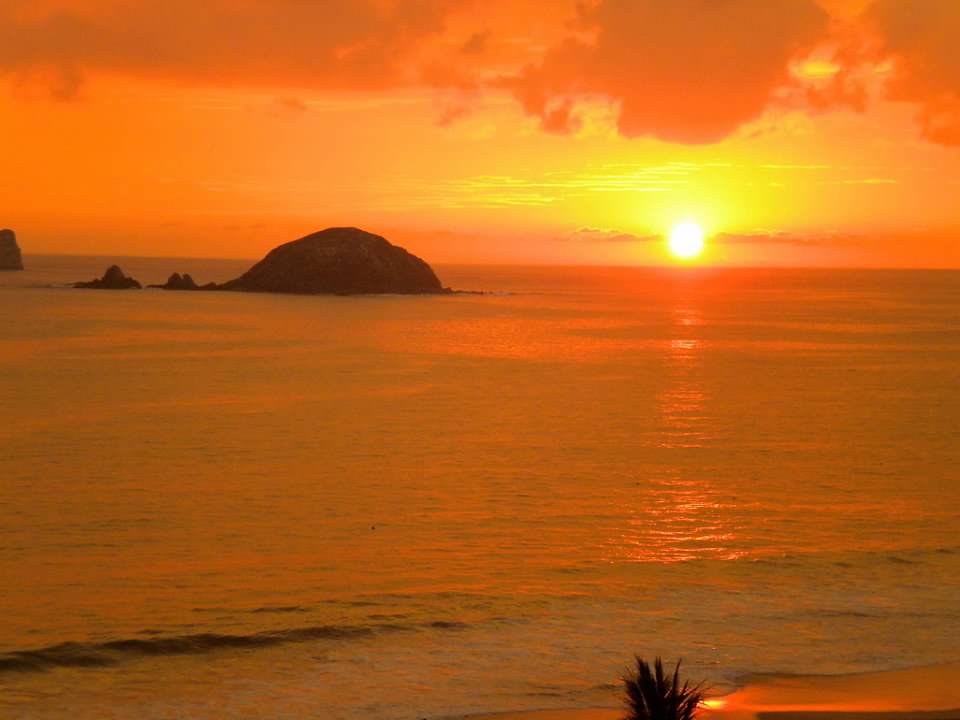
Time to say adios? Final year at the Krystal? Maybe.
Trump’s hostility towards Mexico won’t endear gringos to the Mexicans. I sensed no specific animosity towards us, mostly a practiced indifference. Friendliness exceptional.
The hospitality workers of Ixtapa less fluent in English, even veteran servants seem to have lost their articulate edge. As if to match, I have lapsed in Spanish as well, which is to say delinquent with Duolingo, and so it seems any semi-fluency on my part goes a long way communicating with the younger and newer servers.
Benny the famous entrepreneur of fishing tours told me more than once that when he was young he learned if he was ever going to make anything of himself — make any money — he needed to learn English. He has done well. Three boats — two pangas and a cruiser — he still patrols the beach on foot along Playa Palmar seeking clients, lately shadowed by his son Benny Junior, who apparently didn’t listen to his dad and speaks English just a little like a lot of young men his age. Benny the elder says business is slack because fewer and fewer gringos sign up for fishing excursions. He says Mexican tourists aren’t interested in fishing. He offers whale and dolphin watching but it doesn’t make up for the slack in fishing trips.
We are no help. Over twenty visits to Ixtapa we have gone fishing half a dozen times on one of Benny’s boats, captained by one of his chief boatsmen, and caught more than our share of black tuna. We’re fished out. If we go to Las Gatas for a shore lunch we choose our fish at the market, and it isn’t black tuna.
We have never signed up for a big game excursion for sailfish. Last year on the Zihuatanejo pier coming back from Isla Las Gatas we witnessed a gang of eight guys heave-ho and trying not to drag an enormous sailfish hauled in on an excursion boat that afternoon. It took eight guys twenty minutes to haul the big fish the length of the pier to hoist it by the tail and weigh it and display it to us gawkers under a gallows. I forget its exact weight — a zillion kilograms — a number too heavy to comprehend. The guy who claimed to bring it in said it took two hours. The captain, who likely did most of the heavy lifting those two hours, concurred with what the guy said. The fisherman and his buddies from the excursion seemed giddy with pride and glee and posed for pictures with the upside down beast. Spectators on the pier remarked it was the biggest catch they ever saw. So big its sword nose was bent in half on the concrete pier deck.
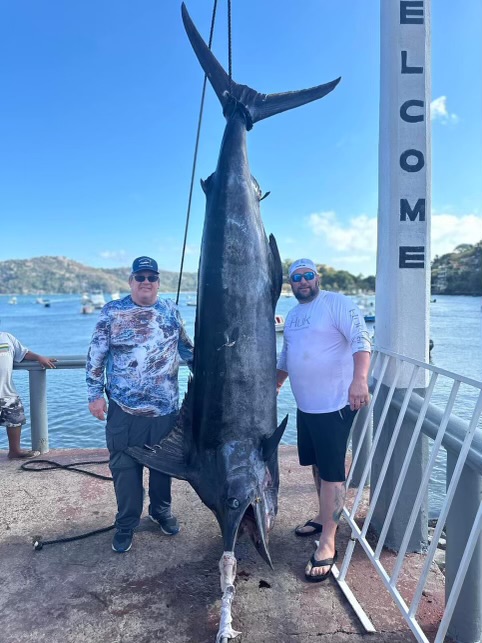
It made me sad seeing this magnificent beast humiliated. What happened to the corpse? They say it got donated to be butchered for tacos. They say sailfish is too bony for steaks. The fisherman got his trophy photo, which he presented to the General to proudly display on a pillar at the General’s sports bar. I think of it as a grand waste of sea life for the amusement of an American tourist. To each his own.
We tell Benny maybe we’ll sign up for a boat ride. A ride down the coast past Zihuatanejo Bay can be relaxing, but the sightseeing part of it lost its allure after the third time around. There’s a small archipelago of humpy, barren, rocky islands past the mouth of the bay towards the airport. Saguaro cactus grows six to a dozen feet tall grow on the craggy cliffs along the ocean side of Islas Las Gatas, which you can only see from a boat.
Las Gatas isn’t really an island but they call it that. It’s really a peninsula at the southern mouth of Zihuatanejo Bay accessible by boat. Tourists take a water taxi across the bay from the Zihuatanejo pier. The bay is immense. Between the city and its three beaches and the so-called island of Las Gatas is a rugged strip of wild real estate with no road or official trail. It isn’t the Darien Gap and can be hiked with proper shoes and arduous patience, but in the heat of day the effort will exhaust you for your beachside day trip and to my knowledge there are no one way tickets for a water taxi from Las Gatas back to Zihuatanejo pier.
We used to make at least excursion each year to Las Gatas with some gringo friends we met at our hotel who came down to Ixtapa each year like us. In the morning about nine we would ride a bus to Zihuatanejo. The buses run every few minutes on the main boulevard along the hotels, essential transport for the resident workforce of the region. Not much more than oversized step vans with seats and windows, these buses chauffeur young, old, men, women, all the people without cars who go between Lazaro Cardenas to the north and Petatlan to the south through the Ixtapa Zihuatanejo corridor, a population of about 200,000 souls keeping busy. Riding the bus has always been one of my favorite pastimes checking the real pulse of this place. Few gringo tourists ride the buses, but those who do know where they’re going and why. Roxanne and I used the bus to independently explore beyond the Ixtapa hotel campus and take day trips into Zihuatanejo el centro to see what the day life was like.
Our group excursions to Isla Las Gatas with Bob and Rose and various other pals from the hotel would start our adventure on a bus into the heart of Zihuatanejo, Downtown Mexico, to the mercado central, a roofed labyrinth of vendors of fresh meat, fish, produce, spices and wholesale sundries like vanilla. As Rosa’s shrimp booth we would choose a dozen or so jumbo size shrimp, and while she tripped the veins we would peruse the bins of the fish dealers to pick out red snappers and mahi-mahi, which they would filet for us at no extra charge. Our seafood packed in plastic bags of ice we would exit the market to the central taxi stand, and we would hail a couple of taxicabs to ride across downtown to the embarcadero at the pier of the harbor.
Adjacent to the navy station at the gateway to the pier we would purchase blue round trip water taxi tickets to Las Gatas. We prefer the blue ticket water taxis to the white ones because the blue are more reliable. The taxi is a standard, no frills fiberglass panga boat with a capacity of about ten passengers. Young men and boys hang around the pier to assist passengers with the awkward boarding and unboarding and expect a few pesos for their service. The boat captain collects the half of the twin tickets and reminds us to watch our heads and we duck under the roof as we slide onto the benches in the cabin. uides the craft by outboard motor through the anchored vessels moored in the harbor and out into the bay for a fifteen minute crossing of open water to the strip of peninsula at the southeast point of the mouth of the bay. The view from the middle of the bay all the way to the other side tells a panorama of habitation rising from the three city beaches into terraced hillsides, a city in a bowl crested by villas backdropped by wooly green mountains, sailboats and jet skis on the water between beaches, the habitation like illusory monuments hanging off zigzagged cliffs. From a distance Zihuatanejo looks like Paradise City.
On the other side we would disembark at a small concrete pier where more young men and boys reach out to assist us for pesos like valets at a car park. We tote our go bags and our ice bagged seafood down the semi paved path around the edge of the steep peninsula towards the ocean. Facing the jagged breakwater of lava rock and dead coral at the edge of the mouth of the bay a long stretch of sandy beach stretches almost a mile to the jagged edge, and all along the beach from the edge of the sand is a succession of canopied cantinas open for business. Asking for business. We get there early because by noon the place is jumping with daytrippers.
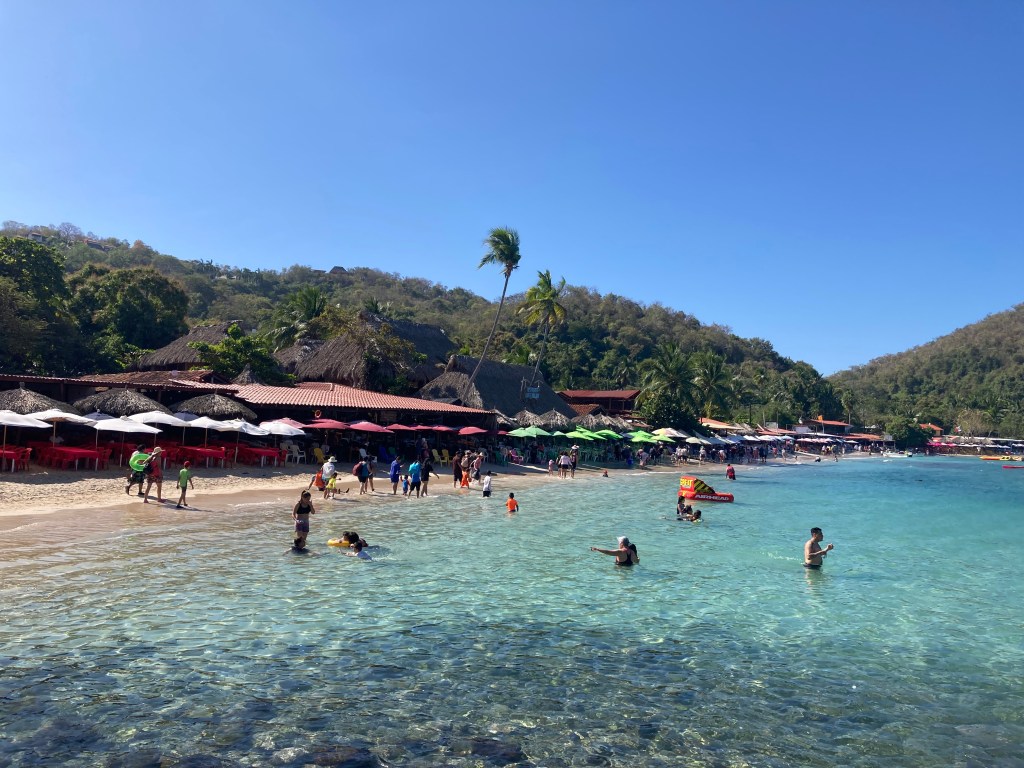
Cruise ships used to dock at Zihuatanejo for day trips to Las Gatas. Not so much any longer. Roxanne and I first went there directed by the vacation package people with whom we booked our first couple visits to the Krystal. We tried snorkeling but learned the fish were dull and the coral long dead. We came back on our own just to swim in calm waters and drink beer and walk the full beach, people watch, something to do off the beach at the hotel. When we made friends with Bob and Rose and booked fishing trips with Benny the excursion included, at a discounted extra price, a shore lunch at Las Gatas where our boat captain would hook us up at one of the beach cantinas to cook up our catch and serve it with drinks and fixings from the menu. When we felt fished out and tired of tuna we devised our customized excursion (Bob and Rose’s idea) to bring our own shore lunch bought at the market and arrange a cantina to reserve us a shaded table (or two, some years there was about a dozen of us) with a few beach chairs to take into the water and cook our shrimp and fish to order.
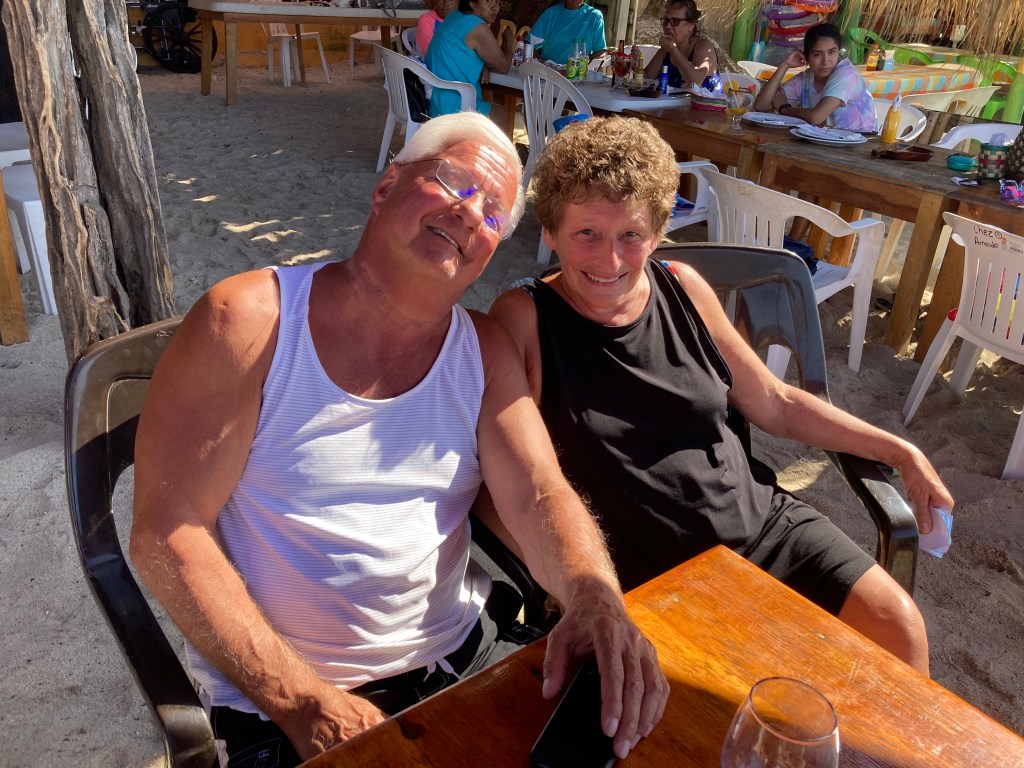
Based on a few years of trial and error founded by our experience from Benny’s boat captains we established a connection (Rose’s cell phone) with Chez Arnoldo, third cantina from the front. Bob and Rose think the host and manager is named Chaz. We would arrive around 11:00 and Chaz and his crew would be ready for us and our sacks of seafood. From our front row tables we watched the cantinas come to life as the beach swelled with the visitors arriving behind us on the water taxis from Zihuatanejo. With our first round of margaritas we observed as the grocery delivery boat beached in the sand with its load for the day. The kitchen grilled our lunch while we floated in the gentle waves of the volcanic lagoon. We bought Victoria beer by the bucket. At lunch time we feasted on butterfly shrimp in three styles, coconut, garlic and the chef’s sauce. Mahi mahi Veracruzana. Red snapper steaks in garlic. All served on platters with rice, beans and salad with salsa and chips with ceviche and fish taquitos. With the lunch hour so much on the beach front came to life. Jewelry vendors with their sample boxes entertain the ladies from table to table. Masajistas pass through offering appointments at the cabanas down the way. Cupped fruits. Ice cream and shaved ice. Crafts and trinkets. Hair braids and beads. Henna tattoos. The vendors pass through like Playa Palmar only more condensed. Some of them like the jewelry guys might well turn up on Playa Palmar before day is done.
Around three while the sun is still high we tally la cuenta with Chaz and pack our beach bags and thank him and all the servers and cooks. Gracias all around. As usual we pay in cash. What we saved bringing our own fish we easily spent in tips, and the exquisite service amid the daily surge of hungry and thirsty tourists was worth it. The last water taxis leave at six. We try to leave before four to beat the rush and get back to the Krystal for sunset at a leftover palapa or check our phones on the balcony. We do not ride the bus home but take taxis from the Zihuatanejo pier back to Ixtapa because by then we are tipsy and a little exhausted from the sun, another hard day exploring the heart of a Mexican vacation.
This year we did not go to Las Gatas. No Bob and Rose, no sense. Just the two of us? Las Gatas meant more than just a day trip, it drew us as a ritual pilgrimage of celebration of being at Chez Arnoldo one more year. Together. Besides Bob and Rose our excursions included at least half dozen other compatriots from the Krystal, all known to us, friends and relatives down for the week or two more than their first year. All comrades celebrating a day of adventure in a foreign land on the sea. Health issues, aging, economic reasons and personal preferences reduced our numbers after the pandemic to just us four last year. Bob and Rose had their cellphone connection with Chaz, not Roxanne and me. Going to the fish market for just us two wasn’t economical, and we learned from earlier experience the food off the standard menu wasn’t worth it. The pilgrimage for just us two lacked special status. Old times sake didn’t occur to us. Without Bob and Rose or any of the others the whole daytrip seemed pointless. Lonesome. Almost lonely. Not worth the hassle.
Roxanne misses the social aspect more than I do. Bob and Rose had to cancel for health reasons this year. We’ve hung together with them at least twenty years. I like them because they mind their own business, even if they like to talk about themselves — there are several stories they have told so many times I could recite them back word for word, but I won’t, as if they’ve confided in me because I won’t forget them and won’t rat out their simple worries for a cheap story about the human condition. They are honest people with liberal opinions who bring to their vacation in Mexico a respectful place to reside in the tropics away from the turgid winter of Minnesota, as well as away from the rat race back home in the middle of America. Much like Roxanne and me. Missing them reveals to me a greater absence of isolation. Not having them around doesn’t make me seek new friends. Roxanne thrives making conversations among the other snowbird gringos at the pool. I’m not as adept. The gap left by Bob and Rose is insupplantable, notwithstanding their extroversion attracting a variety of aging boomer vacationers along the way. Bob and Rose were good mixers. They didn’t wear their liberal hearts on their sleeves, and they were good guests at the hotel.
Roxanne reports back to me what she hears from the gringos who hang out at the pool. They are a subcommunity of repeat vacationers who, like us, retreat to the Krystal Ixtapa in the dead of winter from more northern North America. Some more Minnesotans not from the Twin Cities, like Bob and Rose. Some North and South Dakotans. The rest Canadians from Manitoba, Saskatchewan, and Alberta. The pool people. Familiar faces. Names like Dennis and Mary. A very civil faction of people who prefer to hang around the pool under umbrellas than down at the beach under palapas, like me. Word among the pool people this year laments the passing of the guy known as Big Mike that past winter. Several other of the usuals were gone from the Krystal, defecting to the Emporio, they say, because the Krystal was getting too Mexican.
I see the same dwindling proportion of gringo vacationers and guests to the rising tide of Mexicans as the natural flow of society favoring the Mexican middle class and the decline of the influence of the American baby boom generation. I don’t see this as any reason to abandon this hotel or this location to retreat from harsh winter or the inanities of the American world. What I fear is feeling backlash from Mexicans who might resent a gringo attitude of lost entitlement if it got around gringos liked Mexico but didn’t like Mexicans.
Unless they are servants, of course.
Roxanne reports that the pool people like to talk politics in a form of code that aligns with the MAGA movement. They still reargued against the pandemic lockdowns of yore, and that damn Governor Walz of Minnesota or Premier Trudeau practically destroyed our economy with dictatorial powers. And what of lives lost or saved? Hell, people die all the time! And you can’t prove anybody was saved. They hail the return of Trump. The tariffs will do us good. The Canadians relished becoming the 51st state, rolling in that real cash.
I overhear them myself when I’m at the pool or standing at the bar. They talk more brazen than subtle, maybe lulled by the padded walls of the prevailing Spanish, maybe emboldened by victory over the dreaded radical left, or maybe just a little tipsy and overconfident nobody would disagree. I play dumb — or deaf — and act as if sensory impaired. Roxanne is known as a socially astute mixer but I pass myself as a naive simpleton, a bumpkin and a bookworm disengaged from any kind of popularity. I’m sure they don’t know my name — I’m Mr Roxanne. Roxanne doesn’t endorse their political musings, or their social attitudes or conspiracy theories, but gives them a listen just to have people to talk to and to give a listen to somebody else’s gripes. I’m a little disappointed to hear them breach the customary No Politics Zone, an unspoken tradition among all visiting gringos dating at least to the Clinton administration, through the Bush years, Obama, Trump’s first term and frailly carried through Biden. Sometimes you might hear a Republican conservative caucus having dinner, and since the pandemic I have overheard allusions to a stolen election, but overall, except for occasional unasked-for praise of Trump by moot, supposedly disinterested Canadians, people mostly leave their American politics at the Mexican border. No red MAGA ball caps. No campaign t-shirts.
After all, none of us has any say in the elections of Mexico.
I tell myself it’s too soon to tell how it will all turn out because he just got inaugurated, Trump, and maybe it won’t be so bad with the trade wars and he’ll show some presidential mercy once he settles back into office. The country survived four years eight years ago and the world was no worse for wear, given a worldwide coronavirus epidemic that killed millions and stopped civilization in its tracks, which could hardly be blamed on Trump. His malfeasance in office in that epoch was supposed to be proof he should have never been elected at all, and yet there he was, back in that Oval Office behind that resolute desk, or speaking from one of his golf resorts, proclaiming away every liberal principle in the canon of American government.
I didn’t sit well in the middle of a groundswell victory celebration of MAGA in the heart of Mexico, so without our liberal friends Bob and Rose to confide in I meant to keep to myself under the palapa on the beach, reflecting and observing, reading, and watching the theater of beachgoers and the ocean waves rolling upon the sand.
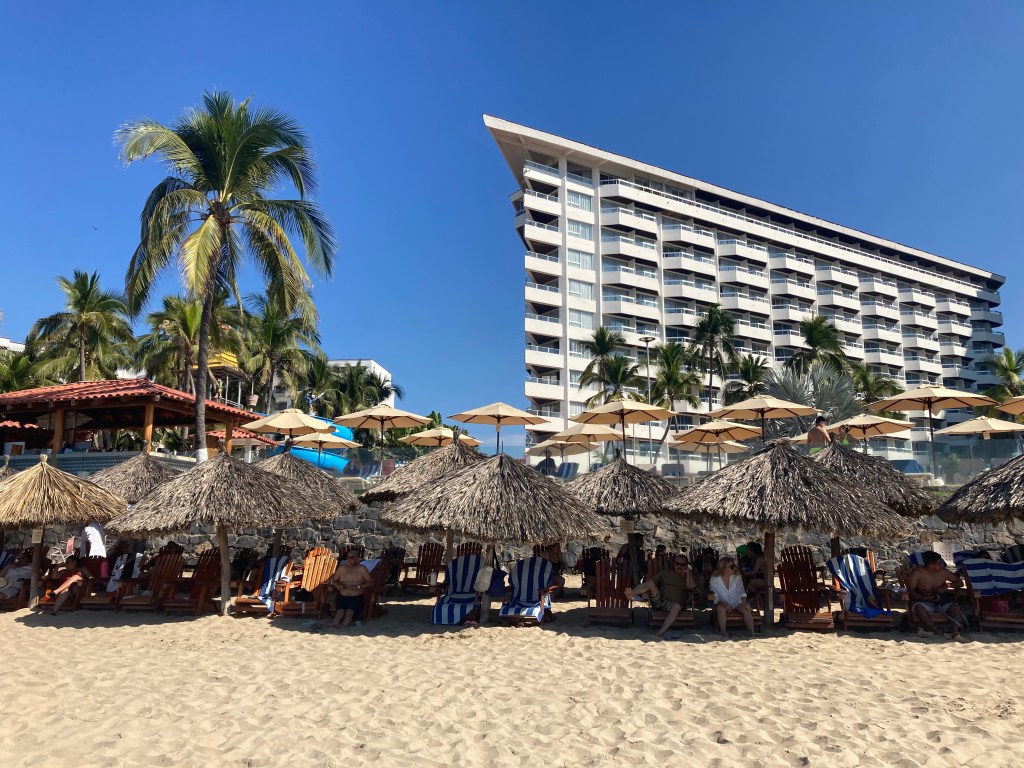
Those four weeks of meditation on the beach gave me pause to indulge in some paranoid depression. When I wasn’t worried about what it would be like back home, my impressions of my immediate surroundings left me anxious each day whether my welcome in Mexico could run out at any minute.
The year before, on a typical afternoon at the beach under the palapas there was an incident between me and a middle-aged Mexican couple. They were at a nearby palapa with their young teenage kids, enjoying two or three days at the ocean. They played tunes on a portable system. Gradually the dad raised the volume. I caught his eye and made a calming hand gesture to request he turn it down, if just a little. The Krystal posts a notice in Spanish and English prohibiting personal music devices without earphones, but it isn’t enforced strictly, only when the music is audaciously loud or two or more devices compete like a battle of the bands. I asked the man if he would turn it down, just a little. Instead his wife cranked it up louder and he began to dance, coming towards me. The two teenage kids grabbed their towels and took off for the pool.
As he approached me the man did not look happy. In English he said he was on vacation and had a right to have fun. He had been drinking. Behind him his wife who turned up the volume yelled at me. “This is our country. Go back to your own country.” The man stopped his approach before he arrived in my face. I remained in my chair until he retreated and then I went away to the hotel to cool off and take a whiz. When I came back I observed from the patio above the sea wall the head of security, a decades long stalwart named Andres, was down at the man and woman’s palapa holding a calm conversation. I waited until its conclusion to give the scene a chance to normalize before I reoccupied my beach chair. No more eye contact was made. The music played muted, then went away.
Within the hour that same afternoon I was in the pool when I saw the man wobbling across the wet pool deck. His foot slipped and he went down on his back. Immediately he stirred but couldn’t stand up without help. Several guys came to his aid. Andres from security strode to his side to escort him someplace he could sit. I talked to Andres later that afternoon, and I tried to apologize for the incident, but he waved it off. “Drunk people do stupid things,” he said. The next day I saw my erstwhile nemesis in the crowd in the pool. We made no eye contact and I kept a distance. He looked sober. Tranquil. I kept an eye out for his wife. In a day or so they were gone. I learned later that our friend Rose witnessed the altercation and ran upstairs to get Andres because she was scared the guy might beat me up.
Ever since I’ve been self conscious of the impressions I conveyed to the Mexicans — servants, proprietors, taxi drivers, and especially tourists, who were under no obligations to be friendly. I keep seeing that angry woman at the beach yelling, “This is our country. Go back to your own country.”
It’s eminently clear that the Krystal’s business model relies on domestic Mexican tourism and not so much the gringos from up north like us. Nothing personal. The Mexican market has matured along with the rise of the middle class, who can afford three day weekends or a week at the beach, nowadays as normal as a summertime jaunt to a rented cabin along a lakeshore in northern Minnesota for any average soul. The decline in numbers of snowbirds seeking refuge from winter in the Mexican tropics has easily been supplanted by leisure seekers from towns and cities within driving distance. The Krystal offers all-inclusive package deals to attract occupancy, and the place is near full every week with Mexican families and couples, a few gringo retirees or near retirees testing where they might spend their retirement winters, and maybe a few North American vacationers looking for midwinter adventure someplace new they heard about. The retirees will eventually die off, and the ones soon to retire think twice about the amenities and potential risks of calling Ixtapa Zihuatanejo a winter home, while the one-off gringo vacationers discover for all its charm there is no adventure except the lazy kind, the ocean and places to eat.
There used to be, several years ago, a tour guide — El Guia — who canvassed the beachfront palapas trying to sign people up for tours to the nature preserve south of the airport. It sounded interesting but I resisted commitment. He got upset. “You gringos, all you do is sit around on your fat asses and drink away your day.” He had a good point. He made me feel guilty. I asked around and learned El Guia had a good reputation, and there was indeed a flourishing nature preserve to explore if you like that sort of thing. He grew up around the Krystal, as his parents both worked at the hotel. Roxanne and I talked about it and decided next time El Guia came around we would sign up. We never saw him again.
The years we first started coming down, Ixtapa Krystal was not only a refuge from Minnesota’s harsh winter but a place of relaxation and rehabilitation from high stress and anxiety at my job. Retirement pretty much solved the stress and anxiety, though I took several winters for this to sink in. Freedom to do little else than swim and laze around at the beach seemed ideal for awhile. I got an enormous amount of pleasure reading done, and a considerable amount of writing. The pandemic allowed this laziness to influence my everyday life at home, and it gradually became clear there was nothing in my life to recuperate and restore myself from, and most of the rest and relaxation I was getting each winter came at the expense of an urge for some kind of greater vitality. Something more than a field trip into Zihuatanejo and a day at Las Gatas.
Compared to vacations and trips elsewhere, with the exception of a visit to Mexico City our time spent in Mexico constituted little other than beach time. In the capitals, provinces and cantons of Europe we hustled around exploring sites. In Mexico City we visited Frida Kahlo’s blue house and the murals of Diego Rivera. True, in the early days we walked the blocks of Zihuatanejo to get to know the backstreets of Downtown Mexico. And we took field trips to towns like Petatlan and Troncones on occasion. We passed up tours with El Guia. There is supposed to be a Nahuatl excavation site in the hills, but people who have gone there say the excavation is in such an early stage there is little revealed to see.
Gazing at the perpetually rolling ocean that month I slowly concluded that I needed stimulation beyond what I brought with me in reading material from home, and Ixtapa Zihuanejo offered me nothing more. I didn’t need to recuperate. I was already relaxed. No more craving to hunker down, hide out and hole up. I realized I was all caught up with my own rehab. I no longer needed a place of anonymous seclusion to meditate the midwinter state of some complicated existence, but rather found myself in the enviable situation of feeling as satisfied with my life so far as I could ever reasonably expect. I had found a beautiful beach on the Mexican Pacific where the sun shines just about every day and the daily high temperature averages 87 degrees Fahrenheit, compared to mostly cloudy and lows below zero back home. I was ever grateful to have found comfort and joy all the winters at Ixtapa Zihuatanejo. We have been well fed and the lodging is of the highest hospitality. To consider breaking our traditional relationship to this place meant searching for somewhere else just as good or better.
Instead of our usual six weeks at the Krystal we cut our time short to four weeks, with intent to turn around in a week again and fly to San Juan to spend two weeks exploring Puerto Rico in a rented car. This is something we would not dare to do in Mexico. In Mexico City, being a big city, we relied on public taxi. In Ixtapa Zihuatanejo we relied on foot, buses, taxis or tour guides with cars and vans, and thus we never ventured very far from our hotel. No road trips.
For one thing the roads and highways of Mexico are notorious for car crashes. Our gringo insurance carrier would never permit us to rent a car in Mexcico without extra expensive coverage. Secondly the countryside surrounding Ixtapa Zihuatanejo seems dangerous. Armed and in full combat gear, federal troops establish checkpoints on the main freeways leading in and out of the district, which assures us only that they are looking to interdict somebody, and those somebodies might do us harm. There is much talk in North America about the cartels, crime and a high murder rate in Mexico, even if it isn’t spoken about between the Mexicans and the gringo tourists. Roxanne and I witnessed a murder a few years ago, on the restaurant plaza in Ixtapa as we paid our check for dinner, when a small kiosk vendor in the plaza took a bullet to the chest from a shooter in a baseball cap who was purported to have argued earlier in the day with the vendor over a kickback payment to the shooter equivalent to $20 USD. The vendor’s wife was shot in the face. Their young daughter was unhurt physically but obviously traumatized. The shooter got one more shot off, at a blank wall while he ran against the grain of the dinnertime crowd and disappeared towards the parking lot behind Ruben’s hamburger casa. We used to run into retired couples from the Pacific Northwest and western Canada who drove all the way down to Zihuatanejo in their RVs and campers and said they thought nothing of the danger traversing two thirds of Mexico north to south, and then back in the spring. We haven’t run across those types in years.
Even twenty years ago we thought driving to Ixtapa unthinkable. Not that we would fetch any ransom if we were seized by kidnappers, but how would they know unless they tried? With the political tensions only growing more intense between our two countries the potential for confusion and misunderstanding could only amplify resentment. We felt reasonably safe and secure within the Ixtapa Zihuatanejo district, broadly named Lazaro Cardenas, but we would never feel free to drive a car up or down the coast or up into the mountains to explore the countryside as we have in France, Germany, Switzerland, northern Italy, Czech Republic, Canada and Ireland. I would never care to drive across downtown Zihuatanejo.
A couple of years ago, to celebrate the end of the pandemic, after our six weeks in Ixtapa we spontaneously took off again, this time for Hawaii, where we spent two weeks on the Big Island, poking around in a rental car. We’re feeling cloistered and confined in Mexico. We need less rest and relaxation and more physical stimulation only more flexible mobility will procure. Hence our curiosity about Puerto Rico — not as far away as Hawaii, or as expensive we have heard.
It would be sad to kiss off Mexico. There’s a lot to love. For me it’s proven the perfect hideout from the American rat race. Nobody really knows me and yet I am assumed to be of good character — good enough to trust for la cuenta. I have never double-crossed their hospitality or disrespected their honor, and I am grateful for their respect for my privacy. For more than twenty years they have granted me free, unlimited access to about three miles of clean public beach. A chair under a palm palapa on that beach has been all the personal space I required to live most of the day for up to six weeks every winter. My driver’s seat. I didn’t need to get a car and drive up to Chilpancingo, capital city of the state of Guerrero or any such day trip, because that wasn’t why I chose to retreat into Mexico the most stressful time of my year. I would have liked to drive up into the Bajio mountains north of Mexico City to visit San Miguel de Allende, but all along I feared what could go wrong. To witness a murder in my happy place got me to articulate to myself why I didn’t tour beloved Mexico the way I did Ireland. I think about my confrontation with the couple on the beach over the music volume and I wonder if an escalated misunderstanding isn’t inevitable the more I hung around.
Nobody would know we aren’t worth kidnap ransom, but somebody might try. With Trump stirring a trade war there could be dozens of motives to shake us down or chase us away. I’ve already calculated in my head the loss of gringos to the tourist economy is already being made up in domestic traffic. I was losing my anonymity and security of feeling as invisible as I wanted. The MAGA dingoes and right wing Canadians would have to fend for themselves in the winters to come, and Roxanne and I pondered politely the prospect of not coming back.
After all, life here was easy. And predictable. If insanity is doing something over and over expecting a different result, then this was my place of sanity — coming here year after year expecting the same result. The weather was almost always sunny or partly sunny, and hot. The ocean was perpetually elegant. There is a lot to be said about doing nothing. The serenity is addictive.
The vendors trudge by in the sand selling trinkets and souvenirs, Yeti mugs, t-shirts and beach wraps, sunglasses and hats. They offer to bead and braid your hair or illustrate your skin with henna tattoos. One lady, Margarita, sells home made tamales every day lugging an old Penguin cooler up and down the beach every day. She passes the palapas at the Krystal about 3 and 3:30, and I highly recommend her tamales, all fresh, wrapped in banana leaves and juicy. There’s a rule against eating meals at the palapas but Margarita’s tamales seem to be exempt.
Hector hauls a big camping backpack and hawks his hand carved sculptures he fashions from ironwood and polishes with brown Shinola. I have purchased over the years a turtle, a whale, a palm tree and a buffalo. Other vendors sell snacks such as peanuts, pork rinds, coconuts and fresh shrimp. Solicitors in white uniforms with notebooks tout fishing excursions like Benny’s. Young men and women pass out flyers hyping the local disco. Photo service agents solicit clients for their photographers.
The most fascinating buskers are the musicians who trek the sand in cowboy boots and cowboy hats in twos and threes in matching western shirts, carrying guitars, accordions, sometimes an upright bass or snare drum and cymbal, offering to set up around a palapa to sing and play favorite Mexican songs. Whole families chip in to hire them and usually sing along.
The entire beach called Playa Palmar forms a wide sandy horseshoe along three miles of Ixtapa Bay, bounded by steep, rugged hills of volcanic rock at each end. We walk this beach two or three times each day. The Krystal sits exactly in the middle of the beach. We can go either way. We usually go left amid the busiest half. We pass the most populous hotels and condos, where the shoreline and surf are jumping with bathers and walkers. Kids sculpt sand castles and bury their dads horizontally up to their chins, or just dig holes to be filled with the flow of the waves.
Couples pose for selfies against the surf. Girls and young women pose like glamor models for phone cameras or photography services. Volleyball nets front each hotel and condo complex, balls supplied. The Krystal and Fontan hotels provide balls and portable goals for sand soccer. American footballs get tossed like Hail Marys over the crowds. Frisbees get tossed and pairs play catch with Aerobies, a round, flat, hollow, aerodynamic thing like tossing the rings of Saturn.
Some play bocce ball, pitch horseshoes or toss those bolo balls connected by cords at a three rung rack target. (Bean bag cornhole tossing hasn’t caught on yet.) Some just jog or run on the flat wet sand. Others like us just walk back and forth enjoying the ambience of the beach activity.
At the far left end of the beach is the resort called Pacifica. I single them out as particular and peculiar. They are the most aggressive at trying to sell time share memberships. Their campus straddles a boggy stream that runs from a mangrove forest through the Ixtapa golf course. On the beach side of the stream is the low rise hotel with its social center, restaurant, swimming pool, lounge chairs, recreational amenities and palapas facing the flat beach. On the other side of the stream bed is a steep rocky cliff with terraced levels of condominiums rising hundreds of feet above the beach and facing the sea. Guests at the resort cross the boggy stream via footbridge or ride a cable gondola between the main resort and the condos on the terraced cliffs.
The tides in recent years have not treated the Pacifica’s beach front kindly. They have buried a wall of sand bags behind a battalion of thick wooden pilings to keep the sand from eroding all the way up to the edge of the deck of the main hotel. The tide is winning.
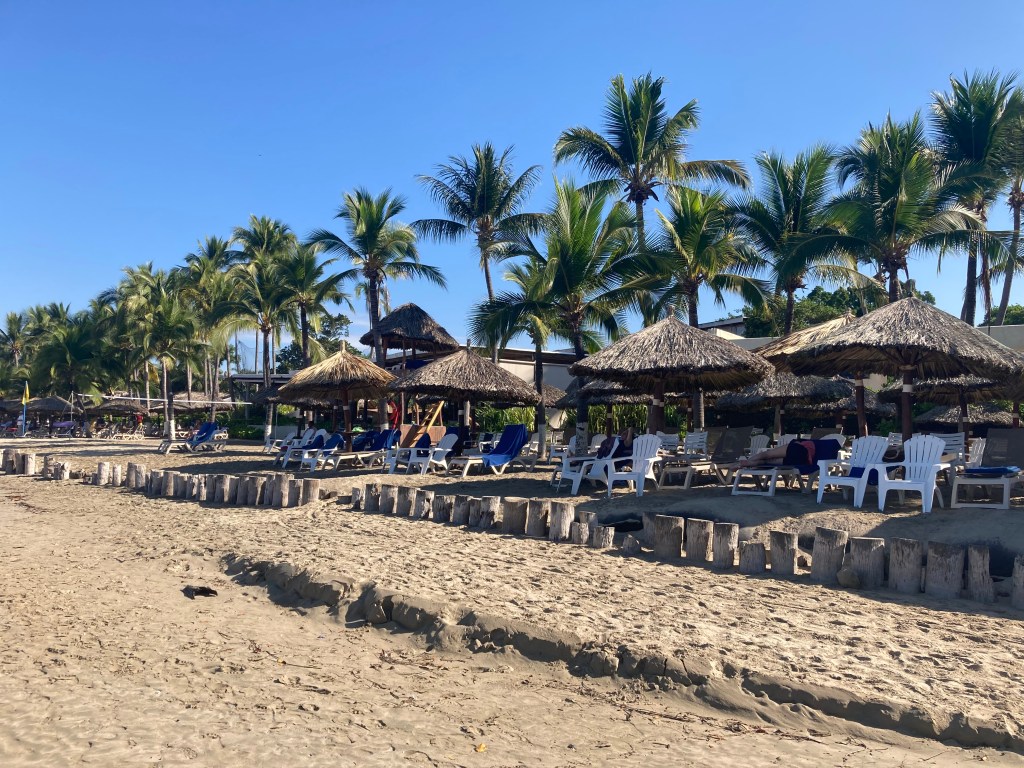
Most problematic is the boggy stream coming out of the mangrove swamp. The water is brackish and often smells like poop. Sometimes it swells enough from rainwater in the mountains to flow into the ocean carrying organic pollutants that float in the tides and grosses-out would be swimmers for a hundred yards from the mouth of the stream.
This year the Pacifica employed a daily gang of laborers with shovels wheelbarrows to dig sand off the beach to build a dike to hold the stream back from the ocean to contain it from polluting the swimming beach. The brackish swamp water builds up behind the dike and the smell gets poopier. Then overnight the tide washes away the sandy dike, the stream courses into the sea along the rocky cliff and crappy matter spoils the swimming. The shovels and wheelbarrow crew goes back at it the next morning. It’s a losing cause.
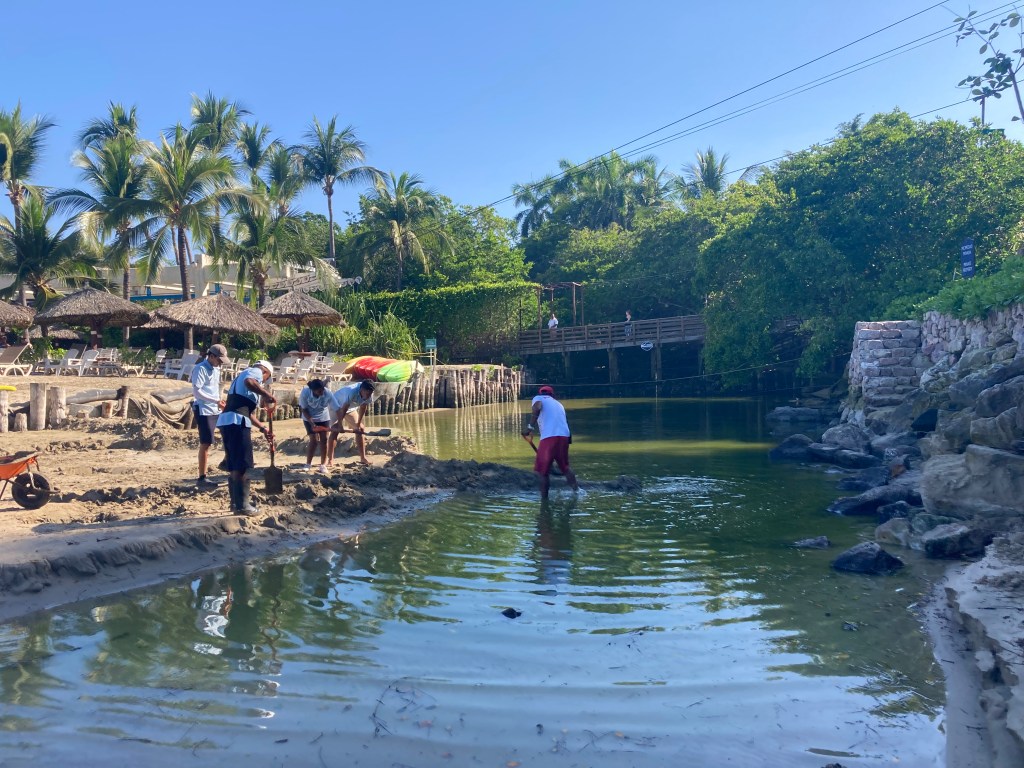
Yet I have overheard a crew chief from the hotel tell onlookers it’s an effort to contain alligators who dwell along the golf course from venturing onto the beach. Common sense would say any determined alligator can climb over the scrawny dike, and anyway there is a wire fence further upstream at the golf course to restrain the gators.
Clear to any observor the Pacifica faces an existential crisis. In that environment nobody should buy a time share, and in good conscience they should stop selling them. But business is business. Perhaps they are a metaphor for the destiny of Ixtapa.
The pity for Roxanne and me is that’s the beach front on Playa Palmar with the gentlest surf for swimming. Most days the surf in front of the Krystal is far too rough for a leisurely swim. If the water is clear down by the Pacifica we will swim in the ocean. Otherwise we cool off in our hotel pool.
If we walk the other direction, to the right from the Krystal, it’s a mile and a half of rough surf and open, unpopulated sand to the rocky breakwater along the entrance to the Ixtapa marina and the rocky hillside condos and villas beyond. A couple of hotels neighbor the Krystal, and then a couple of cantinas — one the former Carlos and Charlie’s night club, and another one called Tanta Vida which we liked for occasional lunch until they stopped serving fish tacos — and then the Delfinium where dolphins perform but you can’t swim with them any more.
Fronting the Delfinium and facing the broad sandy beach are the six cabanas offering massages until 5 pm. Beyond the cabanas is a swath of public access, mostly vacant because of the roaring surf, and then a series of three modern, bleach white, high rise condominium buildings standing lonely as if unoccupied above the desolate beach. Finally a group of low-rise two-story condos painted in pastel colors reside in a return to welcoming scale adjacent to the marina. The beach ends at a wall of jagged rocks like at the Pacifica three miles away, only no boggy stream, just sand and a steep pile of rocks extending into the sea as a breakwater for the port of entry to the marina, where the yachts dock. There’s a boardwalk with a couple high end restaurants and nothing else, no shops or cantinas. There’s a tower like a water tower with windows purported to be a night club, but I haven’t seen it open for customers in years.
Beyond the marina there are walking trails into the jungle of natural habitat leading eventually to a nature preserve at Playa Linda. There are alligators there too, only they are called crocodrilarios. Beyond the marina along the coast opulent villas layer the modestly terraced hillsides towards the outskirts of Ixtapa, where there is little sandy access to the sea until Troncones.
The walk back from this direction faces the whole length of Playa Palmar, three miles, all the high rise buildings, the low rise infill structures, and the beaches denser and denser with people at the shore the further and further away from the marina. The beach from the marina and fronting the condos all the way to the public access and the massage cabanas is all but virtually deserted except for lonely walkers going the extra quarter mile to walk to the wall and give it a symbolic kick before turning back to their base camp. At public access sometimes someone might pitch an umbrella and set up chairs to sun bathe, but the vast sand in front of the condominiums goes unpopulated except the walking transients. Now and then some inhabitants of the high rises can be seen behind their walled deck lounging around their swimming pool, and once in a while an awkward couple or young parent with a child will venture down near the surf, but mostly that stretch of beach is the loneliest. I can feel lonely there even when walking with Roxanne. And there’s no extra serenity felt in the solitude of that stretch beside the three high rises, as if it were an eerie ghost town of white slab towers with windows and balconies. No wonder we almost always chose to take our walks in the direction of the Pacifica, where the people were and all the action.

Most of the day I would read. Under the palm thatched palapa I reclined and absorbed printed pages. Roxanne too with her Kindle, when not socializing at the pool, though I rely on paper, which means toting six or seven books and four or five back weeks of the London Economist, a newspaper, to catch up the year’s end. This year I caught up further with the Prey series of detective fiction by John Sandford, and three of the more current Navajo police novels carried forward from Tony Hillerman by his daughter Anne Hillerman, and a newer work by the Swedish guy, Fredrik Backman, called Anxious People. For non-fiction, besides stories from the Economist I read a book called All the Beauty in the World by Patrick Bringley, a soul searching tour of New York’s Metropolitan Museum of Art told from a seasoned security guard. My daughter Michel gave it to me for my birthday. For my birthday or Christmas, both in the same month, she often gives me a book evoking history or sociology, and I always read them. If all else failed me and there was nothing left to read, I’ve been slogging the past year and a half through William L Shirer’s tome from 1960, The Rise and Fall of the Third Reich, a fascinating but sorry saga, overwhelmingly detailed, exponentially exhausting and I’m way too self-conscious to be seen reading it in public with a swastika on the cover.
I subscribe to my home newspaper, the StarTribune, which now calls itself the newspaper of Minnesota — used to be newspaper of the Twin Cities, and before that the Minneapolis Star and Tribune. I get the digital edition via wi-fi on Roxanne’s old iPad when I’m away from home and keep up with news from the outside world. In its bumpkinny way the StarTribune does a credible job of collecting and presenting world stories and national events and issues and concerns of governance and national security. They cover state and local news in depth, and I like to know what’s going on back home when I get up in the morning and brew coffee at dawn, la magrugada.
Morning to night, I don’t lack mental stimulation.
I can’t always keep bringing my mental stimulation with me. If I continue to keep reading while I travel I should probably get my own Kindle, or a new iPad of my own compatible with digital books. Physical books take up valuable travel space and baggage weight. Even so, I am dependent on the written word to complete my day. I can write to my heart’s content but I need to take in perceptions formed from word testimony from outside my immediate experience. I need to read to know what I think I know. I need to read to question and challenge what I think. I need to read to enter somebody else’s life beyond my own.
I can read like that at home. I have better access at home. Ixtapa is not a literary mecca or Zihuatanejo a hotbed of libraries and book stores. I used to get an English language daily newspaper from Mexico City delivered to me at my palapa by a vendor named Victor for less than a dollar a day in Mx pesos, and in it was more Mexican news than I could comprehend. Then it stopped printing. Why? Internet, said Victor, who instead sells soccer t-shirts — of which I have purchased four, just to illustrate how many years the paper has been gone.
Maybe I’m better off uninformed about events in Mexico. Ignorant bliss. Easier than fighting through the misinformation credibility of the American White House. Every day I felt a little more scared to go home. The great mess was unfolding with trade wars, meddling in matters of nobody’s business and noninvolvement where participation is crucial, sanitizing language beyond political correctness and calling it Truth Social, the roundup of immigrants, National Guards in select cities, one by one, and a purging and dismantling of the federal workforce with this mercenary coup of bureaucrat stormtroopers called DOGE.
Maybe at my advanced age I should stop paying attention altogether because I have learned over and over it doesn’t do any good one way or the other, what happens happens. I choose instead to use wi fi and monitor news events on the trusty old iPad. If anything, this annual sojourn in Mexico could be a retreat away from America, a detoxifying period of no news is no worries, but it’s not easy to let go. Pop culture connects everybody everywhere. Mexicans use cell phones. Krystal hotel cable TV offers FOX network. CNN international. It seems against my nature to willfully allow others to be aware of anything more than me, even when such knowledge doesn’t reward me with anything tangible, not even lasting solace.
The prospect of presidential pardons of the couple thousand or so insurrectionists who stormed the federal capitol back on Epithany Day January 6, 2021 really pissed me off and proved again in my mind that Trump is every bit the Snake he preached about when he ran in 2016, and now that he has again seized power he will exploit that power to his will, he holds absolute power and the country and the world will reckon with the power they have given him, he is above the law and he will flaunt it, he has no regard for the truth, or for justice, or any abstract set of rules like the Constitution of the United States.
Letting those Jan 6 thugs off the hook actually rewarded what they did and why they did it. Remember the immortal chant: Hang Mike Pence! Forget all that. These are the guys who’ll get recruited by Homeland Security to work for Immigration and Customs Enforcement (ICE) to round up the immigrants for mass deportations. Adios amigos. We will not be replaced indeed.
In Mexico I reflect how much I am among the lucky. I am a white American. I’ve lived a relatively privileged existence. A charmed life. I belong to a class of people who can choose to be immune from social chaos and absolved of any blame. People may observe me and guess I am rich, and I am by relative standards (and by psychological standards) but in the economic scale of the world I’m just American middle class, well protected, secure and content. Anonymous as I want to be, or can be in the metaverse. Unpersecuted. Even my personal and private life is without chaos or turmoil. Yes, I am lucky. How much longer?
My favorite pastime at the beach is getting a massage. One hour sessions at a cabana, three times a week, a mere ten minute walk from our palapa. $400 pesos MX, about $20 USD, plus tip. We tip generously.
It began our third or fourth year we came down to Ixtapa. Set back on the desolate stretch of beach towards the marina, before the three high rise condos were built, next to Carlos and Charlie’s and the Delfinium, Roxanne and I took a walk and discovered that somebody had set up a row of four white army style tents. From the doors of each tent a woman wearing a white uniform waved to walkers on the beach. Uniformed colleagues from each tent stood near the surf, hailing passersby and offering business cards promoting massages at the tents. $200 MX pesos for one hour at the time, about $10 USD. Skeptical, we politely declined but accepted their calling cards.
Seemed sketchy. Reminded me of a scene from the movie McCabe and Mrs Miller where the young prostitutes of the frontier greeted passing cowboys, waving from white tents pitched along the trail (set to a Leonard Cohen song like “Sisters of Mercy”). One afternoon a persistent young woman persuaded us to try it out. It changed our lives.
This is what I will miss the most if we never come back to the Ixtapa Playa Palmar. Masajes. On the beach.
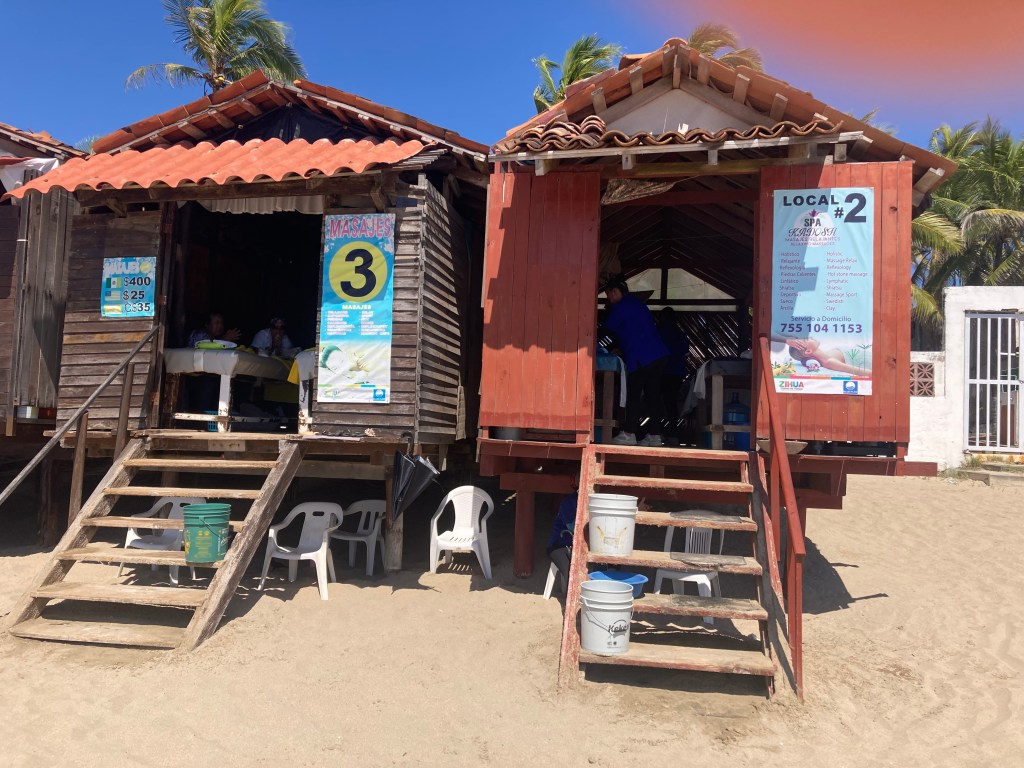
Within a year or so small wooden frame cabanas replaced the tents. Cabin sheds the size of a one car garage, sturdy, open sided with curtained upper windows. Accommodated six massage cots, plus supply shelves and personal cubbies, two chairs and a makeshift desk. Surplus hotel towels and sheets served for linen. Clean. Las masajistas, invariably women though a man or two worked the beach a couple of years and male masajistos work at the hotel spas. The beach cabanas numbered six, numbered 2 through 7, all in a row, side by side. Four to six masajistas worked at each cabana. Never in twenty years were we turned away, and rarely were asked to wait. By the time the beach massages turned popular, Roxanne and I got adopted by a series of preferred masajistas who made appointments with us so we always got in, and even if we were asked to wait or we arrived early it was fun to sit in the chairs under the umbrella next to the cabana stairs and talk with whoever was not busy and taking a break. The first years the tents and cabanas were looked after by local beach boys keeping security and landscaping the sand and hauling pathways of water in buckets leading from the surf to the cabanas. Not many years into the enterprise the young men stopped hanging out, and still no security problems occurred. The women took charge and the enterprise became an institution and from a novelty turned into a ritual.
It wasn’t only cheap, it was a thrill. With few exceptions the massages I received from the first time were textbook. The women were as often middle aged as would be young in their twenties, and administered the massages with the same techniques, and some of them truly put their heart into their efforts and showed skills that were taught at some academy somewhere, although nowhere did I ever see diplomas or licenses on the premises. Most of the time the masajistas wore light clinical jackets like dental assistants or farmacia clerks over street clothes. Isabel wore scrubs sometimes and I called her Doctor because she had extraordinary healing power in the touch of her hands. Over the years we came to know some of them year over year, and as we extended our stays beyond two weeks to as many as six, we visited the masajistas for an hour every second or third day, meaning we set up appointments about a dozen times every season with the same masajistas, who as I said tended to befriend us and deliver masterful massage care. For me it’s the purest thing that unites me with Mexico, the medicinal value of the massage care given to me at the little cabana clinic at Playa del Palmar at Ixtapa.
I first came to Ixtapa seeking a place to rehabilitate my frazzled nerves and stressed out body from my rat race job and being middle aged and to escape of course the soul killing cold of Minnesota winter, if only for a couple weeks, three weeks, a month, six weeks, maybe eight … A massage every few days at the beach with a breeze and the sound of the surf, faint voices en espanol, sometimes music, sometimes Shakira, it was sublime therapy. An hour of bliss at the hands of someone who seemed to be able to determine from her touch the muscles needing special care, needed kneading, and the bones of my spine requiring gentle adjustment. Face down on the table with my face pressed into the cutout, or face up with my eyes covered with a cloth, nothing to see, my mind would drift and my body relax in total vulnerability and trust.
One thing I loved about a session at the masaje cabanas was the code of silence within the cabana. The senoritas whispered sometimes. At around the halfway point of a massage, she might say, “Over,” to get you to roll on your back, and “Finis” when it was over. Otherwise there was no chitchat. This was not a hair salon. Once in a while somebody might come in with somebody and try to talk with her companion, but someone inevitably would shush her and say, “Silencio”.
My first steady crush was a young woman in her twenties named Janeth — they wore name tags in those days. Black wavy hair worn short, deadly black brown eyes, cocoa face right off the cover of a magazine with one small scar left of the cleft of her chin. So pretty she scared me. Despite her European movie star ambivalence she took me as a regular customer and her routine massages felt like sincere effort to go beyond textbook training and provide comfort and relief to the body on the table, me. After three years she was gone. I stopped making appointments and simply showed up with Roxanne and we would go with whoever was available. We learned that everybody was pretty good, capable, and some were better than others, always worth the visit. Always therapy. Always the sound of the ocean and the feel of hands wringing my soul.

Then one year I met Isabel and Roxanne met Rosa. They both worked at number 2. Rosa was late middle aged and gave Roxanne a massage she would not soon forget. Roxanne thought she found a maestra. By coincidence and as if it were fate, I lucked into Isabel. Tall and athletic, Isabel dug deep into my muscles to find the kinks that never went away in my calfs and certain spots just inside my shoulders, and a certain area around my third thoracic vertebra that sometimes makes me feel like I’m wearing a yoke. She could feel where my body most needed attention and she gave extra pressure, not just passing by from limb to limb. She sparked with true effort. She in the end offered along with Rosa to book appointments in the deskbook, and we faithfully returned to them year after year, every two or three days at usually one o’clock, five or six weeks at a stretch. We put our lives in their hands.
I called Isabel Doctor because I believed she had healing talents in her hands. I said she should go to medical school. Freckle faced and energetic, she had long, rippling tangled streaked hair of amber and dirty blonde. Slender and athletic she used to run on the beach after her shift ended at 5, and sometimes she would wave to us if she caught our eye running past our palapa. Over the course of years we met her daughter. She was a single mom. Maybe I overstepped when I urged her to try to go to medical school if she wanted to. I was motivated by a genuine appreciation for her healing touch and expressed myself with the basic American belief that in life one can accomplish whatever one sets a mind to. Isabel would modestly shrug my praise off with a shy smile. I wish I had the means to pay more than lip service towards her education.
Then one year no Isabel. She was having a baby, they said. Maternity leave.
Rosa was still there for Roxanne at cabana 7. Not to worry, she said to me and walked me down to cabana 4, where she introduced me to Zuliema.

She looked about eighteen. A baby-faced, full figured beauty with black black hair and smooth brown skin and vivacious black eyes, she was instantly adorable. She smiled bright as the sun. Her mother also worked in that cabana and communicated with Zuli in sign language. She explained in English her daughter was deaf and mute, could neither hear nor speak, though she could read lips in Spanish. Did I mind? She was fresh out of school,whatever their massage academy.
Of course I didn’t mind. Within seconds of when she first laid her hands on my back I could tell she was gifted. Less therapeutic than Isabel, Zuli’s touch transcended muscles and nerves and skin to induce a bliss so elegant as to breach spirituality. When the hour ended I was almost delirious, hardly able to believe the exquisite attention she gave me. It gave the sign for thank you with reverent applause. I told her mother she was gifted. We set up appointments in her spiral notebook and faithfully I returned to Zuliema at cabana 4 every two or three days for six weeks to receive bliss in silence.
I wondered about that old trope about people who lack one sense like sight develop an acute sensitivity to their other senses, and that Zuli possessed an extra powerful sense of touch. I don’t know. I do know she possessed a kind of aura she infused into me that left me almost spellbound.
The following winter Isabel returned to work and I was cursed to choose between her and Zuliema. They embarrassed me pretending to rival for my favor, and ultimately I booked every other massage with one then the other. One day they fooled me by switching places mid-massage, starting with Zuli and finishing with Isabel, and I failed to detect the difference. The following year we continued to alternate. The year after that Zuliema was absent on maternity leave. The year of covid we didn’t go to Mexico.
The next year Zuli was back but Isabel was gone. Did she go to medical school? No, she simply chose to be a stay at home mom the other women said,including Rosa and Zuli’s watchful mom who worked at number 4, and so on. These past two years I have been enthralled exclusively in the hands of Zuliema. This year might be our last. I savor each session, will never forget the walk along the beach, surf to one side, resorts bordering the other, to the cabanas of massage, a trek of more than a quarter mile from our palapa at the Krystal, a pleasant walk away from the congestion fronting the hotels for an hour massage at cabana number 7 at 1:00 with Zuliema.
Mostly I savored the massage. There was a loving care in the working of her fingers and palms and wrists and forearms to infuse my muscles and tissues with life and vigor and balance and I was happy. Relaxed and vulnerable. Roxanne at the cot adjacent, though I couldn’t tell, the room was mostly silent except whispers in Spanish. No conversations. The sounds of the surf pulsed beyond acres of sand, distant but close enough to underbeat the silence of the room and give context to the random voices from the beach. Of all the reasons I love Ixtapa Zihuatanejo I will miss the most the masaje on the playa, especially the gifted magic of Zuliema. I feel sorry she may never know how beautiful her name sounds when spoken out loud.
It occurred to me how lucky it was that the atmosphere at the massage cabanas was not a haven for chit chat like a hair salon. The quietude and serenity of the sanctity within the massage cabanas enabled me to unplug my mind from the world of mindless chit chat and daydream my soul away with the ocean breeze and the surf, feeling my body reconstituted muscle by muscle and nerve for nerve with no effort from me, simply submission, surrender to relaxation. In a lucid moment of such bliss that past winter it occurred to me I didn’t need to come back to Ixtapa Zihuatanejo any more to escape a stressful, high-pressure life. It was 2025 and I didn’t live a life of stress, or high-pressure. The only reason to keep coming back was a one hour massage for 400 MX pesos, plus tip — twenty dollars USD. Primitive in its setting and with meager resources, the playa masajistas offered the same, or better when it comes to Janeth, Isabel and beloved gifted Zuliema, as one gets back home at a decent spa at five to ten times the price.
At this point I feel a need to emphasize how non-sexual the whole thing is. In the early years, when they operated out of MASH tents and then the frame cabanas, there were crews of young guys hanging out and hauling water and keeping watch in beach chairs like lifeguards. Bouncers. I saw their hairy eyeballs every time I trekked the sand to the threshold for a session. I could understand protection. And far as I know, there was never an incident with a masajista involving an abusive or sexually aggressive male customer (though I have heard tales of a customer trying to haggle down the price) and after the first few years the crew of chicos went away, and still no inappropriate behaviors. No expectations of what some call a happy ending. For one thing, there’s no privacy, all the massage tables are often occupied at once and only a sheer curtain is an option for the shy. And having observed these women doing hour after hour of hard physical labor between nine and five every day, six days a week, I can attest to their physical condition. With five or six masajistas per cabana, that accounts for a posse of thirty or more women who could be summoned by a bell, whistle or an air horn to protect their own. If necessary.
Non-sexual contact. But I would not say unsexy. I could never deny the arousing mental feelings being touched by beauty.
Just like I don’t know who trains them in the art of massage, I don’t know who bankrolls the enterprise. The small strip of beach between the finge of the hotel strip and the sprawl of new condos is not free, though the overhead is cheap. Recalling the early presence of the chico squads it isn’t hard to suspect a cartel of some kind might be at its heart. These days it’s easy to accept the concept that behind every business in Mexico is some cartel. And presuming thus, one simply accepts that it really isn’t anyone’s business who owns the business as long as the beer is cold, the food is delicious and the massage is bliss.
To characterize enterprises in Mexico as cartel usually implies drug trafficking, or human trafficking also. Vice in general. Twenty or so years hanging out along this coastline loosely called Lazaro Cardenas, first one week and eventually as many as six, every year, the only time I witnessed any criminal activity was the night I saw a souvenir kiosk vendor shot to death at the Ixtapa fountain plaza by a youngish looking chico in a red baseball cap — who also shot the vendor’s wife but didn’t kill her and spared their 12 year old daughter– who fired one last shot at a brick wall as he ran into the crowd on the plaza and dashed towards the parking lot behind Ruben’s hamburger emporium and gone. Except for that instance I never witnessed a crime, maybe some shady looking behavior, and one time someone local tried to hack a clone made of my bank debit card — don’t pay by debit card, I learned, locked out of my card by a vigilant bank — but nowhere else did I see behavior indicating commercial behavior under threat of criminal violation.
That I didn’t see it doesn’t mean it doesn’t exist, in plain sight maybe, if one knows where to look. I never brought up the subject even among the servant staff we came to know more than just by first names. (Of course Zuliema would never tell, even if I could ask her.) There was no local newspaper or website reporting crimes. Gossip among the gringo tourists retold the shooting of the kiosk keeper. Patrons at he restaurants around the plaza heard all three shots and one way or other ducked under the tables. Later talkers speculated who shot them and why. Somebody said they heard somebody observed an argument between the kiosk vendor and the punk shooter earlier that afternoon where the punk demanded two hundred pesos and the vendor told him to go fuck himself. They called it a lowlife cartel shakedown. The gringos recalled how an American guy in his early thirties got shot dead out front of a disco at about two in the morning for calling out a local pimp and demanding his money back for a date he wasn’t satisfied with, only proving no matter where you are, nothing good happens after two in the morning.
Widely known but never discussed with locals are the disappearance in 2014 of 42 student teachers in upstate Guerrero on the road to Mexico City, as well as the assassinations of downballot politicians and the bombing of a police station in Zihuatanejo. Troops in camouflage combat gear patrol the streets of Ixtapa, and occasionally the beach, reassurance in an unnerving way. There’s always a hint something could go awry. There are checkpoints on the highway to the airport and points north towards Troncones. Still, there are no reports of crimes against the tourists, snowbirds or expats. We are reminded everywhere to be aware of our surroundings, which makes common sense.
One conversation, though, stands out to remind me of my lingering longtime cynical suspicions whenever I looked out past the city to the foothills of the Sierra Madre del Sur and saw a plume of smoke from a burn pit. Jesus Calderon used to be a senior server at the restaurants of the Krystal Hotel up until his retirement around 2020, ZOZO, a year of change for many people. A year or two before that, during the offseason when Jesus spent more of his time at his campo, his small ranch in the hills with his horses and cattle, a small group of men approached his house one day. They had guns and bound his hands and produced a sheaf of papers they intended him to sign. The papers signed the deed to his land over to them. Jesus said he refused to sign. They threatened to kill him and burn his body. He refused to sign the papers. He said there was no legal way to take his land if he was dead and though he didn’t want to die he also didn’t want to live letting his land to be stolen this way. Besides, Jesus said he pointed out to them, the papers described a different plat of land, not even his, so he couldn’t legitimately sign away somebody else’s land. This stalemate went on all night and into the next day. The men never beat him, only put a gun to his head a few times. They were unkind and rough but didn’t beat or kick him. Jesus perspired into his baseball cap as he recounted this to us one morning at breakfast during a lull, fear recurring in his eyes. Eventually the men blindfolded him and drove him somewhere in a truck and let him go, drove away and disappeared into the dust. He had to walk his way back home. He left it at that.
Jesus was a reliable narrator. We’d known him at the Krystal about twenty years. He was the local union steward and eventually the most senior waiter on the restaurant staff. He spent shifts hustling back and forth on the beach front hustling buckets of Modelo and pina coladas to the palapas. He paid his dues and trained others when they were new in the art of hospitality and the science of customer care, which served the hotel well and set standards making it a desirable place to stay. Jesus was a professional lifer and made good tips and over the years at the Krystal, which pre-dated our first impressions of him, got himself a small farm in the hills where he liked to ride his horse and watch over his half dozen cows. A handsome caballero, now probably in his early sixties, he is rumored to have fathered a few offspring now handsome young adults among the emerging generation of Zihuatanejo. A gregarious man, discerning of judgment and impeccable in manners (who taught me Spanish) Jesus may have shown a mysterious dignity but there was nothing deceptive about him, and he wasn’t the kind to circulate rumors about himself or his private life to get attention or exact pity. He poured it out to us in a burst of confidential momentum during a moment after a breakfast rush, prompted by my question posed discreetly and based on a gringo rumor confided by one of the other hotel servants that Jesus had been kidnapped by a cartel the previous summer.
That story, and the murder on the plaza after dinner another night, intrigued me enough to seriously question why I had always been a naive optimist about Mexican culture. It was all Frida and Diego on the 500 peso note. This place where I returned each winter to seek refuge and repair and rehabilitation from a homeland of craven stress and psychological demands of a paranoid and decadent society was indeed deep down as sinister as any place I’d ever been and more dangerous than I was willing to concede.
And now my mind grew restless for activity beyond rest and relaxation at the palapa on the beach. Things to do with all the blissful energy generated by the mindful meditation inspired by massage. Something more busy than marching back and forth, up and down the beach. More than swimming. More than just lazing the day away in a chair under a palm leaf palapa and watching the sea and the people on the beach, reading.
I remember Luis, El Guia, a twenty-something guide going palapa to palapa along the hotels soliciting business to go visit the wildlife preserves along the southern coast south past the airport. We turned him down and he got pissed. “You people come here and all you do is sit on your asses and drink beer and margaritas, you never explore anywhere or learn about what matters.” This was at least ten years ago but it stuck in my mind. I disagreed with him then and was relieved when he went away in a huff and it didn’t lead to a confrontation. Roxanne and I did a lot of local exploring on our own, thank you, but I agreed with him enough not to argue with him, and after she and I talked it over we reconsidered taking a nature tour with Luis just to hear what else he had to say. We asked Jesus if he knew Luis and he said he knew him well, his parents worked at the Krystal and he was raised hanging out at the hotel. We waited for him to come back around to tell him we changed our mind and would like to book a tour. He never came around again.
Those were the days of escape from stress and craving for relaxation and rehabilitation, when I was probably at the peak of my latter-day corporate career and clearly felt entitled to sit on my ass for a while to rest my body and refresh my mind away from cold winter in Minnesota where I lived and worked so very hard. It was the whole point of traveling to Ixtapa. Escape. Escape a brutal cold winterscape for a warm place where plants bloomed and fresh ocean air cleared the sky. Escape my job managing teams of people who performed operations in financial services for a famous banking corporation. Escape from American mass media and bizarre politics and nonstop hype and counterhype of my society and culture since the turn of the century, to come to a place where I could disappear and think through what my life was really about. A place to take an annual time out, eventually six weeks a year. Even before Roxanne and I traveled Europe for the first time as empty nesters we used our vacation time to go-go-go, go as far as we could, do as much as we could and see as much as we could with what budget we could afford in the allotted time. Not down in Mexico at Ixtapa Zihuatanejo. Life at the Krystal hotel was primarily a beach vacation spent at peace spending days and days watching the sea break against the sand from a shaded chair beneath a palm palapa and thinking about how good I had it in this world.
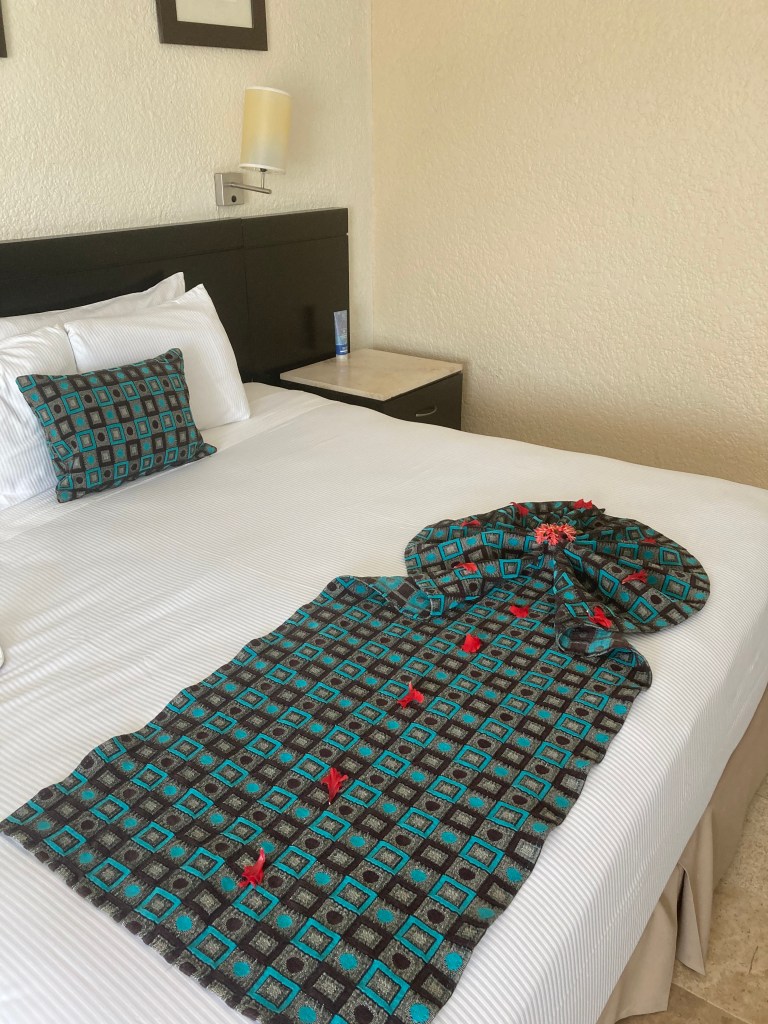
It worked. For over twenty five years I escaped into therapy to the Krystal hotel to heal my soul almost every winter because that’s what I wanted. A room with a king sized bed on the sixth or seventh floor with a balcony view over the pool and facing the ocean. Two decent restaurants on the premises — now three with a new traditional regional Mexican cuisine opened just a year — make it four with a recently added Italian cuisine named for Cinque Terre — plus a food truck, plus a pool patio grill next to the main outdoor bar for lunches, there is always quality food and service at hand. The pool — they call it alberca, the word for reservoir, rather than the common piscina, probably opting against any suggestion to anglos that pissing in the pool is okay — is clean and well kept, and there is a water slide into the deep end. The patio is spacious and decked with continuous chaise lounge chairs always occupied. Down stairs from the sea wall dozens of palm palapas line the sand in two rows just below the free standing restaurant they cal Las Velas, as in the pun for both sailboat and flame, and the main patio bar, lunch grill, patio dining and the lawn next to the Kids Klub area, and past the stairs along the sea wall white umbrellas with chaises line up next to the umbrella palapas of the hotel next door, Tesaro.
As I have said, at the Krystal there are palapa beach people and there are pool people. I prefer the beach and like a front row palapa. Palapas cannot be bought, or reserved in advance, but I wake up just before sunrise and don’t mind taking our beach towels and an identifying paperback book or old edition of the Economist down to pick out my favorite palapa, and if that’s taken pick my second favorite, set out our paraphernalia, smoke a cigarette watching the walkers and joggers in the red cast of sunlight coming over the mountains and lifting the shadow off the sand and pinks up the surf. Sunrise, la madrugada, one of my favorite Spanish words. When I return to our room the coffee maker is done, Roxanne usually wakes and we take up our devices to read the e-edition of the Star Tribune. We groom ourselves and dress in our bathing suits, gather our books and more paraphernalia in beach bags, have breakfast at the Aquamarina downstairs or across the pool patio at Las Velas and then go down to the palapa to occupy our home base headquarters for the day.
Typically. Walk the beach. Maybe a massage. Swim. People watch. Sometimes lunch at Las Velas or down the beach at Tanta Vida. Rinse in the pool and repeat. And read. Eventually the setting sun occupies the attention of everyone remaining outdoors. Sunset comes just after six, when beach people and pool people alike retreat to their lodging to get ready for the night. But first the sunset. Roxanne and I are crazy for sunsets. On the best of them the big orange ball descends with grace that last tenth of sky over the ocean horizon where you might see a sailboat, or a whale. The open water of the wide bay of Ixtapa is blocked by a grouping of rounded rock islands, typical along the coast in this vicinity. This grouping features a prominent rock and some little ones as if in the big one’s wake or orbit. From a distance at shore they look heroic, gleaming white in the sun, but up close in a boat you discover the stone is covered with birdshit and the romantic spell is forever broken. The sunset in the bay restores some of the dignity, the golden ball casting the rock islands in melted contrast to its reflection under the horizon. On the best occasions the sun invites picture takers to pose somebody with their hands positioned in the air like they are holding up the sun, the way they pose in Pisa like they’re holding up the Leaning Tower.
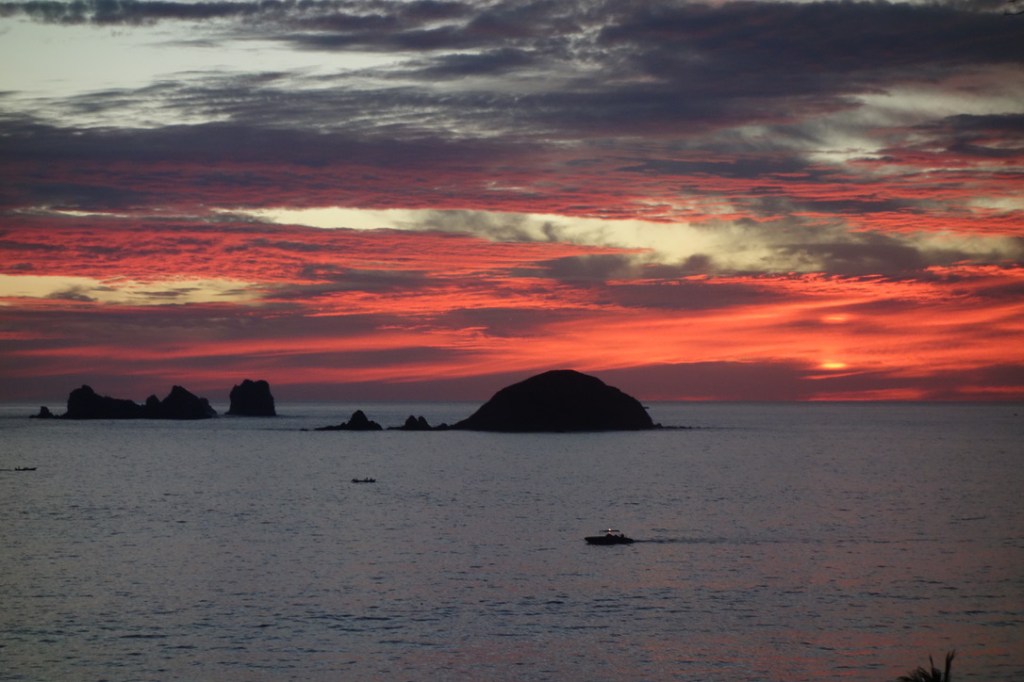
Some days thin clouds gather out there off the coast towards Japan and the red ball is sliced before it truly reaches the sea, but it’s still very pretty to see. It’s interesting day by day, staying as many as six weeks, to observe inch by inch the progression north of the islands the place where the sun actually goes down from January into February, a few minutes later as the days go by. These years Roxanne and I are given to packing it in by five o’clock to clean up and dress for dinner, but we try to see the compelling sunset view from our balcony.
We laugh at ourselves when we talk self-consciously about our fetish for sunsets but make no excuses. A Pacific sunset view from Ixtapa Bay at Playa Palmar is the simplest pleasure to conclude the day, a moment of serenity and vespers. We have seen the green flash.
Actuarial stats tell us our sunsets are numbered. We live well at our advanced age, in our low 70s, an average middle American lifestyle based on a full adulthood engaged in our work and family as functional community members and productive contributors to society. We played the game, voted, taught our kids right from wrong, went to work and did our jobs, minded our own business and earned a good credit rating, and when the time came to retire — that is, to stop working a job — I knew in my heart it was time to let go of that part of my life and stop going to work, my life no longer depended on a paycheck. Over eighteen years vested in my employer’s generous retirement plan netted a nest egg I feel comfortable to live out my actuarial years. Roxanne — much more reluctant to sever her career, didn’t fully leave her job for a few years after me — built a fair civil service pension. And we both qualify for Social Security. Roxanne’s department at the U got eliminated eventually or she might be still showing up at the lab (an agricultural scientist) but right away I was ready to say good bye to the commute on the light rail train downtown to the office tower and the rigorous rites, rituals and rigamarole of commercial banking. I did good work, made an honest living, formed several professional relationships and was well compensated, but there came a time when I didn’t care to do it any more. I wanted to go on vacation for life, like Tommy Bahama. I contemplated it for years. It was a matter of when. I gave the company three months notice. My boss and various colleagues assured me I wouldn’t do it, I would miss it too much, get bored and would change my mind.
They didn’t know me, did they. But what ever doubt I may have harbored went away a mere week before my last day when Roxanne’s sister’s husband Jack died in his sleep between ten o’clock December 31, 2013 and seven o’clock January 1, 2014. I could have stayed on at the bank another year, two or three, like Roxanne at the lab at the U, and I could have kept contributing to my 401.k and deferred Social Security for the sake of bigger monthlies in the future, but New Year’s Day 2014 I made the only new year’s resolution I ever made in my life, and that was to retire, walk away from the job and say, enough is enough, it’s time to live off all that dough-ray-me I’ve been tucking away all the years and live my version of the Life of Riley — what my mother’s Kelly side of the family would call my half bum half playboy vision of my retirement lifestyle. I trusted myself with free time.
At the time Michel and Sid, Clara and Tess were still living in Switzerland and I didn’t need to ask for PTO to spend a month visiting Europe every six months. By then Roxanne had amassed so much vacation and comp time she might as well have been retired. And now, we are well accustomed to our freedom. Our mortgage was paid off in 2007. We’ve lived beneath our means to get this far, and our budget allows us to indulge in life’s simple pleasures like flying to Chicago for a Shakira concert. And afford priorities such as an escape to the tropics every winter. We are debt free. We are lucky enough to call ourselves healthy. We are not rich but we live well. We know we don’t have that many more years to pursue our dream curiosities as we age.
At the same time I have found contentment as a homebody of simple pastimes and meager ambition. The pandemic taught me to enjoy my own company. New ways to deal with depression — customized versions of Cognitive Behavior. In 2025 I found myself in Ixtapa contemplating an emerging restlessness to make something more of my time at the beach. I loved the beach. It was simply the best place to be on a January or February day. And yet, I craved more.
The ocean had a captive audience in me. The ambient temperature in the daytime reached 92F with thick humidity. Seems I used to love the heat but in recent years it oppressed me if I left the vicinity of the sea or the pool between the hours of 11 in the morning and five in the afternoon. Roxanne too. In the early years for a diversion we might take the bus to Zihuatanejo and explore the town, check out the shops and maybe have lunch and one of the many cantinas. It seemed that lately even the city beaches offered no respite from the heat. With Bob and Rose and several other Krystal companions we used to make day trips across Zihuatanejo Bay to a beach cantina at Isla Las Gatas, but without our compadres there seemed little incentive to to abandon our palapa to make the trek. Likewise the shops of Ixtapa and the souvenir stalls offered no curiosities worth the thick heat. I thought of Luis, El Guia, and his tour down the coast to the nature preserve, but even now I could only imagine the heat and sweaty humidity. With only bus or taxi transportation between Zihuatanejo to the south and Playa Linda a few miles to the north, our mobility to get out and explore the hills and villages in the countryside was restricted. From what we heard about Mexican traffic and the preferences of villagers that tourists stay away, and from observing military checkpoints, and contemplating stories of cartels and the story told by Jesus Calderon, we would never rent a car to create our own road adventure the way we would in France, Ireland, Canada or back home. It didn’t feel safe to go off by ourselves beyond the coastal community. Besides, there were no ancient ruins, pyramids, historical, archaeological or architectural sites in the region (aside from the tiny indigenous villages among the hills, where outsiders were unwelcome) and no mountain vistas in the arid and scrubby terrain.
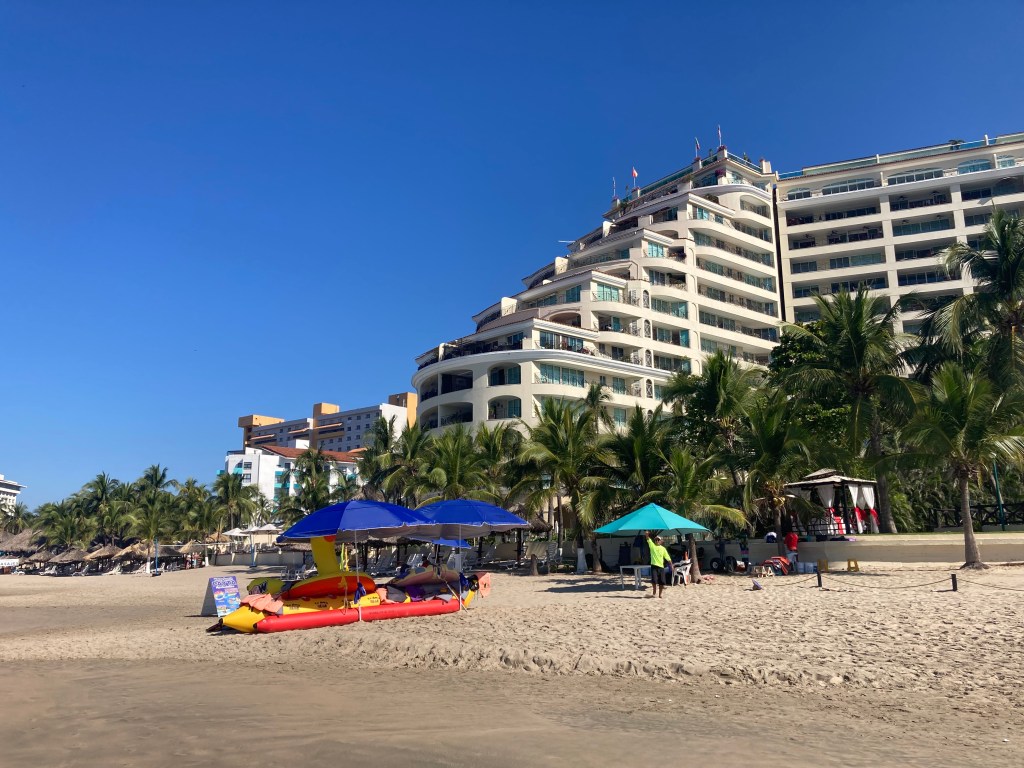
Just the beach. Ironically, the most interesting architecture in the region is the 14 story Bayview condominium, a wedding cake of arches and balconies located on the south end of the beach at Playa Palmar, which we passed by every day on our walks. The beach was reason to exist. More ironic was the awareness that Ixtapa was chosen as the steady repeat destination to escape Minnesota because it enabled me to indulge in lazy, passive behavior, spending my days doing almost nothing, all on purpose, and now I was finding that I was becoming bored with my chosen boredom.
Under our palapa I would read. I would write in my journal. I often brought five or six books from home. Roxanne would bring two or three and her Kindle, cued with e-books. Besides the books, I would usually bring at least three recent issues of The Economist, a newspaper, my news backlog from the hustle of the holidays. The books might be non-fiction, such as All The Beauty in the World, a backstage memoir of a former security guard at New York’s Metropolitan museum, or The Silk Roads, a history book by Peter Frankopan tracing civilization along ancient trade routes between East and West. I’ve read the likes of Malcolm Gladwell and Joseph Campbell on the beach. I read the entire Project 1619.
Mostly I read fiction. I discovered Fredrik Backman and Roddy Doyle at this beach. Peter Heller too. I’ve kept up with the chronicles of Navajo detectives Leaphorn and Chee, originated by Tony Hillerman and continued aptly by his daughter Anne with the development of the character Bernadette Manuelito. Then I got interested in St Paul Minnesota crime writer John Sandford, and over the years I backfilled reading his entire catalog, all the Prey books featuring Lucas Davenport, the Virgil Flowers series, the books featuring the artist computer whiz known as Kidd, and the emerging series based around Davenport’s adopted daughter Letty. Sandford has been around since the 1980s and each novel elevates the genre of the murder mystery ever higher. He is one of my favorite authors. Almost concurrently I found an exceptional espionage novelist in Daniel Silva, whose series featuring Gabriel Allon began in the 1990s and evolved among international tensions ever since. There are similarities in style and structure between Silva and Sandford which set their work apart from contemporaries of note. I also like David Baldacci, who toggles both murder crimes and spies.
What worries me about my recent propensity towards the novels of Sandford and Silva is the reflection of their stories on my psyche. I try to pick stuff to read that I can take to heart. Life’s too short. I guess I’ve been an active thinker and literary participant in what I read as far back as the stories of Alice and Jerry at St Simon of Cyrene, If I Were Going, second grade, my first trip to Europe. The trouble with identifying with the novels of John Sandford for me is that Sandford’s intense detailed narratives of acts of evil sometimes permeated my dreams, much less posed moral questions in my head when I wasn’t reading but busy at something else. Same with Daniel Silva.
Vivid insight into the minds, motivations and methods of supremely corrupt people could not help but scare me and make me more paranoid and suspicious of the world around me. The novels are fiction, of course. As Minneapolis writer David Housewright put it, if there were half as many psychopaths running around Minneapolis as John Sandford portrays we would all be driving our kids to school in armored personnel carriers. And as vividly suspenseful and poignant each heroic story, each book shelves itself into memory and some other experience obscures the book’s freshness — perhaps another book, and maybe the next one in the same series — because there’s no reason to get obsessive over the adventures of modern day agents of good in an evil world.
And yet, real life offered an array of intrigue. Roxanne kept me up on the gossip circulating among the MAGA pool people. They heard from an inside source that next year the Krystal would only offer all-inclusive accommodations. No more what they called the European Plan, room charges separate from food and amenities, which were charged a la carte. Rox and I never liked the idea of all-inclusive. We didn’t drink enough to break even and didn’t need an incentive to consume more. As for food, it may seem like a never ending all-you-can-eat buffet but confining ourselves exclusively to food at the hotel — for six weeks — completely alienated us. Yes, the hotel food was good, but not great, and the menu repeated itself all too frequently. We ran a tab for when we had breakfast or lunch but for dinner we preferred to go out to a restaurant in Ixtapa within walking distance or take a taxi to Zihuatanejo, where the food was better and it was nice to get out of the hotel in the cool of the evening after sunset. We could understand the economics on the side of the Krystal, a business model based on short-term, 3 – 5 night rentals marketed towards the domestic Mexican tourists who saw an all-inclusive stay as a good deal. For us it seemed like paying for something we didn’t use. According to Roxanne, the MAGA pool people felt likewise, and some suspected it was a conspiracy to cater to more Mexicans and squeeze out the gringos.
The other thing was another rumor from high up inside that next year the Krystal would discontinue honoring coupons for its decades-old loyalty program. Rox and I got in on it from the beginning, along with Bob and Rose and most of the MAGA pool posse, some Canadians, when we seemed to find ourselves coming back to the Krystal year after year for extended stays — more than one week — and the hotel came up with a marketing scheme to attract guests like us to keep coming back, so they offered discount coupons for future stays based on nights spent plus referrals of other future customers and options to buy coupons defaulted on or otherwise forfeited at a discounted discount price. In all, Roxanne and I accumulated coupons into the 2030s, and given they could be redeemed early, we still held enough coupons to last at least three more years at a rate of six weeks a year. The coupon terms were simple: each night of lodging priced 25% below the hotel’s cheapest package rate and a 20% discount on amenities charged to the room. Coupons expired the last day of each year of the coupon. There were restrictions during Christmas but not Easter. We forfeited 2020 to the panademia. The marketing scheme worked very very well. For us it seemed a dream come true, a reliably high quality tropical vacation at a bargain price, easily accessible and affordable well into our advanced age. The Krystal hotel got loyal, trustworthy, tidy and polite returning guests worth at least $85 thousand Mexican pesos a year. Win – win.
The pool people complained they felt gypped. Some of them liked to book their next year’s stay a year in advance, while they were currently registered, and they were told the room rate was all-inclusive and their coupons were expired. They were told the contract for the coupon program only lasted ten years. More than ten years had passed for most of us. Far as I could recall, there was no time limit expressed in the membership contract except that each year’s coupons expired on the last day of the year. Otherwise we had coupons for the discount for at least a week in 2034, if we didn’t spend them early. But what could I do? Sue? In a Mexican court? We always contacted the Krystal by e-mail in late June or early July for reservations, always based on booking our flights and vice versa. Projecting ahead, the policy changes at the Krystal added to rising doubts we would return in 2026, and I didn’t want to wait until July to decide.
The MAGA pool people suspected a conspiracy to squeeze out the gringos. Unwilling to surrender Ixtapa altogether, they talked about leaving the Krystal and going to the Hotel Emporio, two buildings down the beach. Room rates competitive. No all-inclusive. Might have a better pool. Nice rooms, but no balconies.
I was thinking of skipping Mexico, period. What would be gained by Mazlatan or Puerta Vallarta? We already tried Cancun and visited Chichen Itza. We’ve visited Mexico City — Frida Kahlo’s blue house and the murals of Diego Rivera at the National Palace — but that, like Paris, is not a beach vacation. We’ve considered visiting the Mexican city of Morelia, said to be a picturesque colonial town, and seeing San Miguel de Allende, said to be a charming colony of the arts, but these would be day trips and I’ve said before, I don’t want to drive in Mexico or take a long-distance bus, and unlike Europe there are no trains. After twenty-some years of Mexico the allure is the beach, and Playa Palmar at Ixtapa is a fantastic beach. Hard to replace.
But probably necessary. I used to say that if you want to experience the real Mexico you will find it at the Krystal hotel. Now it’s more true than ever. Even after experiencing Mexico City, I still refer to Zihuatanejo as Downtown Mexico. To clumsily steal a quip from a Jack Kerouac character named Remi Boncoeur, I say, man, there are sure a lot of Mexicans in Mexico. All kinds. They are at home here. Rudely perhaps, and harshly honest, that woman at the beach a year ago who yelled at me (in English) to go back to my own country had sympathy from a lot of people under the palapas I’m sure. Here we were at a popular vacation resort and who is this guy complaining of music too loud? Some ball-headed old gringo reading a book. It was Mexican music too. I like Mexican music, but who would know? I have heard about a slogan of MAGA demonstrators that goes, “We will not be replaced.” Replaced, I wonder, like how and by whom. A rhetorical question because I know the answers — immigration portrayed as alien invasion, and overall a population of underclass un-white people willing to work. In America. In Mexico replacement theory is proving itself in reverse. Year by year visitors from upper North America to Mexico has declined since we started coming to the Krystal to the point where our presence is almost irrelevant, more and more Mexicans seeking long weekends by the sea, in their own way seeking escapes from stress, boredom and oblivion. If Americans and Canadians decline in the tourist mix in Ixtapa the chilangos and familias will take up the space, and the culture of hospitality will adapt to itself without the pesky gringos.
The true expats will remain, forever embedded anonymously among the fabric woven between the populace and long term tourists wandering far from home.
I never came there to be a missionary to evangelize the American Way. Part of the allure was seeing Mexico as is. If I have a critical eye I also look for mitigations and a will to live and let live without imposing my judgements of circumstances none of my business, such as governance by cartels. The relative poverty is obvious. Even so, year by year over the decades there is ample evidence of the rise of the Mexican standard of living from Third World status. Even in backwater Zihuatanejo there’s not only an Aurerra Bodega but also a Sam’s Club, neither of which rely on tourist shoppers. From iPhones to flat screen LG televisions, Mexicans have skipped past middle technologies to compare itself among the rich world, whether the United States accepts it or not.
I think about Mexico’s collective self-awareness in light of the bullying abuse from Washington DC. Only days in office (Roxanne and I did not watch the inauguration) Trump announced tariffs on Mexican goods and threatened to tear up current trade agreements he himself renegotiated with Mexico (and Canada) during his first term. He threatens to deploy our armed forces against the drug cartels. He keeps claiming an invasion of migrants who are the “worst of the worst” of criminals sent to the US by vague Mexican authorities and says a massive crackdown is imminent. Trump asserts that Mexico poses threats to National Security. Hearing rhetoric against them like this, what do Mexicans think?
I am not a journalist (obviously) and don’t go around interviewing subjects. I don’t ask personal questions about things that might make people uncomfortable or none of my business. I see what I see and hear what I hear, feel what I feel and try to engage people with sincere respect and respectful sincerity. I am a writer. Things I observe may enter my journal or end up here in the blog. I keep confidences. Still, I am hard pressed to say what Mexicans think of America and the Americans who elected the president who heaps such abuse upon their country.
Over the years we have been befriended by several locals and I cannot say anybody feels free to talk about politics, local or national or international. Most if not all are associated with the hospitality industry, and I can understand why it’s in their best interests not to risk being overheard voicing unpopular opinions. Or should I say unpopulist opinions. I admire their apparent que sera attitude, and if it’s genuine they are better than me.
From a distance I pay attention to news from home. The hotel carries FOX and CNN International on cable in the room but we don’t watch TV except the NFL football playoffs. FOX always makes me angry at its blatant, unfiltered MAGA propaganda. CNN International takes too long to get to the point. I’m not fluent enough to watch news on the Spanish channels. We keep up via the internet with CBS News Minnesota, Roxanne gets feeds from the New York Times and we both read the e-edition of our home town newspaper, the Star Tribune. I get daily newsletters from The Economist. From these sources I saw the covid-19 pandemic coming from Wuhan, China while we were in Ixtapa in January 2020.
Deja vu all over again.
I hate it when I think I see something coming and it comes. It looked like the first Trump administration was just an improvisational dress rehearsal. This time around Trump has a floor plan and a script. Picking up where he left off, supercharged from finally beating up Joe Biden, he is establishing an administration dedicated to disestablishing every liberal institution of the infrastructure of the federal government of the United States.
Woke no more. Everybody back to sleep.
Didn’t he say at his 2024 campaign rallies that if he got elected the country would never have to vote again? He promised his voters he would take control and solve national divisions, his way. His first act after inauguration was to pardon 1,500 convicted insurrectionists from the Capitol riot on Epiphany Day, January 6, 2021. He has since begun a purge of the Department of Justice to sack every US Attorney who pursued charges against the insurrectionists or any other ally of the President, or Trump himself. He proclaimed a new Department of Government Efficiency headed by a neo-fascist billionaire immigrant from white South Africa who is charged by proclamation with unchecked powers to investigate every department and agency of the federal government and terminate any and all jobs they see fit and close down the whole office if it wants to. Already employees at the Internal Revenue Service were getting furlough notices en masse. The beautiful functioning bureaucracy that runs the USA is being dismantled, institution by institution, in favor of a ruling class of plutocrats and oligarchs running the government from extralegal private means while controlling society by propaganda propagated by communications technology — that’s what I foresaw coming while gazing at the surf.
Another Trump promise on his campaign trail was to hunt down and deport every one last immigrant taking up space within the borders of the United States if he can help it, and he was already starting the roundup in Los Angeles, California, where he said he wanted to send federal troops to reinforce Immigration and Customs Enforcement (ICE) sweeps, justifying martial law under the Insurrection Act of 1807. I could see Trump going after a two for one: a sweep-up of a million or more undocumented immigrants and confrontation with demonstrations organized by protesters he can proclaim as insurrectionists and bust them up with federal troops. I could see another Kent State magnified by the millennium and in my mind’s ear I heard the opening guitar bars of Neil Young, four dead in Ohio. This was just the first week of his presidency. Just the beginning of four years. LA is as good as any place to start, but how soon will he get to purging Minneapolis? Who can stop him? The Supreme Court makes me laugh.
His cabinet appointments scare me. Barbie doll ex-beauty queen and Trump sycophant ex-governor of South Dakota, Kristi Noem will be Secretary of Homeland Security. She will be known as ICE Barbie, and she will be ruthless, illustrative of her other nickname, Bad Dog, earned by a chapter in her 2024 autobiography where she proudly described shooting her wire-haired pointer at a gravel pit for disobedience.
Attorney General will be an ultra right-wing attack dog and former Florida attorney general Pam Bondi, tasked to cover Trump’s criminal activities in office, sack US attorneys who built cases against his allies, including but not limited to the January 6 insurrectionists, and pursue criminal indictments against his targeted enemies. She will cease enforcement of civil rights laws and slap suits against prestigious universities to block funding for research it deems too woke.
Robert F Kennedy Jr will be Secretary of Health and Human Services, a guy who advocates going completely off the grid to avoid vaccinations and links acetaminophen taken during pregnancy to autistic children with no evidence. As sort of a celebrity backup to give Kennedy some credibility Trump appointed Mehmet Oz, Dr Oz from daytime TV, director of the Centers of Medicare and Medicaid. Between DOGE and Kennedy the Center for Disease Control (CDC) will get slashed and health care will revert to the frontier of anybody’s guess.
Sycophant gadfly playboy Kash (in pocket) Patel has been installed as Director of the Federal Bureau of Investigation (FBI), or head hairy eyeball of the FB-Eye, installed by Trump to back up Bondi at her Department of In-Justice in prosecuting Trump’s enemies such as the fictional terrorist conspiracy they call Antifa, and calling off investigations into real life threats such as the Proud Boys.
For director of National Intelligence Trump installed an obscure former congresswoman from Hawaii named Tulsi Gabbard. It appeared she was planted in her position to be ignored except a nod and a wink to her classified briefings the public can never see and Trump can discreetly disregard. Hers is likely the simplest non-disclosure agreement ever signed.
Pete Hegseth is the new Secretary of the Department of Defense, also known as the Pentagon. Hegseth wants the official name of the department changed back to the Department of War, and Trump will gladly pick up his sharpie pen and change it, so obliged is the president who counts on Hegseth to consolidate militant MAGA even more harsh than the vice president. Folks might call him Heggie, but that resembles hygge, a Danish word that very loosely translates as “woke”, so he probably wouldn’t like it and ban any journalist who would do so from covering the Pentagon. For some reason he reminds me of Heinrich Himmler, so I think of him as Heinie Himmler Hegseth. Already he is purging the armed forces of senior officers, female officers and any personnel known to be LGBT, liberal or woke, in his effort to restore a warrior mentality to American troops. Trump cannot say no to his biggest foil since Rudy Guiliani. If Heinie Hegseth wants war this commander in chief will give him one. One he can lose and still come out saying he won and blame Heinie for the mistakes and miscalculations.
Alone among these and other appointments to fawning amateurs and spoiled loyalists the one appointment that stands out as particularly sane is Marco Rubio, Secretary of State. The Cuban-American former US Senator from Florida comes from an uncompromising traditional Republican caucus that used to include Dick Cheney. In 2016 he ran for president and lost the party nomination to Donald J Trump, who humiliated Rubio — “Little Marco” — at every rally. Four years later after helping save Trump from conviction and removal from office via two Senate impeachment trials in the first term, Rubio is called upon to represent the United States as our leading statesman to the world and defend Trump and his foreign policy with a straight face. It’s always been easy to believe Rubio lives in politics because he is at heart a civil servant and patriot. Except maybe a cross-generational grudge against Fidel Castro he appears to have no axes to grind. He serves at the pleasure of the president, and for Rubio it will be a dicey deal. The American citizens may luck out having Rubio embedded in the Trump circle because in his conservative way he embodies integrity to do his best to steer policy in foreign relations through peaceful diplomacy and counterbalance the influence of the secretary of war.
The hidden easter egg, as it were, the secret maestro of the machinations driving this Trump administration is rostered at the White House as a senior advisor named Stephen Miller, a senior architect of the MAGA movement and principal author of the campaign’s policy document, Project 2025, a treatise of fascist racism and xenophobia published by the Heritage Foundation. Stephen Miller is the Joseph Goebbels of the Trump regime. Under his direction ICE will beef up its ranks and sweep across the country arresting every suspect of color in sight and detaining them in secrecy at inhumane locations and deporting them as fast as possible before due process can be invoked. The state of Florida has volunteered to build a detention camp deep in the Everglades they want to call Alligator Alcatraz. The goal is to eradicate immigration and deny USA residency to any and all ethnic migrants by any means necessary, including selective denaturalization of citizens. Trump says he will end birthright citizenship for children born inthe US from parents who are non-citizens, contrary to the 14th Amendment of the Constitution.
The Constitution also specifies that the states and not the federal government regulate all elections, but Trump wants to set uniform federal rules prohibiting mail ballots and requiring proof of citizenship to vote, citing election fraud that does not exist except in Trump’s mind. He has ordered the Justice Department to subpoena from each state a roll of registered voters to judge ineligibility, with no safeguards to private information.
On the international front Trump campaigned that he would end the wars in Gaza and Ukraine his first week in office. With Gaza he can’t get past his vision of beachfront real estate when negotiating with Israel. With Ukraine he’s punishing President Zelenskyy for squealing on him for trying to put the squeeze on Joe Biden and getting him impeached the first time, so Trump sucks up to Putin and condones Russia’s invasion, flips the bird to NATO and insults the European Union. And he has further riled NATO and the EU by threatening to seize Greenland by force from Denmark. He reviles Canada, who shares a 5,525 mile border with the US — longest international boundary in the world. He keeps calling them the 51st state, and further antagonizes the longtime US ally and trading partner by slapping a 25% tariff on all Canadian imported goods. He’s slapping 25% tariffs on imports from all countries.
Trump justifies the tariffs claiming national security. He says it will raise enough federal revenue to virtually eliminate the need for income tax, contrary to the calculations of every sane economist — the policy was tried unsuccessfully before by Herbert Hoover, whose administration presided over the onslaught of the Great Depression. Trump says the costs of the tariffs on goods will be paid by the countries of export, when the costs will be really paid by the importers and ultimately consumers. He is such a liar. He is the Lyin’ King.
Project 2025 is direct response to The 1619 Project, a compendium of critical essays looking at the establishment of the United States since slavery. The MAGA movement is particularly aroused to anger over public recounting of all the horrible shit white supremacy has perpetrated upon blacks in America and pledge to cleanse official historical references to events exposing racist mistakes of the past. The results will purge museums, libraries and even national parks of any didactic material considered “woke”, that is viewed as espousing a left wing agenda of imposing DEI upon the American public — diversity, equity and inclusion. MAGA is resoundingly anti-DEI. To them, diversity, equity and inclusion are three vices to never aspire.
A key fulcrum of leverage MAGA can use politically in the state of Minnesota in its next elections is the role of DEI in the massive fraud committed against the state department of human services during the pandemic where dozens of individuals pocketed millions of dollars billing the government for hundreds of thousands of meals never served to thousands of fictitious children. The friction around DEI centers on the charitable sentiments of state administrators hesitant to respond to whistleblowers who smelled something fishy going on with invoices submitted by food providers organized as a consortium known as Feeding Our Future. An eventual state and federal investigation brought fraud and conspiracy charges against almost a hundred individuals and hundreds of millions of dollars in bilked money. Most defendants plead guilty, and almost everyone else who went to trial were convicted, including the ringleader of Feeding Our Future. Where DEI comes in is in the political fallout. It’s come out that authorities thought very carefully over accusing a group of ostensibly well-meaning people representing themselves as benevolent and charitable, of lying, cheating and chumping the government, when the overwhelming number of the defendants belong to the local community of the Somali diaspora.
Never mind that the Feeding Our Future ringleader is white.
Trump already hates the Somalis. He has called them “garbage” who add nothing to American society, and speaks of denaturalizing them (a very high percentage of the 80,000 Somali refugees who settled in Minnesota are citizens) and deporting them wholesale back to Africa, including Democratic congresswoman Ilhan Omar, she of his nemeses The Squad.
The Somalis of Minnesota now surpass in notoriety the Haitians of Ohio said to be eating cats and dogs. It crosses my mind to stop keeping up with the news, just blank out and unplug and like the ice queen in the Frozen story sings, let it go. For one, I alone am not responsible for Minneapolis’ reputation and like the prayer for serenity implores, I need to accept the things I cannot change and change the things I can (if I want to) and be wise enough to know the diff. I did not kill George Floyd and there are several Somalis I’ve known through the years I can put in a few good words for if it would do any good. They didn’t just show up yesterday. Refugees from the jihadi terror overwhelming Somalia have been in Minnesota for more than a generation. They remain a visible community among the (if you forgive me) diverse elements of the population of the Twin Cities metropolis, centered in Minneapolis, my home town. They stand out for their women in traditional Muslim dress, head to toe like old time nuns, and men with beards and pillbox hats and the long thobes, like neighborhoods of Hasidic Jews or colonies of Amish, they congregate in districts long underused by the underclasses. They drive the Ubers and Lyfts, serve in health care jobs and work in the food and hospitality trades. They have renovated abandoned warehouse spaces into mosques. All along the way they have been harassed and occasionally terrorized. Incidents were vicious and one would think conditions in East Africa must be incredibly brutal for some of them to want to live in Minnesota instead, not considering the weather, but the Somali community has persisted and made a stake of socioeconomic equity among ethnic small businesses, the trades, academics and professions, as have the migrants who came before them, the French, Swedes, Norwegians, Germans, Finns, Irish, Italians, Ukrainians, Dutch, Irish, Scots, Blacks, Southeast Asians, Latinos and whoever else came to live in this place once roamed by the Ojibwe and Dakota barely eight generations ago.
Somalis have included themselves within the fabric of society enough to get Ilhan Omar elected to the House, she herself a persistent achiever of appeal beyond identity politics who came to America as a refugee, pursued an education, became a citizen and went to work as advocate of social justice by articulating liberal policies as affecting human rights for all and not just special interests. She is young yet and could go on to campaign for universal human rights at the United Nations or some cogent international foundation.
What’s too bad for the reputation of their ethnic community is the Feeding Our Fraud scandal smearing bad blood on the whole bunch for the actions of a hundred people, laying blame on liberal government and giving credence to MAGA outcries to round up all those un-Christian jihadist conspirators who came to America to game the system and sabotage the free-market capitalist economy with Sharia. Barely three generations ago there were public outcries against niggers getting shoved down people’s throats, and see what happened. The critical lesson from Feeding Our Fraud is not that a certain ethnic group came to America to deliberately exploit humanitarian loopholes in the safety net because they all assumed it was easy, but that these guilty individuals may have taken their cues from the worst of bad examples, the oligarchs and autocrats who are the leaders of the country, who act as if it’s expected to swindle the public trust to succeed at life in America and the rest of the world.
Here I was in Mexico a week and a half not really at peace. I told myself I was relaxing by the sea but the monotony was no lasting consolation. Reading offered escape from the escape, but that itself offered mind exhaustion, and for the most I didn’t feel like writing. Some of it reflected my paranoia of being observed with a pen transcribing into a notebook. I always used to feel anonymous in Mexico, just another Anglo touristo in the crowd, no worries. Lately I felt as if I were being watched. Maybe it was a Silva novel. It occurred to me how easy it is to put me under surveillance. How would I know? I’m in some public place all day except when in the hotel room, very easy to verify. The real question would be why I would any entity care what I was up to in southern Mexico.
I wouldn’t like to believe Mexican authorities suspect me of being a spy, but why not? Twenty-something years at the same hotel — practically the same room. Few if any social contacts beyond my wife, especially this particular year. There’s a naval base in Zihuatanejo, adjoining the public pier, but I don’t frequent the gate or the guard station. If my mission interacted with someone who is a mole from the Mexican side, there could be anybody of an array of people whom we came repeatedly in contact with year by year, mostly through the hospitality businesses and mostly the servants, and otherwise the possible list of repeat contacts was nobody. No mysterious Venezuelans or Cubans. No expats dwelling near Playa Madera, Zihuatanejo.
Years ago there was an elder gentleman from Argentina who used to stay at the Krystal when we did who spent time with a middle aged lady (our age then) who brought a young girl, her daughter perhaps, to visit with him at a palapa on the beach a number of consecutive years, and I remember because the lady and the never seemed to age but the young girl grew into a young lady. I imagined the elder guy was her grandfather. Their interaction resembled a tutoring session, somewhat formal and scripted. Sometimes the lady would attend. I can’t remember how I learned the man was from Argentina — Andres the hotel security detective, or maybe from Rose, or Bob. In any case the Argentine and I did not hit it off at all. He had a kind of aristocratic attitude that rarely made enough eye contact to stay aloof, and he hasn’t stayed at the Krystal in years. It was absurd to conceive myself a contact with an Argentine secret agent.
In Mexico. Besides him I could think of nobody else dodgy I might be suspected of engaging for nefarious purposes, just as I could not put a finger on who might be watching me from the Mexican side, or who on behalf of the USA. Or Canada. I hadn’t been this paranoid since 1972, only back then I didn’t realize it. Now I wasn’t so naive to think of myself as anonymous and invisible any more. I could be a target. I could be suspected of gathering intelligence — writing in my journal at the beach. I could be a client of a cartel. I could be under cover surveilling a cartel. I could be a left wing agitator stirring up social unrest. Jesus Calderon the servor served as the union steward at the Krystal for several years before he retired, but nobody could seriously link the two of us conspiring against the state of either country. But you never know. They don’t just call them Trumped Up charges for no reason. More plausible, I’m already known as a well-known nobody to Mexican intelligence, protected from harm by my notoriety for being a harmlessly common gringo.
I still think I could recognize the guy who shot the kiosk vendor by how I recalled and described him to an undercover detective who suddenly appeared at the scene with a cell phone and directing first responders. Once the following year I thought I saw him having an intimate, intimidating talk with the first year proprietor of a sidewalk cantina of empty tables in one of the Ixtapa malls, wearing the same red baseball cap, the same hawk profile, and I hoped he didn’t recognize me if he was the same guy as the shooter. We used to eat at that cantina, Los Bigotes de Zapata, when it was owned by a guy named Martin and a servor named Celia worked there and they made the best enchiladas mole, but Martin apparently sold the place and we were hesitant to try the new menu, and then the dark, arrogant, skinny guy in a red ball cap showed up and we left. And never returned. I mentioned the ball cap guy to Roxanne at a safe distance and of course she hoped I was mistaken, so did I and we let it go.
Even so, there was something sinister and foreboding about the character of the guy and how he demanded the attention of the cantina proprietor that suggested the business wasn’t making it. A lot of empty storefronts at that corner of the mall and not much foot traffic after dark, even though the plaza was clean and well lighted. I sensed a heyday passing away.
Two weeks into our 2025 vacation my angst was starting to bother me. Even in a trance of bliss in the gifted hands of Zuliema it occurred to me how vulnerable I was at the massage cabana, like Moe Green in The Godfather. Of course it would do no good for the local tourism industry for something bad to happen to me, unless propaganda spread that I deserved it, or the news could be suppressed whatsoever. I thought about that incident the previous year, at the beach involving my request to cut the (subjectively) loud volume of their music and their request that I go back to my own country. I worried that I may be on a collision course with the hotel’s newest business model, which was designed for me to decline past mere passive ambivalence into ambivalent irrelevance.
In years past the hotel manager and senior staff would host a catered party at the cantina by the pool bar and invite all the long term guests like us and Bob and Rose and the pool people who had been coming back for years and they would toast us in appreciation of our loyalty. That practice ended with the pandemic. New management keeps a distance from the guests. My polite attempts to get answers about the future of the coupons or whether the hotel was really going to go all-inclusive got polite evasive smiles of ignorance from senior staff who professed no expertise or authority to confirm or deny the hotel’s future policies, but they kept assuring me they appreciated my business and would do everything possible to keep our relationship going, and I would get my answers soon, from the top. Maybe manana, or the manana after manana. Proximo ano at the latest.
At least the MAGA bunch at the pool seemed to have sources who confirmed the coupon program was dead and all-inclusive was the destiny of food and lodging. It irked me that these cultural barbarians seemed to hold more clout than me to confirm information but there was a certain feeling of schadenfreude in hearing they held no sway in convincing hotel management not to go that way.
My best, closest connections to people employed at the Krystal happened to be with the servants, not management, and at least in this case the servants really couldn’t say. Maybe they were just being nice just to make me feel good. I knew Jesus Calderon would know something and tell me straight, not be coy or play dumb, but I hadn’t seen him in two years. He never came back around after he retired to ask how we were or say good bye.
Which made me think about all the servants we came to know over the years by name and by face at the hotel, very few of the current staff have been there more than five years. Lorenzo and Javier the bartenders have been about ten. Josefina a server at the Las Velas restaurant about eight. Martin, Jaime, Rafael and Augusto, all breakfast servers at both restaurants, have been around more than fifteen. Juan, known as Juan Toro, also a restaurant server at breakfast at Las Velas and a favorite of ours, might be more than fifteen. He is a favorite because we’ve known him since he started as a beach server when on his first day he turned our belongings in to lost and found as being abandoned at our palapa while we were up the beach at the massage cabanas. We admire his apparent character. Among the housekeeping servants only Lourdes and Filipa have been around almost twenty years. Chief security detective Andres has been at the hotel every year we have visited, as Jesus Calderon would have been. At the front desk they are all new every year. The bell captain Claudio has been there forever, and the bellman who is my tocayo, same name, Bufalo Miguel, one f, who looks like he could be Jay Leno’s brother, has been there about ten years too. Oscar, who can barely walk and runs the concession renting snorkels and boogie boards and selling inflatables and sand toys for kids, has been there forever. And our best friend of all, Anabel De Los Santos, dinner shift server at either of the two restaurants, about twenty years herself.
One may think these dozen or so people I have named who are notable veterans at hospitality would represent a strong and stable workforce for the hotel. While they do form a core of professional hospitality they give cohesiveness to the turnover and help the managers motivate the newer recruits to emulate quality customer service. The newest wave of new people are young people in their twenties, some from training schools and looking for careers. The hospitality industry welcomes more servants. The notable veterans are aging. Oscar at his water toys concession stand can hardly walk, his hips are so arthritic, and he uses a cane and thanks every day he makes it to work. Juan Toro used to be the Kid, and even if he is several years junior to Martin, Jaime, Rafael and Augusto, seasoned servers, Juan has college age kids now, he’s a middle aged professional who will soon be senior staff if he sticks around a few more years. Same with Josefina. The older ones will fade away like Jesus Calderon and a dozen or so more of the established old timers who used to run the place when we first came around, who disappeared one by one over the years into history, replaced by a generation on the move, churning personnel with fresh personalities training for new opportunities, and who could blame them?
Our friend Anabel was a rookie the second or third year we stayed at the Krystal. She was not the first female server but the third, after Marta and Gloria, both of whom left the Krystal within the past ten years. Being female and working as a server was a big deal twenty years ago because it was automatically a male profession where men earned a living to support their families. Feminist principles and women’s rights came grudgingly to Mexican culture and then it hit hard. The president of the country is a woman today. When we started coming to Ixtapa almost all the restaurants only employed men as servers, even ones owned or fronted by women. Seemed strange, but change emerged swiftly year by year through attrition and new enterprises as the numbers of employable women grew in the new millennium, and today you would never know the old norm ever existed. (Taxi drivers are all still men. Hotel housekeeping is still all women, at least at the Krystal.)
When Anabel first started schlepping up and down the beach sand hustling drinks for the gringos under the palapas she was an exception among guys like Rafael, the earlier Martin, and even Jesus himself who hustled cervezas and pina coladas for a living for years during the vacation months. She was not just the new girl but a girl. Marta and Gloria worked at the restaurants and helped out serving the pool patios part time. Anabel used to work as a cleaner at housekeeping. She was a single mama with four kids and hustling drinks (and back then you could order food such as fish tacos) at the beck and call of the hotel guests camped in the sand under the palapas was a step up into man job territory. From the outset one could tell she worked hard because she was on probation. Jesus Calderon was her mentor. She seemed to be catching on fast. Within one more year she was a fan favorite. Her service was prompt and attentive. She spoke good English and made interesting conversation among the guests, both with ladies and gentlemen gringos. She made translations. Over the years I relied on her (and Jesus) for tutoring en espanol. It seemed she was making good tips. Soon after — four or five years — about the time Juan Toro showed up — Anabel got promoted to a servor at the restaurants, working a regular rotation between the Aquamarine and Las Velas, rotating shifts and presumably better money and easier on the legs and feet not having to schlepp the sand and climb stairs to get to the bar. We saw less of her then because we rarely ate dinner at the hotel, though we ate breakfast sometimes and occasionally lunch. Even so, Roxanne and I became friends with her beyond the hotel.
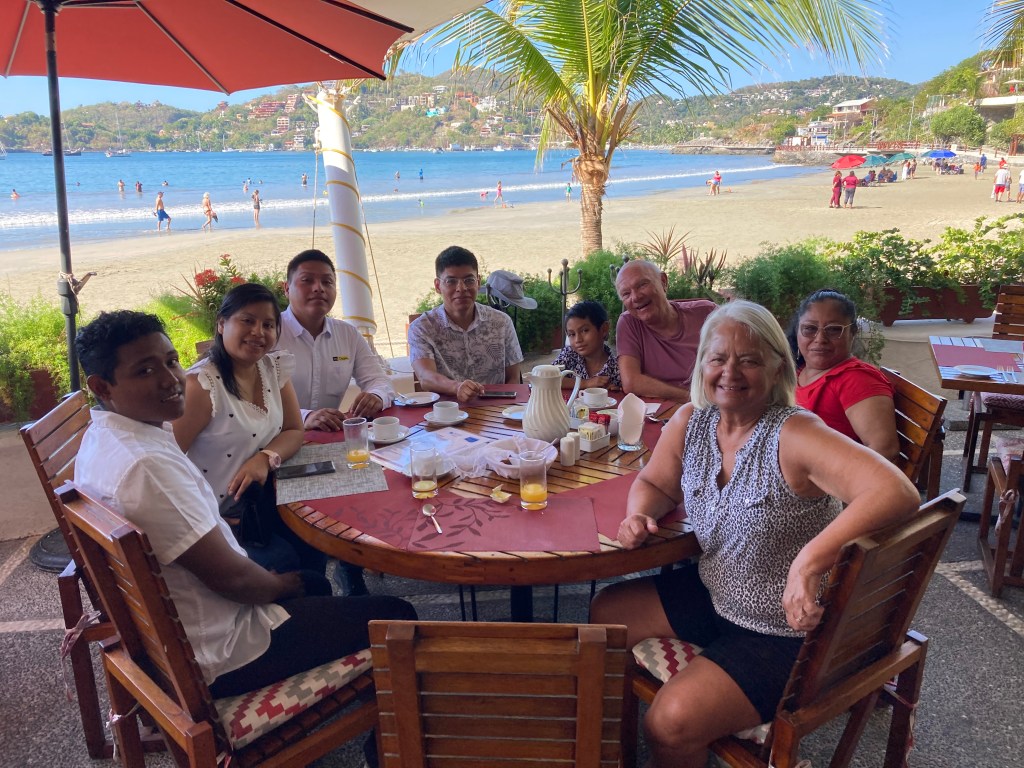
We have dined with her family, out at someplace in Zihuatanejo or at her house, or houses of her friends and extended family. We have celebrated birthdays of one of her sons, Roxanne, and of her grandson together. Anabel has extended kindness and hospitality to us in the highest and purest way. She has befriended and welcomed us to make our residence intimate. She is the prime example of our relationships with Mexicans being with mostly people of the servant class. Our gringo compadres in Ixtapa comprise professionals and otherwise accomplished and accredited members of the American middle class, mostly to an upper degree above our bumpkin selves. In Mexico our closest cohorts are the servants.
Not the managers at the hotel, not the proprietors of the galleries and boutiques, nor the occupants of the mansions atop the hills over Zihuatanejo or the yachts moored at Ixtapa marina. We know no Mexican doctors or lawyers. No telecommunications tycoons. And certainly no cartel kingpins. We are a little chummy with a few restaurant entrepreneurs we have supported over time, but they in their own turn come from the servant class or still belong at an upper level. Didn’t Bob Dylan once sing that everybody serves somebody? Seems some service is much more obvious.
One restaurateur in Ixtapa in particular worked his ass off serving at local restaurants for years until he earned a legendary reputation as a front man and then pooled his savvy and investors to open his own place, The General’s, named for himself, Genero Salinas. We met him many years ago when he worked as floor boss at a popular restaurant and hangout for gringo wannabe bikers called Frank’s. Along with Roxanne’s sister and brother in law, Jack who died in his sleep, and a couple of their friends with whom they were coincidentally vacationing the same time as us (at a different hotel), we hired Genaro, even then christened The General for the way he ran Frank’s, to take us on a tour up the coast to drink a lot of beer and boogieboard surf at Troncones. The General was moonlighting at this with his white Econoline van in the daylight hours and he showed us a fantastic time including a banquet meal at a beachside cantina. On our way back to Ixtapa we stopped at his adobe home at a little tiny town so he could change into his fresh work clothes to put in his shift at Frank’s. We met his wife Estrella, who spoke no English so I had to work with what I knew and Anabel and Jesus tutored me en espanol. Daughter Vanessa was two and Jessica a baby. Both are now in medical school in Morelia, about 216 miles away. Daddy The General established the consummate sports bar in the heart of the plaza in Ixtapa where that poor trinket seller got gunned down — no relation between the two. It would seem by any observation that the shooting has caused no effect in traffic. It’s fun to go there and get greeted at our table by Genaro and Estrella, who works there most nights and still doesn’t speak a lot of English. He remembers us from way back and in his comedian’s way acknowledges our origins and our loyalty. Maybe few or any people can say they met The General from a personal guided tour to Troncones and met his family, but there are hundreds, maybe thousands who can say they first met The General when he was a server or maitre d’ somewhere else long ago and have follwed him ever since. We’re rather proud to know him, actually, and we’ve been free beers and margaritas here and there.

It would be hard enough to end up never coming back to visit Genaro without a personal good bye, but to go away from Ixtapa without saying good bye to Anabel and her family seemed like unconscionable abandonment. Genaro and Estrella’s life will go on with great success without Roxanne and me stopping by for a chat six or seven times a year, all bunched up in six weeks. They will always be beloved by their loyal clientele. Anabel and her kids don’t depend on us, either, for their sustenance. Obviously they live and exist day by day all year long when we aren’t there — and most of their time when we are in Ixtapa, such as when lounging on the beach while they are working or going to school, shopping or caring for the grandchild and a disabled son, living as if we aren’t there.
I often wish I could be a more effective part of their lives in the role of patron, putting up school tuition and so forth, like I would like to be able to afford to sponsor Isabel through med school and Zuliema at whatever she might aspire to in life. I would like to help Anabel afford to live in a nicer house than the one and a half room adobe hovel packed alongside the hillside hovering over greater Zihuatanejo and perched in a dense terrace of similar houses just one earthquake or monsoon mudslide from disaster. We tip generously and buy dinner for the family almost all the time. During the pandemic, the year we did not visit, we wired them a couple of hundred bucks to help them get by. But we can’t afford to support them financially, we really aren’t rich — not rich enough. And they don’t ask for anything. Somehow we commingle socially every year for a very short time and share sentiments. We tell about our lives and show iPhotos on our phones. Never have they asked for so much as a favor more than exchanging pesos for American coins from tips — mostly quarters, the banks readily exchange paper dollars for pesos but will not exchange coins. Maybe that’s money laudering. Actuually it’s an even trade.
As I always said, we never went back to Ixtapa to be some kind of gringo missionaries but we have in small ways acted as undercover ambassadors. Accidental ambassadors. Ever diplomatic and polite. Never act out the Ugly American. If you accept the credo that foreign sovereign entities have no business interfering in American elections then it’s true Americans have no business meddling in how Mexico governs itself. Roxanne and I don’t favor candidates, endorse referendums or debate their issues, though I follow along from an imposed distance through the internet. Of late, as I’ve said, the undiplomatic conduct of our newly re-elected president after a four year gap term continued to worry me down in Mexico the way he disrespected their newly elected female president, slapped high tariffs on imports from there and threatened to deploy American troops to attack drug cartels on Mexican soil to control fentanyl traffic. His bully attitude towards Mexican migrants living and working in the States bode none too well for reciprocal attitudes towards us, and any Canadians mistaken for us.
The Canadians we encountered seemed confused. Most of them come from Saskatchewan and Alberta, known conservative provinces. Alberta leans into petroleum production. Their spoken politics conflate with the MAGA people at the pool but it’s hard to see how they really feel about Trump slapping fat tariffs on their goods and calling their vast country America’s 51st state, scoffing at their sovereignty. They think Trump’s just kidding around and he’ll come around once they replace the detested prime minister Trudeau. A couple guys admitted they wouldn’t mind joining the USA if Trump could be their president. I asked one guy in the pool crowd from Alberta province in the Rocky Mountains, who was the namesake of their capitol city, Edmonton. Who was Edmon? The guy tried to act like he thought fast and said King Edward. I really didn’t know the answer and I said, you’re making that up. There’s no King Edmon. At this point of our stay I didn’t care anymore whether any of the pool people liked me at all, so long as they were nice to Roxanne.
And then there was Trump’s threat to seize Canada’s leviathon island neighbor in the neorthern hemisphere, Greenland. By military force if necessary, he says. Heinie Hegseth the self-proclaimed secretary of war, says his troops are ready to pounce. Never mind that treaties exist permitting the United States to establish military bases all over Greenland, and there is already a hefty US military presence there guarding the arctic as part of NATO, the North Atlantic Treaty Organization. Greenland is is an autonomous territory of the Kingdom of Denmark. A US attack and invasion of Greenland would be an attack on a fellow NATO country, which could trigger Article 5 of the NATO treaty which considers an attack on one member as an attack on all. This could put America at war with Europe. Heinie Hegseth is so anxious to be the secretary of a real war he taunts America’s allies from behind Trump’s resolute desk, and he flaunts his Bible beliefs in the Apocalypse as so inevitable it looms over him as his favorite self-fulfilling prophecy.
When Trump took office the first time, eight years back, it worried me then. That year a couple of my sisters came down for two weeks to the Krystal and we approached Benny to hire us a guide to drive us up to Troncones for the day, in a way to recreate our field trip when we met The General. Benny got us a guy named Fernando, a perfect gentleman in his early forties in a Toyota SUV who showed us an elegant time at a cantina on a sandy beach that stretched forever on both horizons. Fernando said most arruredly that Donald Trump would be good for my country and I should give him a chance. He made me a bet, a hundred pesos that one year from today I would be better off. The honest truth was that in that calendar year our net worth increased and for some reason we were better off. When we came back to Ixtapa I tracked down Benny patrolling the beach for clients and asked to get in touch with Fernando to honor the bet. Benny somberly informed me that Fernando had died of stomach cancer that previous summer.
Two years after the pandemic we were at a party at the poolside patio bar put on by by a Kirk family and cohorts who have been coming to the Krystal for a generation. They invited pool people, palapa people, acquaintances and sundry people this gregariously generous clan had come to know over the years, hotel guests and non-guests alike. I was introduced to a woman who was Fernando’s widow. I told her about my day with Fernando and the beach cantina. That he taught me to deal with anger by finding a palm sized stone, to clench it in my palm and channel the object of anger into the stone, and when ready, throw the stone into the sea. I told her Fernando taught me that if you desire something very much, find a palm sized stone and hold it in your fist and think of the object of desire and, when ready, throw the stone into the sea. I told her that on our field trip he stopped at a roadside stand selling sea salt and made us each buy a small sack. And then I told her about our bet, and I gave her a hundred peso note. I told her when I last saw her husband he had to run an errand and stop at the bodega to pick up tamales for the family celebration that next day. I told her I was better off for knowing her husband.
My whole life was better off for knowing Ixtapa. Even walking the beach meant more than mindless exercise. We did not power walk. We like to mosey, a form of meandering. I’m prone to dawdle and pore over the angle of breaking waves or the antics of the surfbathers. Little kids never tire of burying their fathers in sand. More volcanic stones wash up than seashells. At the end of the beach at the Pacifica the sand platoon does its daily exercise damming the outflow of the alligator creek. Pelicans dive for fish or float in wait in a row just beyond the breakers. Volleyball out front of the Barcelo hotel, soccer out front of the Fontan. Frisbees fly. American footballs. Selfies. The parachute sailing vendors. Maybe the artist Jorge Perez has his card table and umbrella set up and he paints miniature seascapes with his fingertips — we have a triptych of his hanging in out bathroom. And as we pass, both coming and going, I like to pause to admire the Bayview highrise in its elegant climb of arched terraces and wedding cake shape, surely the prettiest architecture in the region. We had friends who used to stay there on the tenth floor and they invited us up for drinks before we went out to dinner, and the accommodations were modern deluxe and the ocean view remarkable.
Not even two weeks into our stay Roxanne and I were talking about alternatives to always staying at the Krystal. We lived there pretty cheaply on the loyalty coupon plan. If the hotel revoked the program and converted to an all-inclusive policy there would be no more financial incentive to stay six weeks at the Krystal. Living in a hotel has simple advantages. It’s right on the beach. Breakfast is only a few flights downstairs. There’s a bar and usually entertainment in the evenings, sometimes a good Latino band and sometimes karaoke. All we really need is a bedroom with a bath and a balcony overlooking the pool. It gets cleaned every day with fresh linen. There is security. Unlike A Gentleman in Moscow we are free to leave the premises, which we do every night for dinner. The daily ritual of the beach palapa by day (barring any field trips) and related beach moseying and massages, and going out into Ixtapa on foot or Zihuatanejo by taxi for a luxuriant meal after dark, then retiring to our room after perhaps a nightcap at ten or eleven, now manifest itself as a bit absurd no matter how much good reading got done, my inner restlessness and tiny paranoid beliefs and delusions persuaded me more every day to make contingency plans for future winters not at the Krystal.
Roxanne and I agreed our dream home in Ixtapa would be a condo suite at the Bayview. It was far and away beyond our budget. Our friend who used to stay there was a retired Twin Cities ear, nose and throat surgeon with a much bigger estate, who passed away a few years ago. What would be nice would be a modest condo flat located on the beach with a full kitchen and patio, swimming pool and laundry located within taxi range of restaurants and a grocery store. We found ourselves outgrown living in hotels, even in Mexico.
Climate change and global warming became a factor in our discussions. According to the iPhone weather app, the daily highs in the 90s were at least four degrees above the average, every day. We observed how it might be nice to take a bus to Zihuatanejo or Playa Linda to walk around the shops for the day if it wasn’t so oppressively hot and humid anywhere away from the beach. Or wouldn’t it be nice to have freedom to rent a car and go places, as if there were places to go. Two years prior we took a two week trip to the Big Island of Hawaii and stayed at a hotel and two different vacation rentals. We rented a car and drove all over the island in the name of adventure and the feeling of being in the tropics in winter and being at the same time in the United States was liberating. It was a great vacation but more expensive than Ixtapa, not to mention so much further away. We easily agreed that spending our six weeks on the Big Island at a vacation condo with a rented car would be a suitable substitute for living at the Bayview, but still unsustainable for every future winter on our budget since we expected to live a while.
We agreed Florida was a ripoff, and Arizona too damn hot and dry.
I came up with Puerto Rico. The poor man’s Hawaii. About the same air travel as Ixtapa. I wouldn’t miss Latino culture so much. We could rent a car and explore the island, maybe find a place we could establish a new base near a favorite beach at a cute little town. They use American money. Roxanne got curious and scouted the internet. She found some deals on accommodations she read aloud in bed and pretty soon we sketched out a plan to leave two weeks early from Ixtapa, fly home for a week or so, then fly down to San Juan and from there rent a car and explore the island for two weeks — more or less the way we explored Hawaii. The idea caught fire with us. Roxanne changed our airline reservations home and booked our round trip to San Juan. I served notice to the Krystal we would be changing our stay short two weeks, giving no reason or any hint of dissatisfaction. I would deal with any questions of hotel policies the next summer if we decided to try to come back to Ixtapa. The next two weeks after I gave our notice to leave early it seemed more and more probable we would not return — some kind of confidence in what we expected to find in Puerto Rico — and my heart began a process of saying a sad, critical good bye.

We would miss the food. Both Ixtapa and Zihuatanejo offer dozens of clean, well lighted places to eat. That’s our problem with the all-inclusive plan, the buffet at the Krystal hotel could never supplant what we liked to eat elsewhere, except breakfast. On our massage day we liked to mosey a few doors towards our hotel to the beachfront cantina called Tanta Vida, until this year the menu dropped the fish tacos. Another favorite place for lunch, besides The General’s, was Soleiado, just across the boulevard and down past he hotel next door, a classy Mediterranean restaurant in an outdoor bamboo garden setting, which offers for lunch a ham and swiss cheese sandwich on a baguette that pairs elegantly with a bowl of their tomato gazpacho. Dinner at Soleiado features a kind of curated cuisine based on the founder’s European recipes, and for anyone who cares they make the best bolognese sauce on the planet.
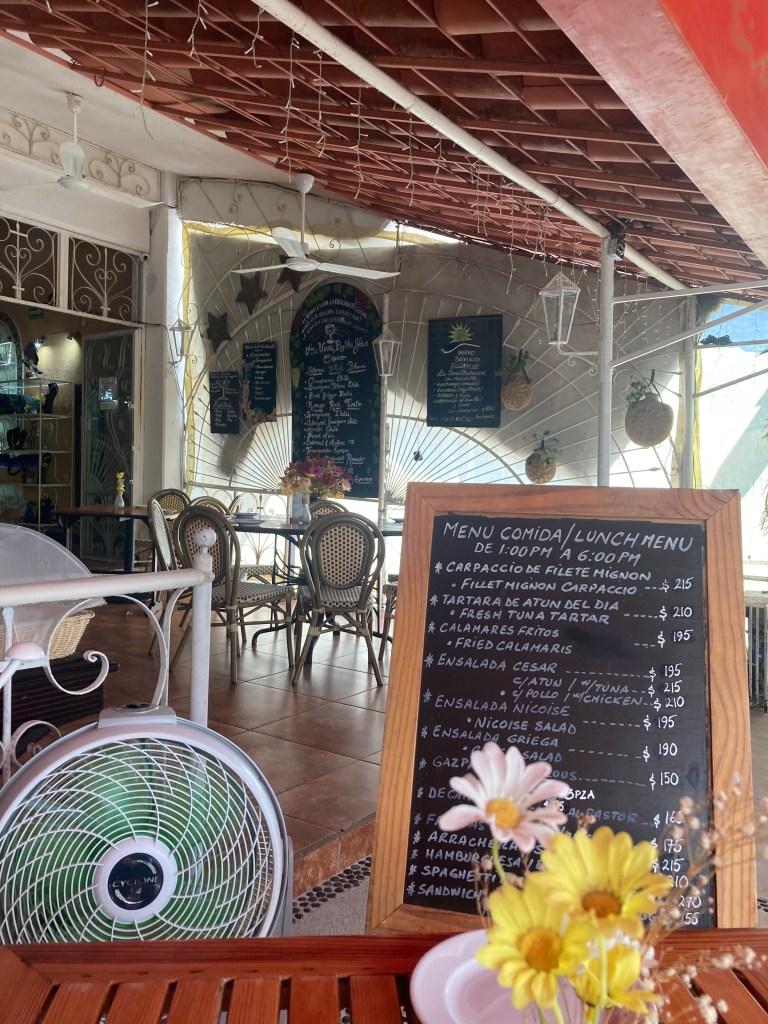
Our favorite dinner is the garlic grilled whole red snapper at the Tiburon restaurant at the Palace Hotel, which is located off the main boulevard, away from the beach hotels but within walking distance of the Krystal around the other side of the nature preserve across the boulevard. A cylindrical tower marks the hotel rising above the trees which confused me for years; we never explored that far and I thought it was some kind of church. It turned out to be a longtime hotel with a certain mid-century class. On the property was a perfectly good looking shiny water park for kids with apparently functional water slides, all fenced-off discreetly and out of service since forever. The guest clientele were invariably Mexicans. The swimming pool patio was partly visible from the open air restaurant and it always looked busy, family friendly. One year we noticed that several rooms appeared to be rented to federale troops in training. It was as if the Palace Hotel existed incognito — never anybody behind the monumental marble front desk — and its Tiburon restaurant operated as an open secret — the kitchen closed at 7:00.
The menu is printed in Spanish but includes pictures. The whole red snapper came grilled to perfection and served with green salad, mash potatoes, and rice too if you asked, and beans. The margaritas were rich and cheap. Only one servor spoke English, Miguel, and his service, along with his support staff, was impeccable, like they all went to a servant school in the mountains above Montreaux, Switzerland. I love their garlic grilled snapper, but I am told the grilled mahi-mahi Veracruz style is also delicious.
There’s an abundance of Italian cuisine available. Besides the bolognese at Soleiado there’s lasagna at Buona Sera at the Ixtapa plaza, or at La Portena on the harbor promenade in Zihuatanejo. A relatively new place in the plaza at Ixtapa is Sabrina’s La Vita e Bella, which makes its own pasta. The sauce of her (Sabrina is a real person) boscaiola is divine over fettucini. One complaint about Sabrina’s is they are a tiny bit stingy with the pasta — or as our friend Bob put it, would it kill them to dish you a few extra noodles? Buona Sera has its own boscaiola sauce but they substitute peas instead of capers.
Also at Ixtapa plaza there’s Lalo’s three cheese shrimp and tequila flambe at the Blue Shrimp. Ruben’s grills New Zealand beef hamburgers. Tequila y Salsa Brava serves barbecue ribs and chicken with baked potato. The most formidable barbecue ribs in Ixtapa are served at Emilio’s, where a rack serves two, as does their green salad. A ship motif place at the Ixtapa marina called Galeon has a good menu all around but I go there for lobster bisque. Deborah’s, located central to the Ixtapa boulevard strip, makes a creamy delicious Alfredo sauce and the town’s best fajitas, and serves a famous chocolate cake. Morelo’s serves meaty enchiladas in a rich, savory mole sauce, but their margaritas are way overpriced. I like the enchiladas at Cocina de Abuela, an open air patio cantina tucked in a corner of Ixtapa plaza near the old Ixtapa Hotel.
Zihuatanejo is a short taxi ride away. Bandido’s, located across the street from Our Lady of Guadalupe church on Avenida Cinco de Mayo a block behind the pier, makes an extraordinary chicken and onion stew called molcahete, named for the carved lava kettle it’s served in. Served over rice it’s enough for two. There are several quality places to eat along the promenade that courses the harbor from the pier to Playa Ropa, including La Portena, Casa Elvira, Sirena Gorda, and Daniel’s, which is the far side of the basketball court at the plaza along the beach. La Potena serves the best lasagna. Casa Elvira grills whole red snapper in garlic and mahi-mahi Veracruzana as good as Tiburon at Ixtapa Palace, and Daniel’s is close and also offers atmosphere of dining under a giant palm palapa on the beach. Sirena Gorda on the promenade near the pier makes their own coconut ice cream, and I like mine with kahlua. If you go there be prepared to be whelmed with paintings of hefty mermaids on every wall. The best shrimp can be had at a place called Letty’s, which used to be on the dark side of the canal where the fishing boats dock, but they have moved locations within Zihuatanejo at least twice and we’ve failed to find it.
Off the promenade to the side streets of Zihuatanejo there are dozens of cafes and cantinas which serve true Mexican tacos al pastor, authentic enchiladas and arroz con pollo. and any locally popular meal you might desire — and beer. Navigation on foot away from the embarcadero at the pier and the promenade through the plaza is safe and easy. The streets are lit and the storefronts open and bright, music plays around every corner and there are several streets closed to vehicles where pedestrians can mosey around the commercial district with no hassle from motor traffic. It’s Downtown Mexico, a vital and vivacious place. I regret two things about Zihuatanejo: the daytime temperature is too high to go there to hang out during the day the way we used to. We liked to take a bus from out front of our hotel across the coastal mountain chasm into the city of Zihuatanejo and eat breakfast at Daniel’s facing sailboats moored in the bay and Playa Ropa a short distance away, the peninsula stretching to Las Gatas enclosing the horizon. It didn’t seem as hot back then, and we would wander around the commercial and residential quarters until we found ourselves back at the main bus circle where we would catch one back to Ixtapa and the beach. These days — recent years — we learned that we lost our stamina to the heat by midmorning, even wilting on the morning bus ride. Air conditioning doesn’t exist on the buses or most public establishments. I regret the heat deters us from moseying around Zihuatanejo during the day. It’s an interesting commercial city. And I regret that we as a couple are old fogies when it comes to partying late into the night. We aren’t nighthawks any more, if we ever were. Zihuatanejo is home to many night clubs. Some of the cantinas so good for a Mexican dinner stay open late and feature live bands or a deejay. The locals like to party after work and mixed with tourists the night life thrives, and it’s too bad I haven’t got the stamina to keep up. I’m used to going to sleep at about eleven, even if there’s a good band playing down behind the Krystal pool bar (The Krystal has a ten o’clock curfew on its bands, though there is a disco called Christine next door that doesn’t even open until ten.) Even so, it’s a minor regret. I don’t feel I’m missing out that we don’t stay out all night and party. It’s not just Mexico, it’s true everywhere we travel, even on cruises.
I’ll miss the food for sure. A new restaurant opened in the strip mall next to Santander bank in a remodeled store front vacant since before the pandemic, one of those unlucky locations. We ate at a restaurant that occupied that spot when we first came down and the food was not good, the service indifferent, and the open dining patio was too close to the boulevard where exhaust from the vehicles corrupted the aroma of the food. That restaurant failed, and we never went back even when new evterprises opened at that location. Until that year, 2025. The new place still faced the boulevard, but since the elimination of leaded gasoline the street exhaust didn’t factor in the atmosphere any longer. The restaurant’s logo was absurdly perplexing: a mermaid riding a sheep. It called itself Santo Pacifico. A handsome middle aged guy dressed debonaire latino proffered the menu and touted the place at the gate. Every table was empty. Roxanne accepted a look at the menu, so I did too. There was nothing there that looked exceptional except a broiled mahi-mahi filet served in a garlic white sauce with mash potatoes and broccoli. The debonaire guy saw my interest and persuaded us to step up to a prime table on the patio and try their dinner. Offered us free margaritas. He seated us where the passersby pedestrians could observe us, as well as cars on the boulevard. He was maitre d’ and our servor, probably the manager and maybe the owner. The dinner was superb. The fish fresh and tender, and the cream garlic sauce like none I ever tasted. Maybe seeing us loving dinner paid off with passersby because two other couples were persuaded to take tables on the patio. Each time we passed by the Santo Pacifico after that we saw at least somebody dining there. The next time we ate there a birthday party was going on. We made a point to go back three more times in our four weeks, ordered the mahi-mahi with white cream sauce and every time it was a delight. We always got the same table, but not more free margaritas.
I could see the Krystal’s logic in implementing an all-inclusive policy. No more a la carte food or beverage tabs to track. Currently their accounting system tracked receipts on paper. Lately I saw young guys in dark blue polo shirts and beige khaki pants hanging around the cashier corner at the main bar by the deep end of the pool overlooking the beach, all supervising and tabulating the transactions. How much simpler it would be to include food and drinks up front in the price of the room and not have to mess with cash, or room tabs, or credit cards. How much more efficient the service would be without servants transacting money. No need for cashier intermediaries. Everybody eats free, drinks free. The hotel collects up front and only needs to track inventory and meet demand. Guests will eat and drink to get their moneysworth of perceived value. The hotel controls costs and prices its occupancy to cover its margin with a more or less captive market and automated workforce. It’s also very easy to see why it would drop the loyalty coupon program to boost revenue.
Roxanne and I mused how nice it would be if we could rent a little house on the beach up the coast towards Troncones where we could read on the veranda and watch the waves, relax in privacy, go about a household routine and enjoy a kitchen, and rent a car or take public transit down to Ixtapa and Zihuatanejo for dinner at one of our favorite places. Not going to happen. Too bad. There was always something sane about the predictability of life in Ixtapa, doing it year after year expecting the same things. Part of its charm derived from how it barely ever changed or aged. Our needs for a wider spectrum of activities and rest clearly outstretched the confines of the Krystal hotel. Nice place to visit but don’t want to live there anymore. Only time would tell by midsummer whether we would find replacement accommodations to return to Ixtapa Zihuatanejo at all. The future of Americano tourism in Mexico looked murky based on news from home, where the president seems to interntionally antagonize its citizens. The Krystal marketing plan was only taking advantage of a coming trend.
If the Krystal and more hotels adopted all-inclusive policy it would seem it would affect the local restaurants if more hotel guests ate their dinners at the hotel. Moreso, the shift would also affect the servants depending on tips. I recall Jesus Calderon lamenting the rise of Mexican hotel guests because in his experience Mexicans don’t tip. Especially chilangos.
Our friend Anabel went on a medical leave from the Krystal restaurants due to back and leg pain. Predictable of a career working on her feet. She’s a smart woman and capable of advancing her career into a sit-down job if she went to a vocational school. At dinner the week before we left she spoke as if her time at the Krystal was ending. We didn’t talk about Krystal economics or tell her we might not come back. We talked about our kids, mostly hers. One son and his partner bought a house on the north side of Ixtapa. Her daughter was engaged to be married next year. Another son had problems with depression and angst; very intelligent, he was bored with secondary school. I was like that, I told her, and I turned out okay. When we parted company I wanted to leave her with the idea that we were not leaving abruptly because the Krystal kicked us out. We were not kicked out.
News from home made me nervous about finding ourselves stranded outside the country in the event of some Trump manufactured crisis. An attack against Venezuela, air strike against a Mexican cartel. or invasion of Cuba. The massive immigration sweeps he promised. Jackboots in the streets. Arrests of political dissidents labeled (the mythical) Antifa. Prosecutions of political enemies. Revoking birthright citizenship. Rigging the election process in the name of election integrity. Jacking up inflation by making consumer prices rise due to import tariffs and corrupting the world economy with crypto money. Deliberately stirring resistence from his opposition to justify oppression in the name of national security. Ethnic cleansing in the name of revoking wokeness. White male supremacy. More lies. The Lyin’ King.
At the Zihuatanejo airport I felt more paranoid about re-entering my own country than I was of remaining in Mexico. The processing and boarding couldn’t have been more routine. In the air over the arid furry mountains I worried what might happen to me at customs. Would I be detained over some security pretext? Rationally I knew I was a small among small potatoes among Trump’s critics, more completely unknown than an average Rolling Stone reader, but the possibility seemed real, I could genuinely face questioning in the back room at MSP to test if I were a spy or subversive secret agent. Over the Gulf of Mexico I imagined Trump croossing out Mexico and writing America on the map with that same sharpie pen he used to draw that hurricane into Arkansas. If I were detained at MSP it could be a message I was on a behavioral watch list at the state department. Or they could disappear me.
Over Texas I recalled the 1980s when I thought the acolytes of Ronald Reagan were after me. In the 1960s and 70s before that I thought it was the cult of Richard Nixon. And in a way they were, and they got me. They drove me deeper into the American middle class. There from the underground I learned to live safe among the prosperity afforded by an accidentally benevolent culture.
As my friend Jim reminds me, this too shall pass. I felt the subtle sensation of descent. The sun, wherever it was in the cold sheet of sky, went down portside so I reckoned we were northbound, the expected direction over invisible Iowa, where Buddy Holly’s plane crashed. Our landing at MSP barely bounced. Customs was so automated it almost looked like they would let anybody through, self-service, only I knew better. The taxi ride up Hiawatha Ave only proved how durable life really is without checkpoints and battle dressed squads patrolling the streets.
Safe at home on my snowy front porch in the chill of the open air, glad to be wrong, I never felt so free.